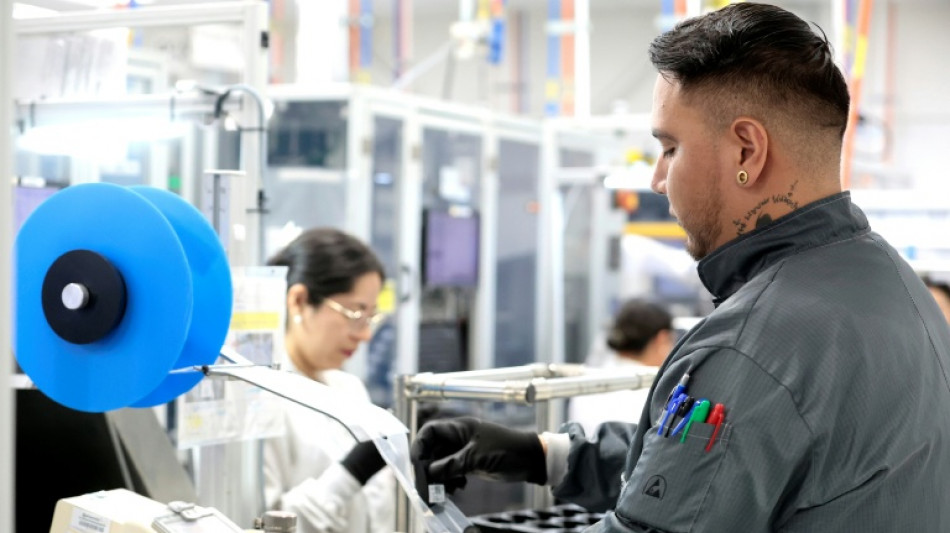
Trump auto tariffs strike at heart of North American trade / Photo: © AFP/File

 Ethiopia and Eritrea break diplomatic ties over conflict

 Downing Street says Manchester City not 'above the rules'

 Hadjar wants to 'fight for the title' from next season

 Bolivia's attorney general arrested for alleged drug trafficking, money laundering

 German sugar tax sparks new government row

 Musk returns to US government for Pentagon war study

 Stocks slide as bond yields spike

 Thousands rally as EU chief urges respect for Kosovo war crimes court

 Man City sponsor Etihad says considering legal action against Premier League

 Family of woman killed by US immigration agent sues Trump administration

 French school protests spread as fires, blockades deepen unrest

 UK tribunal overturns ban on Naomi Campbell leading charities

 Louvre launches appeal as part of new fundraising drive

 Croatian ex-international Simic charged in graft case

 76% of Treasury Teams Hit by Fraud as Deepfake Attacks Rise, Treasury Dragons & nsKnox 2026 Index Finds

 Malawi ex-army chief arrested following allegations over Sudan arms

 German fuel price cuts kick in to ease Mideast energy shock

 'It's history': Zverev against shortening Grand Slam match format

 From Question to Action: Leverate Launches ASK, Its Native AI Assistant for Traders

 UN says strikes on Afghanistan kill 10 civilians

 Two Russian drones hit major bridge in Kyiv

 Alcaraz begins Japan Open defence with win over Michelsen

 ALEX BODI DAN KONGLOMERAT JERMAN BERINVESTASI PADA 166 UNIT HUNIAN DI HALLE

 Ronaldo's Portugal future in doubt after walkout

 European stocks drop as debt fears send bond yields soaring

US President Donald Trump's tariffs on imported cars strike at the heart of a North American free trade agreement, threatening to disrupt supply chains and raise prices, experts say.
Thanks to the United States-Mexico-Canada Agreement that came into effect in 2020 -- and its predecessor NAFTA -- the region became an assembly line spanning the three countries.
"We've been making this supply chain more sophisticated for 30 years," said Juan Francisco Torres Landa, a partner at business consulting firm Hogan Lovells in Mexico.
"There is regional integration based on inputs, raw materials, and processes in all three countries," he told AFP.
Trump said the tariffs were in response to America's trade partners "taking our jobs, taking our wealth," but the duties promise to be a headache due to the deep integration of production chains.
Here are some of the expected impacts of the tariffs, according to experts.
- Snarled supply chains -
During the assembly of a car or truck, parts often cross the borders of the three countries multiple times before the vehicle is finished.
Extensive supply chains have been built involving hundreds of suppliers from different countries.
A car key alone can have more than 50 components from 22 different suppliers in Asia, North America and Europe.
The White House said vehicles assembled in Mexico and Canada could qualify for lower tariffs under the USMCA deal depending on how many of their components are made in the United States.
"Given the complexity of regional supply chains -- where parts often cross borders multiple times -- verifying compliance may require time-consuming adjustments, increasing operational costs," the political risk consultancy firm EMPRA told clients.
"US automakers with production in Mexico could face rising costs and logistical complications, which may lead some to reassess their manufacturing strategies," it added.
- Growth constrained -
Mexico's economy is considered one of the most vulnerable to Trump's planned tariffs due to its close trade relations with the United States.
The Latin American nation is home to many foreign-owned vehicle plants operated by companies including Ford, General Motors, BMW, Volkswagen and Toyota.
More than 80 percent of Mexican exports go to the United States, including around three million vehicles a year.
The auto tariff announcement comes at a difficult time for Mexico's economy, the second largest in Latin America.
Experts surveyed monthly by the Mexican central bank expect economic growth of only 0.81 percent in 2025, worse than the 1.0 percent they predicted in February.
The trade tensions "generate uncertainty and affect private investment and production decisions in key export sectors," Geronimo Ugarte, chief economist at the financial firm Valmex, told AFP.
- Trade deal in limbo -
Mexico and Canada consider Trump's tariffs to be in violation of the USMCA.
Mexican President Claudia Sheinbaum said Thursday "there should be no tariffs" between Mexico, the United States and Canada as "that is the essence of the trade agreement."
Washington's announcements have left the agreement in limbo.
"We need to analyze whether... for Trump, the USMCA should be replaced, substituted or simply extinguished by starvation," Torres Landa said.
Although a review of the treaty is due by 2026, Jesus Carrillo, an expert at the Mexican Institute for Competitiveness, believes trade policy "is being negotiated directly and progressively between governments."
"We're moving from having a treaty to having deals," Carrillo said.
He believes that "the USMCA will remain in effect, but with Band-Aids."
- More expensive cars -
Analysts and US trading partners warn that the tariffs will raise prices for American consumers.
Philippe Waechter, chief economist at Ostrum Asset Management in Paris, thinks the price of a car could increase by $3,000.
There is a risk that consumers will buy fewer new cars, according to the British-based consultancy firm Capital Economics.
"Assuming that domestic producers respond by substantially increasing their own prices, (the tariffs) could make new vehicles something of a luxury item," it said.
N.Fournier--BTB