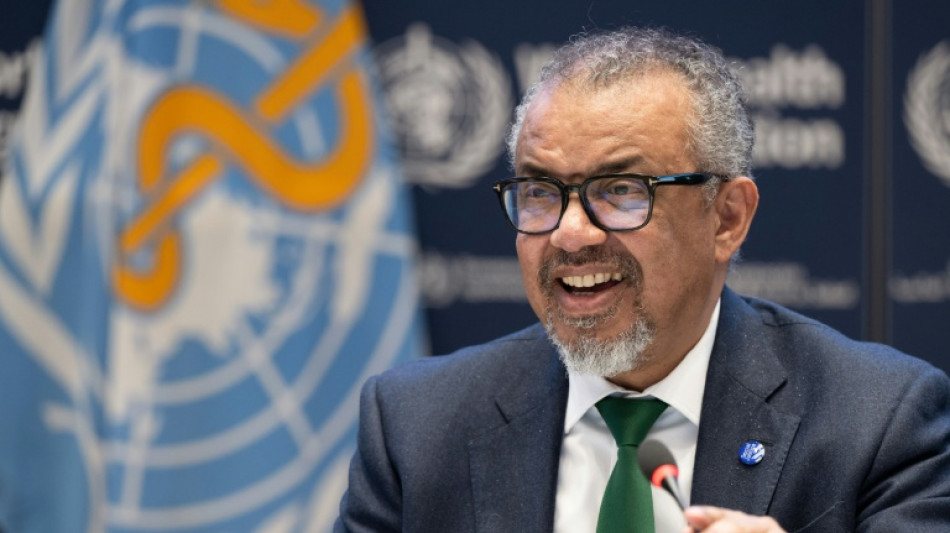
WHO announces 'significant' layoffs amid US funding cuts / Photo: © World Health Organization/AFP

 Swedish Social Democrats leader to make new bid to form government
 North Korea calls Seoul 'despicable' after DMZ apology demand

 Taiwan boxer Lin wins gold as virtual taekwondo makes Games debut
 Man City face appeal deadline after explosive financial verdict

 Pole vault superstar Duplantis to skip indoor season

 Sri Lanka drop Asalanka from T20 against Pakistan

 Disney president says layoffs 'extremely painful' but necessary

 Indian flydubai pilot opened cockpit door to save passengers

 Alex Marquez clocks record lap at MotoGP Japan practice

 Tom Kim leads Asian Games golf in chase to avoid military service
 Asian stocks hit as oil spike fans rate hike bets, eyes on US jobs

 'We're losing our scientists': west Africa's STEM struggle
 World powers gather in Pacific to chart climate battle
 Return of swarming moth spectacle has Australia in a flutter

 Browns snuff out Rodgers fightback to beat Steelers 27-24
 Braves power past Phillies to set up Dodgers showdown

 Asian stocks drop as oil spike fans rate hike bets, eyes on US jobs
 Viral anti-vax posts weaponise Philippine inoculation fears
 Saudi coalition accuses Houthis of drone attack on Medina
 Effective Altruism: the philosophy behind Silicon Valley's AI fears
 Chinese judoka accused of biting as home hope wins Asian Games gold

 Four-member crew docks at International Space Station

 Portugal win without Ronaldo as Klopp's Germany get first victory

 Wemby: 'Very sad' to see players endorse betting firms
 Manchester City Women scrape draw with Real Madrid

The World Health Organization chief said Tuesday that operations and jobs would be slashed as US funding cuts had left the UN agency with a budget hole of several hundred million dollars.
"The sudden drop in income has left us with a large salary gap and no choice but to reduce the scale of our work and workforce," Tedros Adhanom Ghebreyesus told member states, according to a transcript of his remarks.
The United Nations health agency has been bracing for President Donald Trump's planned full withdrawal of the United States -- by far its largest donor -- next January.
The United States gave WHO $1.3 billion for its 2022-2023 budget, mainly through voluntary contributions for specific projects rather than fixed membership fees.
But Washington never paid its 2024 dues, and is not expected to pay its 2025 dues.
This has left the WHO preparing a new structure, which Tedros presented to staff and member states on Tuesday.
"The refusal of the US to pay its assessed contributions for 2024 and 2025, combined with reductions in official development assistance by some other countries, means we are facing a salary gap for the 2026–27 biennium of between $560 and $650 million," he said.
The lower end of that spectrum "represents about 25 percent of staff costs" currently, he said, stressing though that "that doesn't necessarily mean a 25-percent cut to the number of positions".
He did not say how many jobs would be lost at the WHO, which employ more than 8,000 people around the world.
- 'Very painful' -
But he acknowledged that "we will be saying goodbye to a significant number of colleagues" and vowed to do so "humanely".
Tedros insisted that the most significant impact would likely be felt at the organisation's headquarters in Geneva. "We are starting with reductions in senior management," he said.
"We are reducing the senior leadership team at headquarters from 12 to seven, and the number of departments will be reduced by (more than) half, from 76 to 34," Tedros said.
WHO's regional offices would meanwhile be affected "to varying degrees", he said, adding that some country offices in wealthier countries would likely be closed.
"These are very painful decisions for all of us," Tedros said.
The WHO chief insisted the situation could have been worse.
WHO member states agreed in 2022 to significantly increase membership fees and reduce the portion of WHO's budget covered by less reliable and often earmarked voluntary contributions.
"Without the increase, assessed contributions for the current biennium would have been $746 million," he said, adding that instead, WHO expects to receive $1.07 billion in membership fees for 2026-27, "even without the US contribution".
Nonetheless, WHO needed to reduce its activities and recentre on its core functions, he said, even as he acknowledged that "many countries need our support now more than ever".
The US administration's decision to virtually dismantle the US foreign aid arm, USAID, and freeze nearly all assistance, including to health projects worldwide, had made "very severe" impacts in developing countries especially, Tedros said.
But WHO, he said, would now need to focus on helping countries "transition away from aid dependency to greater self-reliance", he said.
D.Schneider--BTB