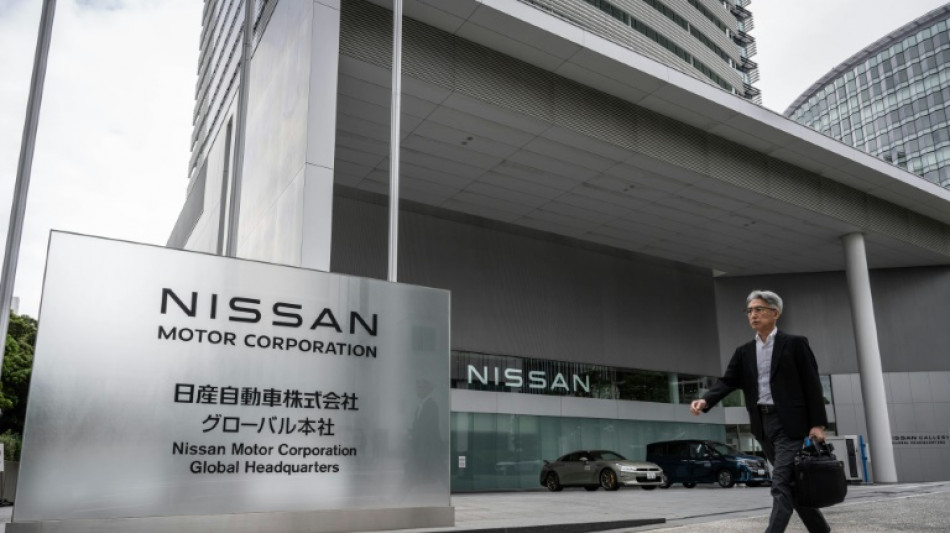
Warning lights flash at Nissan after monster profit warning / Photo: © AFP/File

 Ethiopia's conflict: the regional dimension

 Life expectancy almost back to pre-Covid levels, says WHO

 Turkey's football referee chief faces judge in graft probe

 Verstappen goes own way to avoid the rain

 Oil slides, bonds steady as EU addresses diesel price surge

 Spain housing package at risk in parliament, as protests mount

 Swedish Social Democrats leader to make new bid to form government

 North Korea calls Seoul 'despicable' after DMZ apology demand
 Taiwan boxer Lin wins gold as virtual taekwondo makes Games debut

 Man City face appeal deadline after explosive financial verdict

 Pole vault superstar Duplantis to skip indoor season

 Sri Lanka drop Asalanka from T20 against Pakistan

 Disney president says layoffs 'extremely painful' but necessary

 Indian flydubai pilot opened cockpit door to save passengers

 Alex Marquez clocks record lap at MotoGP Japan practice

 Tom Kim leads Asian Games golf in chase to avoid military service

 Asian stocks hit as oil spike fans rate hike bets, eyes on US jobs

 'We're losing our scientists': west Africa's STEM struggle

 World powers gather in Pacific to chart climate battle

 Return of swarming moth spectacle has Australia in a flutter

 Browns snuff out Rodgers fightback to beat Steelers 27-24

 Braves power past Phillies to set up Dodgers showdown

 Asian stocks drop as oil spike fans rate hike bets, eyes on US jobs

 Viral anti-vax posts weaponise Philippine inoculation fears

 Saudi coalition accuses Houthis of drone attack on Medina

The road ahead looks treacherous for Nissan after the Japanese auto giant predicted an enormous loss just as US President Donald Trump's tariffs on car imports hit the industry.
Nissan on Thursday warned it expected to have posted a loss of 700-750 billion yen ($4.9-$5.3 billion) in the business year that ended in March, blaming asset writedowns and restructuring costs.
"Despite these challenges, we have significant financial resources, a strong product pipeline and the determination to turn around Nissan in the coming period," the company promised.
But investors are unlikely to be reassured.
Nissan, one of the top 10 automakers by unit sales with roots going back over a century, is heavily in debt and lacking a clear next move after a mooted merger with rival Honda collapsed.
In March, the chief executive quit and investors have driven for the hills, sending Nissan shares down by more than 40 percent over the past year.
- Job cuts -
Nissan has lurched from crisis to crisis in recent years, with the dramatic arrest of former boss Carlos Ghosn -- who escaped Japan in a musical instrument box -- the Covid pandemic and the Ukraine war.
It has an uninspiring product line, including in electric cars, especially in China where unit sales tumbled 24.1 percent in the 2023 financial year.
On Wednesday, it announced investments of 10 billion yuan ($1.4 billion) into China, and said it would raise the number of new models it planned to launch by summer 2027 to 10, up from eight.
"We were not at the same speed, mainly because the Chinese brands were exceptional with speed," Nissan's China chief Stephen Ma said at the Auto Shanghai industry show.
Last year, Nissan announced 9,000 job cuts worldwide and that it was slashing production capacity by 20 percent.
In February, talks with Honda on merging to create the world's third-biggest automaker by number of vehicles collapsed. The negotiations had also involved Mitsubishi Motors.
This prompted Moody's to cut its credit rating on Nissan to junk, citing "weak profitability driven by slowing demand for its ageing model portfolio".
- Options limited -
Now, to make matters worse, since April, the United States has imposed a 25-percent surcharge on all imported vehicles.
Bloomberg Intelligence analyst Tatsuo Yoshida told AFP that Nissan will be the most severely impacted of all major Japanese automakers.
Last year, Nissan generated 30 percent of its revenues in the United States, selling 924,000 vehicles there, 45 percent of them imported from Japan and Mexico.
If Nissan absorbs the full impact of the tariffs without passing costs to the market or customers, this would mean a loss of 440 billion yen ($3.1 billion), Yoshida calculates.
To hedge, Nissan is tweaking its production.
This includes reversing plans to reduce output at its Tennessee plant and stopping sales in the United States of two models made in Mexico.
But more drastic measures could be needed, including shifting production wholesale from Mexico and Japan to the United States.
But this will take time, even assuming Nissan has spare factory capacity in America.
"Transferring production means creating capacity, tooling, finding suppliers," an industry source told AFP. "To achieve anything significant, it will take at least two years."
In any case, given the unpredictability of Trump's policies, analysts said it was unlikely that Nissan -- or any Japanese automaker -- would announce any major shift for now.
- Hon Hai help? -
"If this situation goes on forever, it can be a death blow for Nissan, in a sense that it will run out of cash and default," Yoshida said before Thursday's profit warning.
But he added that if this happens, he expects a financial partner to come to the rescue, in the shape of Honda or a technology firm like Apple.
In February, Nissan shares briefly surged on a reported push to bring Elon Musk's Tesla on as an investor.
Reports in December said Taiwan's Foxconn -- also known as Hon Hai, which assembles iPhones and wants to move into cars -- had approached Nissan to buy a majority stake.
jug-tmo-tsz-stu/sco
M.Odermatt--BTB