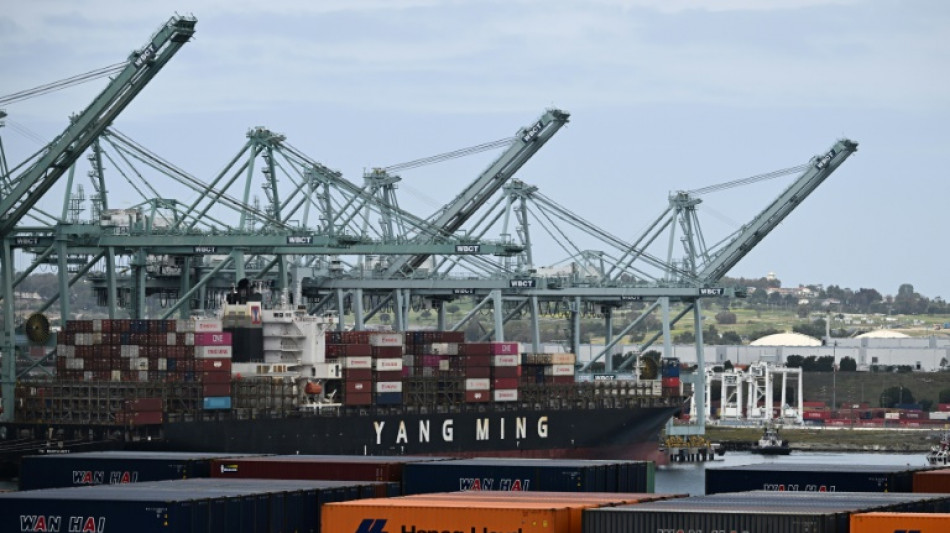
US economy unexpectedly shrinks on import surge before Trump tariffs / Photo: © AFP

 Trump expected to name intel chief Clayton as AI czar: reports

 Argentina unveils passports-for-investment scheme

 Brazil election debate chaos sparks censorship row
 England's Carse charged by cricket body over nightclub incident

 Amazon vows $1 bn for data center towns, decries 'myths'

 Oil prices drop on G7 fuel release, US jobs data boosts stocks

 G7 agrees deal to ease global energy supply concerns

 Spain's government dealt blow as lawmakers reject housing bills

 Food, medicine shortages deepen in Russian-occupied Oleshky

 Man City whistleblower Rui Pinto facing 'dire consequences' - lawyers

 Russia 'tearing Kyiv apart', mayor says, as strikes paralyse traffic
 Taiwan boxer Lin wins Games gold as Japan edge North Korea on penalties

 Japan tame North Korea to win Games gold after shootout drama

 US posts weak job growth data in September

 Ethiopia's conflict: the regional dimension

 Life expectancy almost back to pre-Covid levels, says WHO

 Turkey's football referee chief faces judge in graft probe

 Verstappen goes own way to avoid the rain

 Oil slides, bonds steady as EU addresses diesel price surge

 Spain housing package at risk in parliament, as protests mount

 Swedish Social Democrats leader to make new bid to form government

 North Korea calls Seoul 'despicable' after DMZ apology demand

 Taiwan boxer Lin wins gold as virtual taekwondo makes Games debut

 Man City face appeal deadline after explosive financial verdict

 Pole vault superstar Duplantis to skip indoor season

The US economy unexpectedly contracted in the first three months of the year due largely to a surge in imports as businesses and consumers stockpiled ahead of the introduction of President Donald Trump's sweeping tariffs.
The gross domestic product of the world's largest economy decreased at an annual rate of 0.3 percent in the first quarter, after growing 2.4 percent in the final months of 2024, according to an estimate from the US Commerce Department published Wednesday.
This was sharply below the market consensus estimate of 0.4 percent growth, according to Briefing.com.
"The downturn in real GDP in the first quarter reflected an upturn in imports, a deceleration in consumer spending, and a downturn in government spending," the Commerce Department said in a statement.
US financial markets reacted negatively to the news, with all three major indices opening sharply lower on Wall Street.
- Trump denies tariff link -
In a social media post, Trump blamed his predecessor Joe Biden for the bad economic news.
"This is Biden's Stock Market, not Trump's," the US president wrote in a post on his Truth Social platform. "Our Country will boom, but we have to get rid of the Biden 'Overhang.'"
"This will take a while, has NOTHING TO DO WITH TARIFFS," he said. "When the boom begins, it will be like no other. BE PATIENT!!!"
During an interview with CNBC a few minutes later, Trump's economic advisor Peter Navarro said the decline in GDP was to be expected.
"When you have this import surge that we've had to try to get in ahead of the tariffs, that's dragging down our GDP growth by something like five percent," he said. "I mean, it's just like extraordinary.
"But that's not going to be the case next quarter," he added.
The GDP data was published on the 101st day since Trump's return to office on January 20.
In that time, the US president has announced several rounds of tariffs, laying out plans in March to impose sweeping levies on top trading partners from early April in a bid to reset US trade relations.
The introduction of tariffs sparked a selloff in financial markets, sending volatility surging to levels not seen since the Covid-19 pandemic and spooking investors.
"Usually, government policy doesn't change that much, particularly not in the first 100 days of a presidency," George Washington University economics professor Tara Sinclair told AFP before the data was published. "But this one's different."
"I think it's pretty clear that there were dramatic policy changes that are directly weakening the economy," she said.
"100 days into his presidency, Donald Trump's red-light, green-light tariffs are shrinking our economy, with businesses stockpiling imports in anticipation of tariff doomsday," Democratic Senator Elizabeth Warren said in a statement after the GDP data was published.
- 'Quandary' for Fed -
Following April's dramatic market movement, the Trump administration announced a 90-day pause to the higher tariffs for dozens of countries to allow for trade talks, while maintaining a baseline 10 percent rate for most countries.
It also announced sector-specific measures on steel, aluminum and automobiles and parts not made in the United States, and new sweeping tariffs totalling 145 percent on China.
Beijing responded with its own steep, targeted duties against US goods.
The drop in imports was "partly offset by increases in investment, consumer spending, and exports," the Commerce Department said Wednesday.
The effects of tariffs on growth and inflation are a "quandary" for the Federal Reserve as it attempts to maintain stable prices and maximum sustainable employment, MBA chief economist Mike Fratantoni wrote in a note to clients shared with AFP.
"We expect that the Fed will hold rates steady at its meeting next week and will indicate that it will continue to hold at this level until it becomes clear whether a recession or inflation is the bigger risk," he said.
E.Schubert--BTB