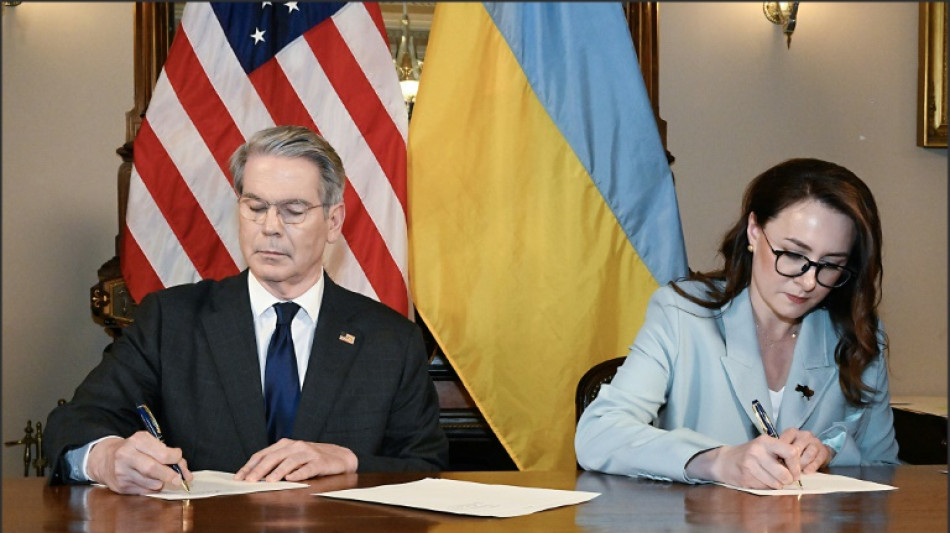
With minerals deal, Ukraine finds way to secure Trump support / Photo: © US Treasury Department/AFP

 Trump expected to name intel chief Clayton as AI czar: reports

 Argentina unveils passports-for-investment scheme

 Brazil election debate chaos sparks censorship row
 England's Carse charged by cricket body over nightclub incident

 Amazon vows $1 bn for data center towns, decries 'myths'

 Oil prices drop on G7 fuel release, US jobs data boosts stocks

 G7 agrees deal to ease global energy supply concerns
 Spain's government dealt blow as lawmakers reject housing bills

 Food, medicine shortages deepen in Russian-occupied Oleshky

 Man City whistleblower Rui Pinto facing 'dire consequences' - lawyers

 Russia 'tearing Kyiv apart', mayor says, as strikes paralyse traffic
 Taiwan boxer Lin wins Games gold as Japan edge North Korea on penalties

 Japan tame North Korea to win Games gold after shootout drama

 US posts weak job growth data in September

 Ethiopia's conflict: the regional dimension

 Life expectancy almost back to pre-Covid levels, says WHO

 Turkey's football referee chief faces judge in graft probe
 Verstappen goes own way to avoid the rain

 Oil slides, bonds steady as EU addresses diesel price surge

 Spain housing package at risk in parliament, as protests mount

 Swedish Social Democrats leader to make new bid to form government

 North Korea calls Seoul 'despicable' after DMZ apology demand

 Taiwan boxer Lin wins gold as virtual taekwondo makes Games debut

 Man City face appeal deadline after explosive financial verdict

 Pole vault superstar Duplantis to skip indoor season

In signing a minerals deal, Ukraine has found a new way to tie the United States to its future, but it remains to be seen if it can guarantee long-term support from mercurial President Donald Trump.
Two months after President Volodymyr Zelensky was unceremoniously kicked out of the White House following an on-camera clash with Trump, Ukraine renegotiated the deal he had been set to sign, with the Ukrainian leader hailing the signed version as truly equal."
Trump has already made clear that he will not back Ukraine's accession into NATO, backing Russian President Vladimir Putin's position that membership in the Western alliance is a red line, and he has repeatedly criticized the billions of dollars in US assistance to Ukraine since Russia's invasion in February 2022.
But after earlier bristling at Trump's demands for compensation for past aid, Ukraine managed through the deal to secure a US presence in a way relatable to the businessman Trump, experts said.
The deal puts the Ukrainians "in their strongest position yet with Washington since Trump took office," said Shelby Magid, deputy director of the Atlantic Council think tank's Eurasia Center.
"While the Trump administration put tremendous pressure on Ukraine to accept earlier deals, Ukraine managed to show that it is not just a junior partner that has to roll over and accept a bad deal," she said.
The deal does not speak of any debt owed by Ukraine, despite demands from Trump after he took office.
- 'Extortion'? -
But one lesson from recent history could dishearten Ukrainians. Trump, critical of US involvement in Afghanistan, early in his first term reached an agreement with the country's Western-backed president, Ashraf Ghani, to develop untapped mineral wealth.
By the end of Trump's term, the United States had effectively sidelined Ghani by negotiating a deal with the Taliban, who swiftly took over when president Joe Biden carried out the agreement and withdrew US troops.
Some of Trump's Democratic rivals dismissed the importance of the Ukraine minerals deal. Representative Gregory Meeks, the top Democrat on the House Foreign Affairs Committee, in a statement called it "extortion" by Trump.
Democratic Senator Chris Murphy said that the agreement was meaningless without Trump committing further weapons to Ukraine.
"Right now all indications are that Donald Trump's policy is to hand Ukraine to Vladimir Putin, and in that case, this agreement isn't worth the paper that it's written on," Murphy said on MSNBC television.
- Shift at least in short term -
Robert Murrett, deputy director of Syracuse University's Institute for Security Policy and Law, said it was too early to see how much of a security guarantee the deal would provide.
But he said that from an economic perspective it can only be read as "something positive, in terms of giving the United States a long-term stake in Ukraine."
"I think the other good indicator is a kind of acid test -- the fact that the Kremlin is very, very unhappy with the deal," he said.
Gracelin Baskaran, director of the Critical Minerals Security Program at the Center for Strategic and International Studies, said that the language in the deal was striking, two months after the Trump-Zelensky clash.
The agreement speaks of Russia's invasion and raises the prospect of renewed US military assistance, by saying that security funding would be counted as US investment in the fund.
She said that the deal was a means for "long-term economic recovery" and acknowledged that much could change over time.
But in the short term, "it actually provides a Trump administration avenue for support" to Ukraine, she said.
"This is a pretty big shift from where we were 60 days ago," she said.
C.Meier--BTB