Trump vs Toyota? Why US cars are a rare sight in Japan / Photo: © AFP

 Trump expected to name intel chief Clayton as AI czar: reports
 Argentina unveils passports-for-investment scheme

 Brazil election debate chaos sparks censorship row
 England's Carse charged by cricket body over nightclub incident
 Amazon vows $1 bn for data center towns, decries 'myths'
 Oil prices drop on G7 fuel release, US jobs data boosts stocks

 G7 agrees deal to ease global energy supply concerns
 Spain's government dealt blow as lawmakers reject housing bills
 Food, medicine shortages deepen in Russian-occupied Oleshky
 Man City whistleblower Rui Pinto facing 'dire consequences' - lawyers
 Russia 'tearing Kyiv apart', mayor says, as strikes paralyse traffic
 Taiwan boxer Lin wins Games gold as Japan edge North Korea on penalties

 Japan tame North Korea to win Games gold after shootout drama
 US posts weak job growth data in September

 Ethiopia's conflict: the regional dimension
 Life expectancy almost back to pre-Covid levels, says WHO
 Turkey's football referee chief faces judge in graft probe

 Verstappen goes own way to avoid the rain
 Oil slides, bonds steady as EU addresses diesel price surge

 Spain housing package at risk in parliament, as protests mount
 Swedish Social Democrats leader to make new bid to form government
 North Korea calls Seoul 'despicable' after DMZ apology demand
 Taiwan boxer Lin wins gold as virtual taekwondo makes Games debut

 Man City face appeal deadline after explosive financial verdict

 Pole vault superstar Duplantis to skip indoor season
With their sleek curves and chrome grilles, the classic American cars on sale at Yosuke Fukuda's yard ooze Californian cool but on Japanese roads new US vehicles are a rare sight -- much to President Donald Trump's annoyance.
Japan's Toyota is the second-top-selling automaker in the United States, where it shifted more than 2.3 million vehicles last year.
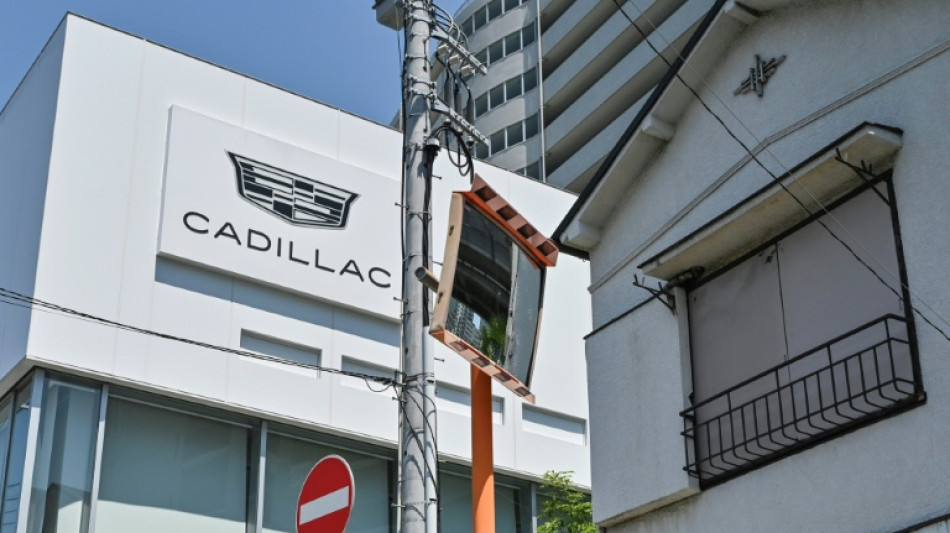
Meanwhile US industry leader General Motors sold just 587 Chevrolets and 449 Cadillacs in Japan, while Ford pulled out of the tough Japanese market nearly a decade ago.
And it's not just an aversion to foreign brands -- in 2024 Mercedes-Benz sold more than 53,000 vehicles and BMW sold over 52,000 including Minis.
"They don't take our cars, but we take MILLIONS of theirs!" Trump said in April, accusing Japan of treating its ally "very poorly on trade".
To try and rev up the US auto industry, Trump has imposed a 25 percent levy on imported vehicles, in a major blow to Tokyo.
Many people in Japan admire vintage US cars, but when it comes to new wheels, they hold more trust in domestic brands, Fukuda told AFP.
West Coast hip-hop booms out at his shop Y-Tech, an incongruous slice of Americana amid the rice paddies north of Tokyo.
"To be honest I think the problem is the size of the roads," as well as an impression that US cars break down more often, which is likely unfounded, Fukuda said.
At his garage, the 20 or so classic US models in varying states of restoration include a silver-green 1970 Chevrolet Nova and a 1954 Buick Roadmaster.
But Fukuda also drives a modern SUV -- a General Motors Yukon, which is two metres (6.5 feet) wide and "sticks out or is packed in" when parked in Tokyo's narrow streets.
Although some US cars are smaller, the brands remain a niche choice because "there are hardly any places that sell them or repair them", he said.
- 'Bowling ball test' -
Yuka Fujimoto, a 42-year-old modelling agency manager, told AFP she had never considered buying a US car.
"American cars don't sell very well" in Japan, where domestic automakers offer "a wide range of line-ups including for families", she said.
However Trump believes Japan is keeping out American cars with "non-tariff cheating".
This includes "Protective Technical Standards (Japan's bowling ball test)" he wrote last month on Truth Social.
"They take a bowling ball from 20 feet up in the air and they drop it on the hood of the car. And if the hood dents, then the car doesn't qualify," Trump reportedly elaborated in 2018.
A Japanese transport ministry official in charge of safety standards told AFP that no actual bowling balls are used.
Trump "may be mixing it up with a test where a hemispherical human head model is hit on the hood", the official said.
But the car's bonnet is in fact required to dent to absorb the impact, he explained.
Tweaking Japan's vehicle import procedures is a potential bargaining chip for Tokyo in tariff talks with Washington.
The country could offer to widen access to a simplified screening process which currently applies to 5,000 vehicles per model annually, Japanese media reports said.
- Fuel efficiency -
Trump's auto tariffs have already brought some changes, with Nissan last month revising plans to reduce US production.
Meanwhile Honda is moving production of its hybrid Civic model from Japan to the United States, saying no "single issue" had prompted the decision.
But US carmakers still face the problem of tepid demand among Japanese consumers.
Hisashi Uchida, a 56-year-old construction firm employee, said his Toyota car "doesn't have any special features, but it doesn't break down".
"Many American cars can't be parked at multi-storey parking lots, and their fuel efficiency isn't good," he said.
Overall "I don't think US carmakers are really putting importance on the Japanese market, which is significantly smaller than their home market", said Masamitsu Misawa, chief editor of Japanese vehicle magazine Car Top.
In contrast, German car brands offer a better range and their designs "better match Japanese people's tastes", he told AFP.
Cars in Japan drive on the left, and unlike US rivals European automakers usually put the steering wheel on the correct side for vehicles sold there, he added.
That could be changing. General Motors' 8th-generation Chevrolet Corvette has right-hand drive in Japan for the first time.
"I think that reflects efforts (for selling in Japan) by manufacturers and importers," Misawa said.
J.Fankhauser--BTB