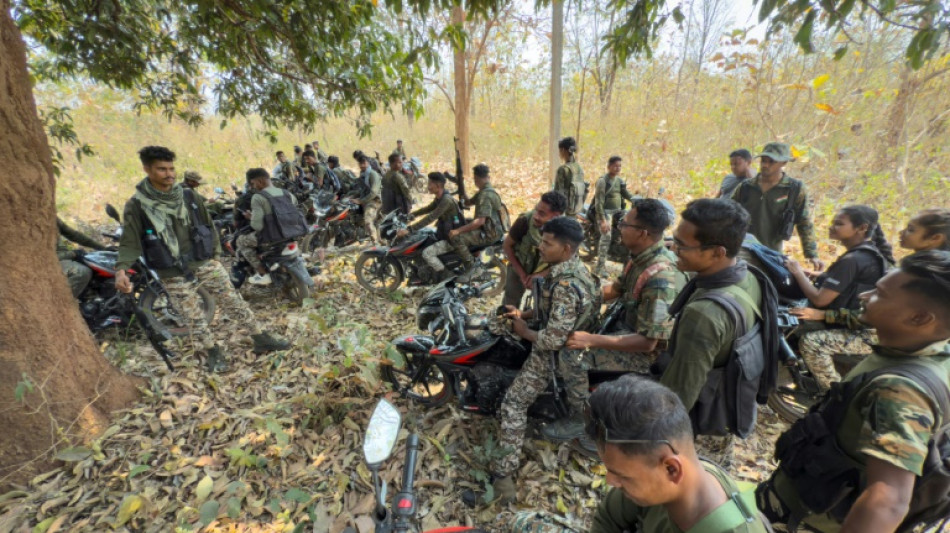
Red sunset: India's bloody push to crush Maoist revolt / Photo: © AFP

 ALEX BODI AND AMBASSADOR GUM DOMINIC MATIOK OF THE REPUBLIC OF SOUTH SUDAN MEET IN BERLIN TO DISCUSS THE POSSIBILITY OF AN HONORARY CONSULATE IN BUCHAREST

 Lula, Bolsonaro wrap up campaigns ahead of Brazil's knife-edge vote

 Toulouse edge Castres in Top 14 derby

 Murakami homer propels White Sox to MLB playoff win over Guardians

 Israel targets top Hamas leader in deadly Gaza strike on anniversary

 Houthis say struck oil facility near Riyadh, as Saudis hit Sanaa

 AI needs safety layers like nuclear plants: ex-OpenAI engineer

 MVP Judge will miss Yankees' MLB playoff series against Rays

 New lizard species discovered in Peru

 Fernandes hails Portugal's 'greatest symbol' Ronaldo, calls for unity
 Grandidier-Nkanang double takes Pau to Top 14 summit despite Vannes fightback
 Trainer Scott gets perfect Arc boost with top notch double

 Ex-PM says Putin cannot admit 'mistake' over Ukraine

 Houthis say Saudi Arabia launches dozens of strikes on Yemen capital

 Qatar and Abu Dhabi F1 Grand Prix to go ahead - F1 boss

 South Korea lift gloom with smash-and-grab Games football gold

 Ireland news conference before Israel game cut short amid tensions

 Protests over housing flare in Spain after relief measures rejected

 Zverev thrashes Shang to set up Djokovic quarter-final at China Open

 Turkey football ref chief jailed pending trial for graft

 North Korea says test of intermediate-range strategic missile included use of AI

 Rampant Sayers leads Hong Kong to third men's rugby gold in a row

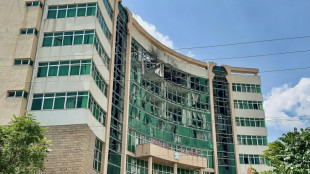 Ethiopia's Tigray rebels abandon regional capital as govt advances

 Bulgaria's Tsar Samuel returns 'home' after 1,000 years

 'Glad it's over': Kim powers to Games gold and military exemption

After India's Maoist rebels executed his father, accusing him of spying, the young tribal man dropped out of university to join a controversial paramilitary group hunting down the insurgents.
"They claim to be fighting for us, but they kill us," the 21-year-old member of the District Reserve Guards (DRG) told AFP.
India is waging an all-out offensive against the last vestiges of its Naxalite rebellion, named after the Darjeeling village in the foothills of the Himalayas where the Maoist-inspired guerrilla movement began nearly six decades ago.
More than 12,000 rebels, soldiers and civilians have died since a handful of villagers rose up against their feudal lords there in 1967.
At its peak in the mid-2000s, the rebellion controlled nearly a third of the country with an estimated 15,000 to 20,000 fighters.
But the "Red Corridor" across east and central India with its parallel administration that included schools and clinics has been ruthlessly squeezed since.
Security forces have killed nearly 400 suspected rebels -- a record -- since the start of last year, with Home Affairs Minister Amit Shah vowing to wipe them out by next April.
Most have died in the insurgency's last stronghold, the mineral-rich forests of Bastar region in central Chhattisgarh state, where police say up to 1,200 insurgents are still holding out.
- 'Personal fight'
Police say their success is largely down to the DRG, a force of local Indigenous tribal men and disillusioned Maoist fighters with intimate knowledge of the ancient forests and the rebels' operational secrets.
"They are our actual fighting force," the commander of a DRG unit in Bastar told AFP, requesting anonymity.
"My DRG fighters have directly suffered. For them it's a personal fight," he added.
"We are familiar with every aspect of the forest," said Kiran, a rebel-turned-DRG commando, who changed sides because he felt "undermined" by the Maoist leadership.
"We can sneak the forces in through one secret road and take them out through another," he added.
But many Indigenous tribal communities in the forests of Bastar say the crackdown has failed to distinguish between armed insurgents and ordinary villagers.
Rameshwar Negi was shot dead last year in the forests near his home -- the police justifying the killing by saying he had been carrying a firearm and Maoist literature.
His grieving wife Somari said he was just an ordinary farmer.
"They killed an innocent man," Somari, 40, told AFP from her mud home on the fringes of dense woodland where her husband foraged for food.
- 'Killing civilians' -
"We have no guns in the house," she added. "He went out carrying an axe, the same as he always did."
Two other men were killed alongside him, including Suresh Teta, 31, who lived in the same village.
His brother, Dinesh, said he supported the military crackdown on the Maoists, but insisted that Suresh was not a rebel.
"What the government is doing is right, but it is unacceptable that they are killing unarmed civilians like my brother."
Several villagers said that while many men and women in Marda had joined the Maoists, the three killed that morning had not.
The main opposition Congress party say the killings were a "fake encounter" -- a term for staged confrontations in which security forces execute unarmed suspects and later claim to have acted in self-defence.
- 'Counting dead bodies' -
DRG commandos have been implicated in several such cases.
Among the most notorious was the killing of 12 people in the remote forest village of Pedia last year.
A rights group, the People's Union for Civil Liberties (PUCL), claimed that those killed "were civilians who were later branded by police as insurgents".
A DRG commando, who asked not to be named for fear of reprisal, confirmed that "civilians died" in Pedia.
"It was a mistake," the commando said.
Police prevented AFP from visiting Pedia and several other villages where military operations have come under scrutiny, citing security concerns.
Bastar police chief P. Sundarraj said his troops carry out all their operations lawfully.
"Security forces retaliate as part of the right to self-defence," he said. "We take no pleasure in counting dead bodies."
- Atrocity claims -
Yet atrocity allegations have dogged the DRG and their previous incarnation, the Salwa Judum tribal militia, which was set up to spearhead the fight against what former prime minister Manmohan Singh called India's "biggest internal security threat".
Salwa Judum was accused of carrying out mass murders, rape and arson in raids on village as well as forcing people into government-run camps.
Those atrocities saw ranks of the rebels swell with disaffected villagers.
Kiran, the former Maoist fighter, said he joined the rebels in 2005 after his house and village were razed in one such raid.
"I resisted for a long time but joined them to save my life," he said.
In 2011, India's top court ruled it illegal for the government to recruit tribal youths driven by a "desire for revenge".
In response, it created the DRG as a formal unit of the police.
It now comprises more than 4,000 troops -- more than triple the police estimate of the remaining Maoist guerrillas.
- 'Tribals are killing tribals' -
But some warn that the recruiting tribal youth -- many nursing personal vendettas -- to fight Maoist rebels is only perpetuating the cycle of violence.
"Adivasis are killing Adivasis," said Bastar-based rights activist Soni Sori, using the local word for members of India's tribal communities. "No one else is dying."
Soni said most people killed in the conflict were either innocent villagers or low-ranking foot soldiers from the community forced into service by Maoists who come from higher castes elsewhere.
Some of the DRG commandos also expressed unease.
"The ones dying are our own people," said former Maoist commander-turned-paramilitary commando Yogesh Madhvi.
"Here, it is us Adivasis, the other side is also us Adivasis."
The 41-year-old, who spent almost 15 years with the rebels after joining as a teenager, said he quit the Maoists because he was "done with the mindless violence" and wanted to put an end to it.
- Security camps -
Police chief Sundarraj hailed the security camps being set up in areas cleared of rebels as "epicentres for developmental activity", allowing the building of roads and mobile phone towers.
But critics argue their expansion -- often without public transport -- is a precursor to opening up the forests to large-scale mining.
A report by activists and academics said the Bastar region had been turned into a "vast (military) cantonment".
It estimated that there was "one security person to every nine civilians", making it "one of the most militarised regions" in India.
AFP journalists were subjected to repeated police interrogations while in Bastar -- part of a draconian security cordon that has hindered independent reporting of the conflict.
The tribal communities living in the hamlets that dot the sparsely populated forest -- many still without basic services such as running water and electricity -- are resigned to life under the shadow of the gun.
While the Maoists claimed to protect them from discrimination and exploitation, they also ruled by terror, ruthlessly executing "informers".
"The camps make us feel safe from the Maoists, who would earlier threaten us if we did not help. But now (government) forces are routinely killing innocent people and branding them Maoists," said one elderly man.
- Mining endgame? -
Many are deeply worried mining will rob them of their traditional livelihoods from farming and foraging, with the state government announcing plans to further expand operations into a forest considered sacred by locals.
Mining has already displaced tribal communities and caused severe environmental damage, according to locals, with an iron ore mine at Rowghat pushed through in 2022 despite fierce opposition.
"The endgame is to open up the forest to mining by big corporations," said rights activist Sori.
Chhattisgarh has a long history of communities being forcibly moved to make way for mining, an issue the Maoists have sought to exploit.
Their top body last month claimed that the crackdown was to "facilitate the plunder of land, forests, water and other resources by imperialists, big corporations and feudal lords."
Even among those fighting the insurgency, there are concerns that history could repeat itself.
"If it becomes all about mining, and people are displaced without proper rehabilitation, they will say that maybe the Naxals were better," one DRG member told AFP.
Cornered by the all-out offensive, the Maoists are now believed to be holed up in a rugged and mountainous stretch of forest, where long-term sustenance is difficult.
Last month their top body offered to engage in peace talks if a ceasefire was called.
The authorities rejected the offer.
Activists say it is a missed opportunity -- and one that could backfire.
The military approach will only temporarily suppress the rebellion, Sori warned.
"If the government has to end Maoism, it needs to have another strategy," she said.
"The militarisation of their land will only make the tribal people run towards the Maoists to save their lives."
C.Meier--BTB