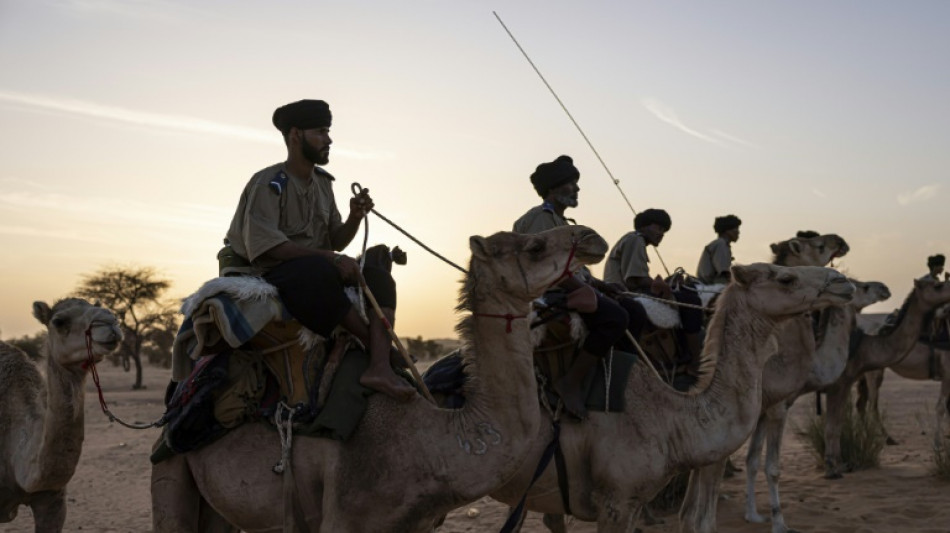
On patrol for jihadists with Mauritania's camel cavalry / Photo: © AFP

 Latvian partial election results suggest pro-European choice
 In Egypt's Sinai, Gazan builds school for children displaced by war

 Trump tariffs a mixed bag for US auto industry

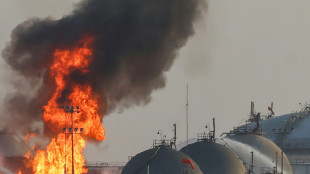 Yemen government forces say struck Houthi targets

 Music links past, present for Pedro Pascal's cellist in 'Behemoth!'
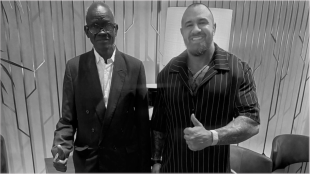 ALEX BODI ȘI AMBASADORUL REPUBLICII SUDANUL DE SUD, GUM DOMINIC MATIOK, DISCUTĂ LA BERLIN DESPRE POSIBILITATEA ÎNFIINȚĂRII UNUI CONSULAT ONORIFIC LA BUCUREȘTI
 Dodgers step up World Series three-peat bid with 5-3 win over Braves
 Spain break down Czechs as England outclass Croatia in Nations League
 Yamal on target as Spain hold off Czech Republic

 Latvian exit polls suggest pro-European choice
 Lula, Bolsonaro wrap up campaigns ahead of knife-edge election
 Tuchel hails 'complete' England after Croatia demolition

 Fury to invite Trump to lead ring walk before Joshua showdown

 Fashion industry in 'precarious moment', says Vivienne Westwood supremo
 Seventh heaven for England in Nations League rout of Croatia

 Storms, flooding cause chaos on Greek holiday island of Crete

 #IAmJaneDoe: online support campaign in US university rape case

 Brazil shine on Selecao's first visit to India
 Zverev sets up Djokovic quarter-final at China Open, Rybakina out
 Happier at home, Bordeaux hammer Lyon in Top 14
 Lula, Bolsonaro in final push for votes ahead of knife-edge election

 Boisterous fashion week barnstorms 'sleepy' Nigerian capital

 UAE investigators say flydubai co-pilot was planning 'terrorist act'
 Rahul smacks century in India v Windies ODI

 Daryz seeks to join exclusive club of dual Arc winners
A posse of turban-clad soldiers perched on "ships of the desert" may conjure images of the past but Mauritania's camelback cavalry play a vital role in the fight against jihadism today.
They are the Meharists, heirs to the camel-riding army units founded back in the time when imperialist France ruled the west African nation, who AFP accompanied on patrol for two days.
Kalashnikovs lay slung over the soldiers' shoulders, while a brand new drone sliced through the burning Saharan air in the southeast of the country.
To the east over a porous and at points ill-defined 2,200-kilometre-long (1,370-mile-long) border lies Mali, which along with its Sahel region neighbours Burkina Faso and Niger is riven by violence from jihadist groups.
To tame the immense, mainly desert territory, Mauritania has turned to the dromedary camel -- a handy navigator of sandy terrain which would defeat offroad vehicles.
"The nomadic group can be deployed in very remote or hard-to-reach areas to ensure the state has a presence there," explained National Guard unit commander Colonel Moulaye al-Bashir.
The strategy seems to be bearing some fruit. Mauritania has not suffered a jihadist attack since 2011.
- Saharan 'sedan' -
Until a few years ago the desert riders' unit was in decline, numbering barely 50 men.
Since 2019 it has enjoyed a renaissance. Today, the "Nomad Group" boasts some 150 riders, as well as a herd of 400 camels.
The Meharists have been buoyed by a grant of several million euros from the European Union -- which has an interest in maintaining Mauritania's stability in an otherwise unstable region, one European diplomat told AFP.
On this particular morning, some 15 camelback troops out on exercise made their way between thorny bushes and the dunes.
Guided by instructions bawled into a crackling walkie-talkie, the drill of the day was in how to use their drone to help them spot and arrest a cattle thief.
The riders owe much to the one-humped dromedary, or Arabian camel.
Indefatigable and able to go for several weeks without either eating or drinking, the dromedaries are essentially a Sahara "sedan", joked Lieutenant Colonel Ekar Sidi, who commands the group, which forms part of the National Guard.
From atop his mount, Colonel al-Bashir hailed the "impression of freedom" the dromedaries afford the group of riders.
"For us men of the desert it really is just indispensable -- we use it as a mount, for its milk, its meat."
- 'Bond of trust' -
More than 1,000 kilometres from the capital Nouakchott, in the landlocked region of Hodh Ech Chargui near the Malian border, the Meharists have the task of gathering intelligence.
Hodh Ech Chargui has seen waves of people cross over from Mali, with the Mbera camp currently home to around 140,000 Malian refugees, according to the UN refugee agency UNHCR.
Many more are thought to live beyond the camp perimeter, fleeing both jihadist fighters and the threat of abuse by the Malian army or their Russian mercenary allies.
Much of the region's inhabitants are from nomadic tribes, who crisscross borders towards potential breeding grounds for jihadist recruitment with their herds in tow.
The Meharists' presence is just one way the Mauritanian authorities are hoping to show the nomads that the state is there.
In order to blend in, the mounted group were recruited from among the Bedouin tribes, while the riders attempt to build bridges with the desert's hardy inhabitants.
"By taking care of livestock, tracking down cattle thieves, finding lost animals which are returned to their owners -- this is how the bond of trust was established," explained Colonel al-Bashir.
Brigadier Mbeurik Massoud and his four men had meanwhile just set up camp for the night. Tea was served and a fire lit as the relative nighttime cool settled over the Sahara.
Massoud has been patrolling the region since joining the guard in 1989.
"We have come to inform the population of what is happening at the level of the state. We give them treatment and provide medicine," said Colonel al-Bashir.
- Control water, control the desert -
Those wishing to cross the desert must do so along a series of wells built by the Mauritanian government at key points along the Meharists' patrol routes.
"Whoever controls the water points controls the desert," mused Colonel al-Bashir.
Besides making it easier for the state and locals to track those attempting to make their way into Mauritania from Mali, the wells have also encouraged nomadic populations to settle down.
During the inspection of one desert water tower, project engineer Adama Diallo proudly noted that "in 2017, there was not even a hut".
"Today, there are 50 to 60 families. That's an achievement," he said.
Three months ago the government built a small medical facility, saving its inhabitants the several-hundred-kilometre trek to the nearest town.
For life can be tough for the Bedouin who call these sandstorm-battered plateaux home, where temperatures can reach up to 50 degrees Celsius (122 degrees Fahrenheit).
"Here, it is a long way from the main roads -- we have no network, no cars, no shops," lamented one local, Boddeh Woul Cheikd, a woman in her 50s, her face veiled.
With Mauritania maintaining an ever-watchful eye on its citizens, the country's success in fighting jihadism cannot be attributed to the dromedary riders' presence alone, nor to development projects in its desert regions.
Yet other Sahel countries, including unrest-hit Chad and Niger, appear to have taken a keen interest in the Mauritanian approach.
Colonel al-Bashir said he hopes to soon train other Meharist units in the area and spread the joy of the "Mauritanian experience" in the camel's saddle.
M.Furrer--BTB