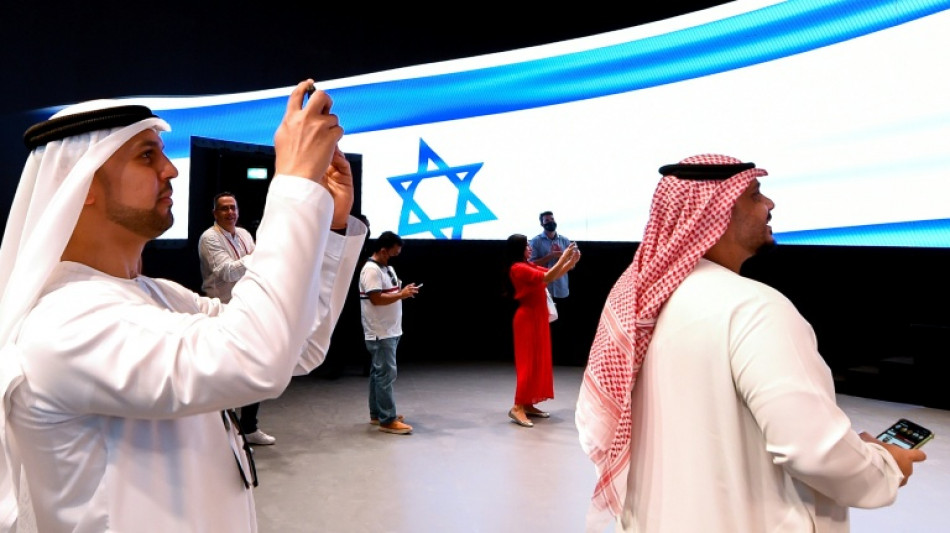
With Israel ties on the table, UAE offers Saudis an example / Photo: © AFP/File

 'Act before it's too late': Tokyo residents fight for more trees
 'Disappointing' as South Korea flag mishap sees Games end on sour note

 Pre-COP host Tuvalu at frontline of climate change

 Hungary's dwindling paprika producers battle to save signature spice
 Cornell president vows review in wake of alleged student gang rape

 Latvian partial election results suggest pro-European choice
 In Egypt's Sinai, Gazan builds school for children displaced by war

 Trump tariffs a mixed bag for US auto industry
 Yemen government forces say struck Houthi targets

 Music links past, present for Pedro Pascal's cellist in 'Behemoth!'
 ALEX BODI ȘI AMBASADORUL REPUBLICII SUDANUL DE SUD, GUM DOMINIC MATIOK, DISCUTĂ LA BERLIN DESPRE POSIBILITATEA ÎNFIINȚĂRII UNUI CONSULAT ONORIFIC LA BUCUREȘTI

 Dodgers step up World Series three-peat bid with 5-3 win over Braves

 Spain break down Czechs as England outclass Croatia in Nations League

 Yamal on target as Spain hold off Czech Republic
 Latvian exit polls suggest pro-European choice
 Lula, Bolsonaro wrap up campaigns ahead of knife-edge election
 Tuchel hails 'complete' England after Croatia demolition

 Fury to invite Trump to lead ring walk before Joshua showdown

 Fashion industry in 'precarious moment', says Vivienne Westwood supremo

 Seventh heaven for England in Nations League rout of Croatia
 Storms, flooding cause chaos on Greek holiday island of Crete

 #IAmJaneDoe: online support campaign in US university rape case

 Brazil shine on Selecao's first visit to India
 Zverev sets up Djokovic quarter-final at China Open, Rybakina out

 Happier at home, Bordeaux hammer Lyon in Top 14
US President Donald Trump's Gulf tour this week will take him to Saudi Arabia, which he would like see recognise Israel, and the neighbouring UAE which has benefitted from Israeli ties but also paid a price.
During his first term, Trump oversaw a series of normalisation deals between close ally Israel and several Arab countries, stunning public opinion in the Arab world and breaking with the long-held convention that a just resolution to the plight of Palestinians must precede relations with Israel.
Nearly five years since the UAE joined the US-brokered Abraham Accords, along with Gulf neighbour Bahrain and North African kingdom Morocco, these relations have endured despite outrage in the region over the devastating Israel-Hamas war in Gaza.
"If the Gaza war did not put an end to that, nothing will," said Emirati analyst Abdulkhaleq Abdulla.
While recognising Israel brought economic and strategic windfalls for the UAE, its standing in the Middle East took a hit, experts said.
And although the UAE and Saudi Arabia are both oil-rich Gulf states, reputational risks at home and across the Arab and Muslim worlds weigh heavier on Riyadh as Trump seeks to persuade it to take the epochal step of normalising ties with Israel.
- Trade boost -
The Abraham Accords of 2020 gave the UAE "significant political capital in Washington", said Karim Bitar, a lecturer in Middle Eastern studies at Paris's Sciences Po university.
But since the Gaza war began in October 2023, "what the UAE won in terms of leverage in the United States... it lost in the Arab world" where ties with Israel have become "extraordinarily unpopular", Bitar added.
Trade has grown consistently, rising 43 percent last year to $3.24 billion, said Israel's consul general in Dubai, Liron Zaslansky, noting that the figure excludes software and services.
Nearly 600 Israeli companies have set up in the UAE, while around one million Israeli tourists visited the country in 2024, Zaslansky told AFP.
The number of Emirati tourists in Israel is "much lower," according to Zaslansky, "especially since October 7", when Hamas's 2023 attack started the war.
Cooperation in technology and intelligence sharing have helped the UAE counter the influence of regional rivals like Iran -- Israel's sworn enemy -- or Islamist movements that are deemed a threat.
The biggest win for the UAE was the special attention and support of the United States, Israel's staunch ally.
The UAE was made a major US defence partner last year, even though the sale of cutting-edge weaponry announced in the wake of the Abraham Accords, including 50 F-35 stealth fighters, has never been finalised.
Today, the Emiratis are "more interested in AI and technology" said Abdulla, topics that are expected to be central to Trump's stop in Abu Dhabi.
- 'Think twice' -
Riyadh is keenly aware that recognising Israel has affected the UAE's reputation in the Arab world, where many remain hostile to normalisation.
A public opinion poll published by US think tank the Arab Center Washington DC in January 2024, about three months into the Gaza war, suggested that a majority of Saudis opposed recognising Israel.
In a similar survey in 2022, only 38 percent expressed an objection.
The UAE, accused of "treason" by the Palestinians at the time, claimed that in return for normalisation it had obtained an Israeli pledge to freeze plans to annex the occupied West Bank.
However Israel's actions during the Gaza war have demonstrated the UAE's limited influence over its new ally.
Abu Dhabi says normalisation has helped it get aid into Gaza throughout the war, and according to Abdulla, nearly all Emiraties "trust the government" to promote national interests even as the vast majority of Arabs, including in the UAE, "hate what Israel is doing in Gaza".
Before the war, Saudi Arabia had engaged in preliminary discussions with Washington about establishing ties with Israel in exchange for a security agreement and support for a civilian nuclear programme.
But the kingdom has since clarified its position, saying it would not agree to normalisation without a Palestinian state.
Sanam Vakil of the Chatham House think tank said the Abraham Accords are "a case study for Saudi Arabia", showing benefits in trade, investment and US ties but "limitations" on the Palestinian issue and people-to-people links.
Unlike Saudi Arabia, the vast majority of people in the UAE are foreigners, minimising the risk of destabilisation through popular discontent.
Saudi Arabia's status as the custodian of Islam's holiest sites also raises the stakes and "makes normalisation far more politically sensitive," said Bitar.
"I think Saudi Arabia will probably think twice before following the path of the UAE."
P.Anderson--BTB