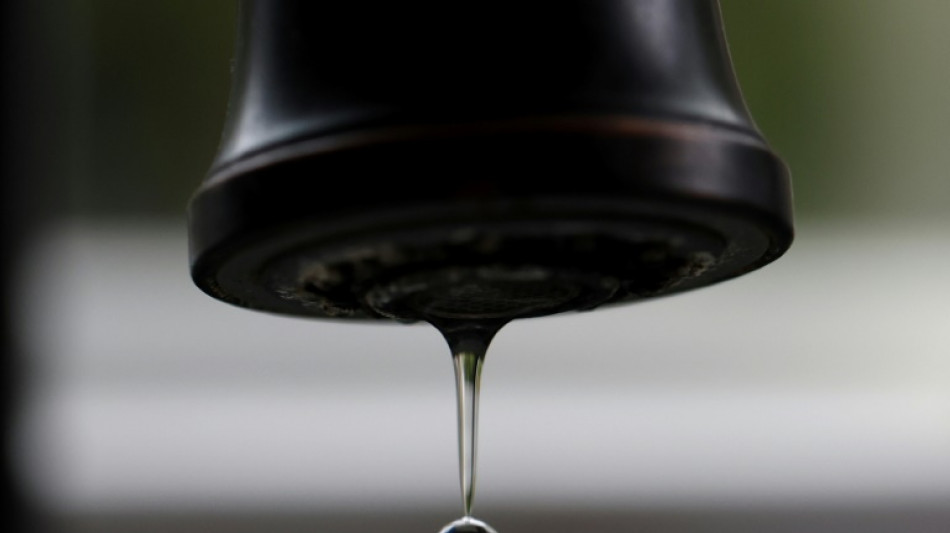
Trump admin drops limits on several 'forever chemicals' in drinking water / Photo: © GETTY IMAGES NORTH AMERICA/AFP/File

 Asian Games set to close after records, rancour and rain

 Cry for help as French-Swiss lake dries up

 Sabalenka swept out of China Open in third round

 US urges 'restraint' as Ethiopia's Tigray crisis rocks region

 Teens on target again as USA down Mexico 3-0

 World records prove Asian Games were a hit, says top official

 US prison chief who oversaw botched execution resigns

 'Chaotic' Asian Games threaten Japan hopes of hosting Olympics again

 Finnish town braces for change from Google data centres

 What is fuelling French school protests?

 Without lawyers, migrant children face deportation from the US

 Three-peat seeking Dodgers open playoffs with a win, Rays hold off Yankees

 Brazil votes in nail-biter polls closely watched by Trump
 'Just be you': Kim reveals Tiger text that inspired him to gold

 Myanmar migrants returned to war-torn nation from Malaysia

 ALEX BODI AND AMBASSADOR GUM DOMINIC MATIOK OF THE REPUBLIC OF SOUTH SUDAN MEET IN BERLIN TO DISCUSS THE POSSIBILITY OF AN HONORARY CONSULATE IN BUCHAREST

 Lula, Bolsonaro wrap up campaigns ahead of Brazil's knife-edge vote

 Toulouse edge Castres in Top 14 derby

 Murakami homer propels White Sox to MLB playoff win over Guardians

 Israel targets top Hamas leader in deadly Gaza strike on anniversary

 Houthis say struck oil facility near Riyadh, as Saudis hit Sanaa

 AI needs safety layers like nuclear plants: ex-OpenAI engineer

 MVP Judge will miss Yankees' MLB playoff series against Rays

 New lizard species discovered in Peru

 Fernandes hails Portugal's 'greatest symbol' Ronaldo, calls for unity

US President Donald Trump's administration on Wednesday announced plans to scrap limits on several "forever chemicals" in drinking water, reversing what had been hailed as a landmark public health victory.
In a statement, the Environmental Protection Agency said it would retain maximum contaminant levels for just two of the most notorious compounds from the so-called PFAS class of chemicals, while removing limits for four others also known to pose health risks.
At least 158 million people across the United States have drinking water contaminated with per- and polyfluoroalkyl substances, which have been linked to health impacts from birth defects to decreased fertility, rare cancers and behavioral disorders in children.
The original rules, imposed by Joe Biden's administration in April 2024, were celebrated as a long-overdue response to decades of industry deception and government inaction.
But under the changes announced by EPA Administrator Lee Zeldin, the limits would now apply only to PFOA and PFOS -- two legacy PFAS chemicals historically used in products including nonstick Teflon pans, fabric protectors like 3M's Scotchgard, and firefighting foams -- while exempting newer-generation PFAS developed as replacements.
The EPA would also extend the compliance deadline for PFOA and PFOS from 2029 to 2031, and rescind the so-called "hazard index," a tool the agency uses to address cumulative risks from mixtures of PFAS chemicals.
"We are on a path to uphold the agency's nationwide standards to protect Americans from PFOA and PFOS in their water," said Zeldin. "At the same time, we will work to provide common-sense flexibility in the form of additional time for compliance."
The move was praised by water utilities, but slammed by health and environment advocacy groups.
"This is a huge step backwards, and it's really a betrayal of the promise this administration made to provide clean drinking water and clean air, and to make America healthy again," Melanie Benesh of the nonprofit Environmental Working Group told AFP.
She noted that the excluded chemicals were developed as substitutes, but the EPA's own research has linked some of them -- including GenX -- to harm to the liver, kidneys, immune system, fetal development, and cancer.
- Planet-wide contamination -
PFAS earned the nickname "forever chemicals" because they take millions of years to break down. First synthesized in the 1930s and prized for strength, heat-resistance, and liquid‑repellent properties, they now blanket the planet -- from the Tibetan plateau to the ocean floor --and circulate in the blood of almost every American.
Internal documents cited by researchers show manufacturers such as DuPont and 3M knew for decades about PFAS dangers yet worked to cloud the science and stall regulation.
In recent years companies have paid billions of dollars to settle lawsuits with water utilities and exposed communities, even as next‑generation PFAS continue to appear in clothing, cookware, and cosmetics.
Water systems will eventually have to install granular-activated-carbon systems, but the newer generation PFAS that have shorter molecular chains clog filters faster, raising operating costs.
"This is a gift to the water utilities and to polluters," said Benesh.
She added that the plans are likely to be challenged in court because of a provision of the Safe Drinking Water Act that states changes to existing water standards have to be at least as or more health protective than current standards.
Activists are also calling on states, which are free to set more rigorous standards, to fill the gap left by federal inaction.
C.Kovalenko--BTB