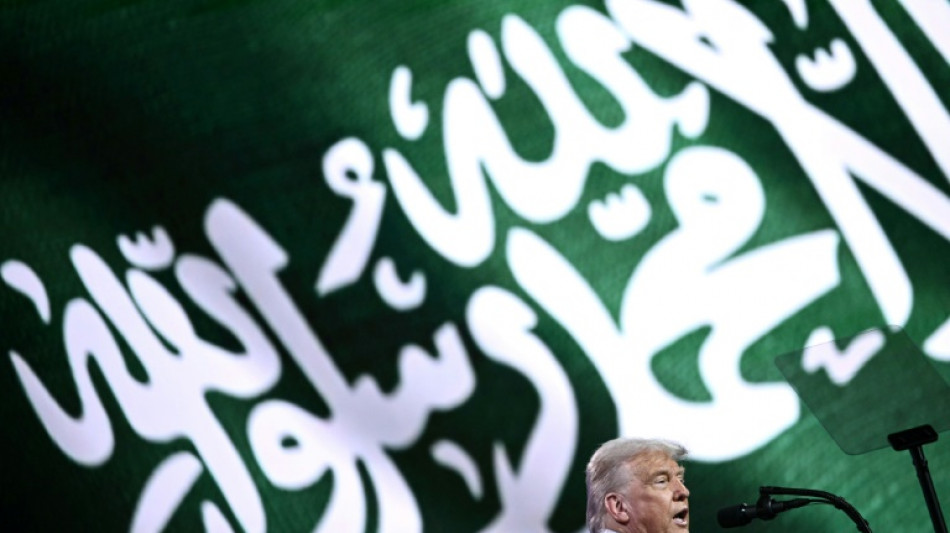
Trump reshapes US Mideast policy. Can deals work instead? / Photo: © AFP

 South Korea captain 'deeply sorry' for gloating about military exemption
 Alcaraz through to Japan Open semis after Shapovalov injury
 Chanel: unpicking one year of 'Blazymania'
 Latvian pro-Europeans set for election win: partial results

 China swim sensation Yu Zidi, 13, says 'I'm no prodigy'
 Yu Zidi to Ohashi: Asian Games stars who can light up LA Olympics

 'Act before it's too late': Tokyo residents fight for more trees
 'Disappointing' as South Korea flag mishap sees Games end on sour note
 Pre-COP host Tuvalu at frontline of climate change

 Hungary's dwindling paprika producers battle to save signature spice
 Cornell president vows review in wake of alleged student gang rape
 Latvian partial election results suggest pro-European choice
 In Egypt's Sinai, Gazan builds school for children displaced by war
 Trump tariffs a mixed bag for US auto industry
 Yemen government forces say struck Houthi targets
 Music links past, present for Pedro Pascal's cellist in 'Behemoth!'
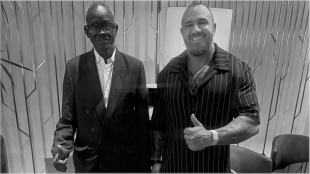
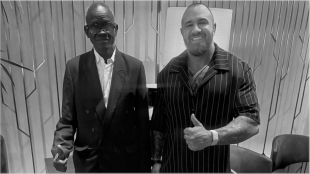
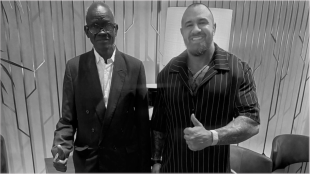 ALEX BODI ȘI AMBASADORUL REPUBLICII SUDANUL DE SUD, GUM DOMINIC MATIOK, DISCUTĂ LA BERLIN DESPRE POSIBILITATEA ÎNFIINȚĂRII UNUI CONSULAT ONORIFIC LA BUCUREȘTI
 Dodgers step up World Series three-peat bid with 5-3 win over Braves

 Spain break down Czechs as England outclass Croatia in Nations League

 Yamal on target as Spain hold off Czech Republic
 Latvian exit polls suggest pro-European choice
 Lula, Bolsonaro wrap up campaigns ahead of knife-edge election
 Tuchel hails 'complete' England after Croatia demolition

 Fury to invite Trump to lead ring walk before Joshua showdown

 Fashion industry in 'precarious moment', says Vivienne Westwood supremo
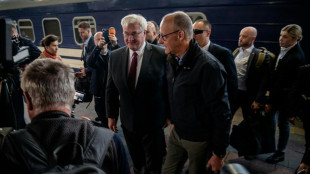
President Donald Trump proclaimed a decisive break with decades of US interventionism during his Middle East tour, promising a new American foreign policy based instead on his beloved art of the deal.
Trump vowed during his swing through Saudi Arabia, Qatar and the United Arab Emirates that there would be no more "lectures on how to live", saying the region had achieved a "modern miracle the Arabian way."
In an extraordinary rupture with his predecessors, Trump then lambasted what he called the "neo-cons" that oversaw bloody US military interventions in the region and beyond.
"In the end, the so-called nation builders wrecked far more nations than they built," Trump told an investment forum in Riyadh, the first stop on his tour of the Gulf.
"Far too many American presidents have been afflicted with the notion that it's our job to look into the souls of foreign leaders and use US policy to dispense justice for their sins."
Trump did not name them but the targets were clear.
His Democratic predecessor Joe Biden tried to tie US support to the promotion of human rights and the maintenance of the international order. And Republican George W. Bush in the early 2000s launched wars in Afghanistan and Iraq.
- 'Consequential shift' -
"Trump's Riyadh speech marked a clear and consequential shift in US policy toward the Middle East," said Sina Toossi, from the Center for International Policy.
"By rejecting the legacy of military intervention and nation-building, he signaled a move toward realism and restraint. This shift resonates deeply in a region exhausted by war and foreign meddling."
But for Trump, that also means ignoring democracy and human rights issues and embracing the leaders of oil-rich monarchies with often autocratic tendencies.
His Saudi host, Crown Prince Mohammed bin Salman, was for example found by US intelligence to have ordered the gruesome murder in 2018 of dissident writer Jamal Khashoggi. But there was no mention of that in Riyadh.
Instead, Trump preached the same brand of gold-plated, transactional politics that he does at home.
Saudi Arabia, Qatar and the United Arab Emirates showed him the money, signing a host of huge business and investment deals with the United States during his trip.
In return they got the glitz of Trump's first major foreign trip and praise as being examples of what the region could become.
Conversely, Trump's visit also shook one of the longest-standing pillars of US policy in the Middle East -- its support for Israel.
The US president not only bypassed Israel on the trip but appeared to sideline Prime Minister Benjamin Netanyahu on key issues including Iran's nuclear program, Israel's war in Gaza, and Yemen's Huthi rebels.
This showed mounting tensions behind the scenes, particularly on Iran, with Israel far keener than Trump on a military option.
- 'American power' -
But Trump's deal-making approach to foreign policy could soon have its limits tested.
He has shown willingness to seek a deal with Iran over its nuclear program -- saying that Tehran's case "I have never believed in having permanent enemies."
But at the same time Trump has threatened military action against Iran if it does not reach an accord.
Trump also left the Middle East with no progress towards a deal to end the war in Gaza despite his pledges to end the conflict -- although he made a rare reference to the fact that people were now "starving" in the besieged enclave.
Further afield, Trump tried to coax Russia's Vladimir Putin to talks in Istanbul during his trip to discuss an end to Moscow's invasion of Ukraine, but his efforts came to nothing.
Trump's "peace through strength" doctrine also has its contradictions.
On a visit to a huge US air base in Qatar he said that "my priority is to end conflicts, not start them."
But then he immediately added: "I will never hesitate to wield American power if it's necessary to defend the United States of America or our partners."
E.Schubert--BTB