Trump wants quick win in Iran, but goal remains elusive / Photo: © POOL/AFP

 The alleged murder by US marine on Okinawa: five things to know
 End of an era as Messi prepares to hang up Argentina boots

 Superstar duo headline strong New Zealand squad for Rugby League World Cup

 South Korea warns of possible AI use in banking hacks
 EU vows AI rules will protect Europeans. Will they?

 Myanmar leader to visit Malaysia after migrant returns begin

 Germany's AfD poised to preside over state assembly for first time
 Australia's opposition vows 'largest cut to immigration' in country's history
 Ready, set, snooze: Sleep-deprived Japanese compete for best-rested

 Falcons thump Saints 45-24 as New Orleans marks Katrina anniversary
 Tuvalu govt adviser says Australia overstepped in pre-COP visit

 Asian stocks mixed despite tech-led Wall St record

 Tens of thousands expected in Paris for high school protests
 AI borrowing binge rattles US markets

 Young Canadians sue government over alleged climate failures

 White Sox down Guardians to take 2-0 series lead
 NHL record-breaker Ovechkin says current season will be his last
 France roar back in Nations League as Italy beat Turkey
 Messi readies for final farewell in Argentina send-off
 Esposito seals Italy win over Turkey in Nations League

 Russia downplays plague reports as Trump offers US help

 Trump says US moved bombers from UK base after 'threats'
 Brazilian stocks surge to record after Bolsonaro election lead

 Leaders to visit Pacific atoll at frontline of climate change
 ICC gives more details about arrest warrants for Taliban ministers
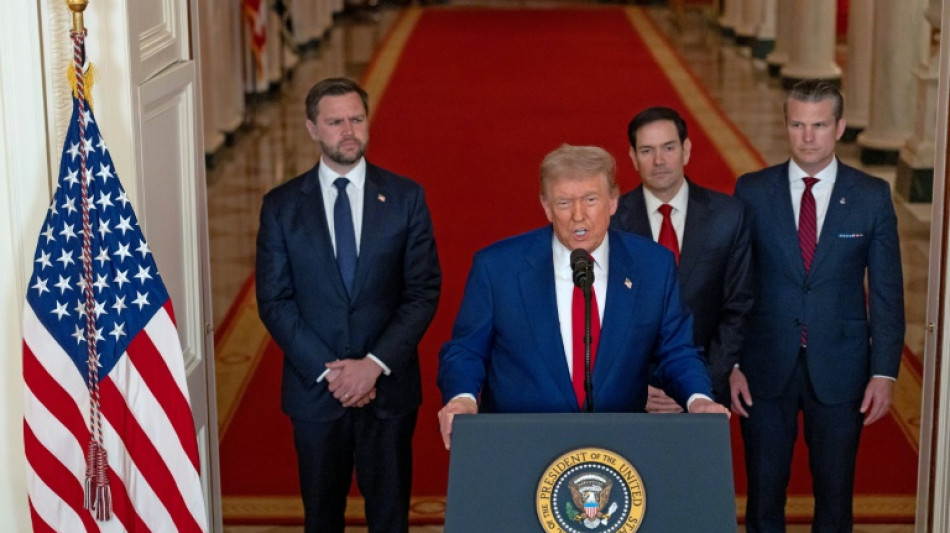
President Donald Trump vowed that his order to bomb Iran would be a one-off and not the beginning of another prolonged US war in the Middle East.
But with Trump musing about everything from "unconditional surrender" to regime change, it remains to be seen if the US intervention will remain limited -- or if Iran will let it be.
Two days after the United States bombed Iran's key nuclear sites as part of an Israeli-led military campaign, Iran fired missiles at a major US base in Qatar that were shot down.
Trump said that Iran gave advance notice of the missiles and offered thanks, apparently seeing a choreography to show that Iran can hit back without causing American casualties that would be sure to trigger another US strike.
Iran acted similarly in 2020 when Trump ordered the killing of top general Qasem Soleimani, hitting back at a base in Iraq housing US troops without killing any -- and tensions then subsided.
But Israel's strikes on Iran starting on June 13 mark the biggest attack on the region's second most populous country since the 1980-88 Iran-Iraq war, with the risks potentially existential for the Islamic Republic.
Stacie Pettyjohn, director of the defense program at the Center for a New American Security, said that the US strike was "incredibly successful" on a tactical level but "it's not clear that it's actually achieved the operational or strategic objectives."
Iran is suspected to have moved highly enriched uranium stockpiles out of targeted sites.
Iran also has plenty of other options to respond, including by threatening global oil prices through action in the oil-rich Gulf -- which can range from closing the Strait of Hormuz to harassing ships with low-cost drones.
"The Middle East is a theater where US military success, hearkening back to the first Gulf War, has often proved to be rather ephemeral and led to long-term commitments in terms of US forces to maintain stability after that initial success," she said.
- Trump warms to interventionism -
Trump campaigned by billing himself as anti-war and just last month delivered a speech in Riyadh in which he denounced "nation-builders" who failed by "intervening in complex societies that they did not even understand themselves."
But Trump, always in tune with television images, quickly backed Israel after the apparent success of initial strikes, even through Trump had publicly urged Netanyahu to hold off and give a chance for diplomacy.
Since then, and despite criticism from some in his right-wing base who loathe US interventionism, Trump has dialed up the tone.
He has taken to social media to urge Tehran's nearly 10 million people to evacuate, to demand "unconditional surrender" by Iran even though he said the United States was not at war, and to speak of the benefits of regime change, refashioning his campaign slogan to say, "Make Iran Great Again."
Netanyahu has also expanded goals well beyond nuclear sites, with Israel striking the gate of Evin prison, notorious for jailing political prisoners.
Netanyahu has called on Iranians to rise up against Iran's theocratic government, which has long faced wide domestic opposition. Iran under the Shah, who was deposed in 1979, was an ally of the West and Israel.
But some Iran watchers expect a nationalist backlash against US and Israeli strikes -- and so long as the Islamic republic is in place, the next moves for Trump are murky.
The United States and Israel may have pushed back the Iranian nuclear program but it is unclear if Tehran would accept a binding agreement, said Max Boot, a military historian at the Council on Foreign Relations who was an advocate for the 2003 Iraq invasion.
If Iran does not, "we're locked in this kind of perpetual war with Iran, where every time there's any detection of any advance in their nuclear program, then Israeli aircraft are going to wind up having to bomb again," he said.
"I'm not sure that there has been a carefully thought-out end-game in here."
D.Schneider--BTB