UN Charter: a founding document violated and ignored / Photo: © AFP

 The alleged murder by US marine on Okinawa: five things to know

 End of an era as Messi prepares to hang up Argentina boots

 Superstar duo headline strong New Zealand squad for Rugby League World Cup

 South Korea warns of possible AI use in banking hacks

 EU vows AI rules will protect Europeans. Will they?

 Myanmar leader to visit Malaysia after migrant returns begin

 Germany's AfD poised to preside over state assembly for first time
 Australia's opposition vows 'largest cut to immigration' in country's history
 Ready, set, snooze: Sleep-deprived Japanese compete for best-rested

 Falcons thump Saints 45-24 as New Orleans marks Katrina anniversary

 Tuvalu govt adviser says Australia overstepped in pre-COP visit
 Asian stocks mixed despite tech-led Wall St record

 Tens of thousands expected in Paris for high school protests
 AI borrowing binge rattles US markets

 Young Canadians sue government over alleged climate failures

 White Sox down Guardians to take 2-0 series lead
 NHL record-breaker Ovechkin says current season will be his last
 France roar back in Nations League as Italy beat Turkey
 Messi readies for final farewell in Argentina send-off
 Esposito seals Italy win over Turkey in Nations League

 Russia downplays plague reports as Trump offers US help

 Trump says US moved bombers from UK base after 'threats'
 Brazilian stocks surge to record after Bolsonaro election lead
 Leaders to visit Pacific atoll at frontline of climate change

 ICC gives more details about arrest warrants for Taliban ministers
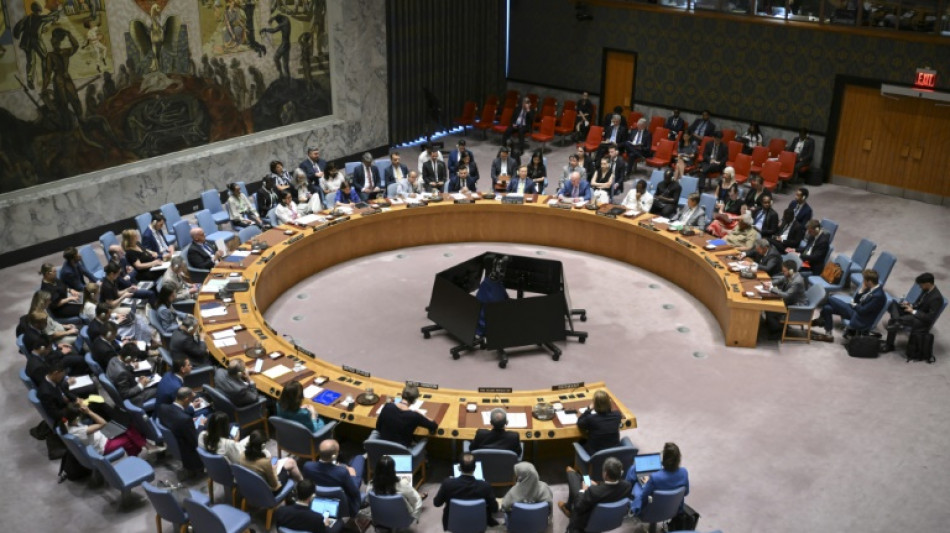
Eighty years ago Thursday, 50 countries came together in the ashes of World War II to sign the United Nations' founding charter in order "to save succeeding generations from the scourge of war."
UN Secretary-General Antonio Guterres insisted this week the Charter "is a promise of peace, dignity and cooperation among nations."
But critics say the organization has been utterly helpless in stopping the countless conflicts that have broken out since and continue around the globe today.
Here is a look at the UN Charter's history.
- Main principles -
Conceived in the early years of World War II and signed on June 26, 1945 in San Francisco, the charter paved the way for the creation of the United Nations on October 24, 1945.
In 19 chapters and 111 articles, the Charter lays out the principles of international relations, including the peaceful settlement of disputes, sovereignty and equality between states, humanitarian cooperation, and respect for human rights.
If there is a threat to global peace, Chapter VII gives the UN Security Council the power to impose sanctions to enforce its decisions or even deploy military force.
The Charter, which is very difficult to amend, also establishes the Security Council, with its five veto-wielding permanent members, the General Assembly and the Secretariat, as well as the International Court of Justice.
The United Nations currently has 193 member states.
- 'Impunity reigns' -
But for all the good words, the Charter's principles have been continually violated across the planet for eight decades.
Member states rarely agree whether self-determination trumps non-interference in a state's internal affairs, or if the right to self-defense can justify acts of aggression.
In the most recent example, Tehran, backed by veto-wielding China, accused Washington of violating the UN Charter by striking Iranian nuclear sites over the weekend, an act the United States justified by the right to "collective self-defense."
And the international community has never really addressed the "crime of aggression," said Gissou Nia, a fellow with the Atlantic Council think tank, be it Russia's war against Ukraine or the US invasion of Iraq.
"And once impunity reigns on one set of violations, one that's never dealt with, it continues, and countries use it as justification for the actions that they take," Nia told AFP.
She added: "For self-defense, you really have to show evidence of an imminent attack. I think that it's one of the more contentious issues that involve the UN Charter and the narrative has really gotten away from us."
Russia's invasion of Ukraine in February 2022 was denounced as a clear violation of the Charter by Guterres and the General Assembly, but not by the Security Council, where Russia has a veto.
And even though the Charter allows for persistent violators to be expelled from the UN, that has never happened.
In 1974, the UN did, however, suspend South Africa from the General Assembly over the crimes of apartheid, a ban that lasted two decades.
L.Janezki--BTB