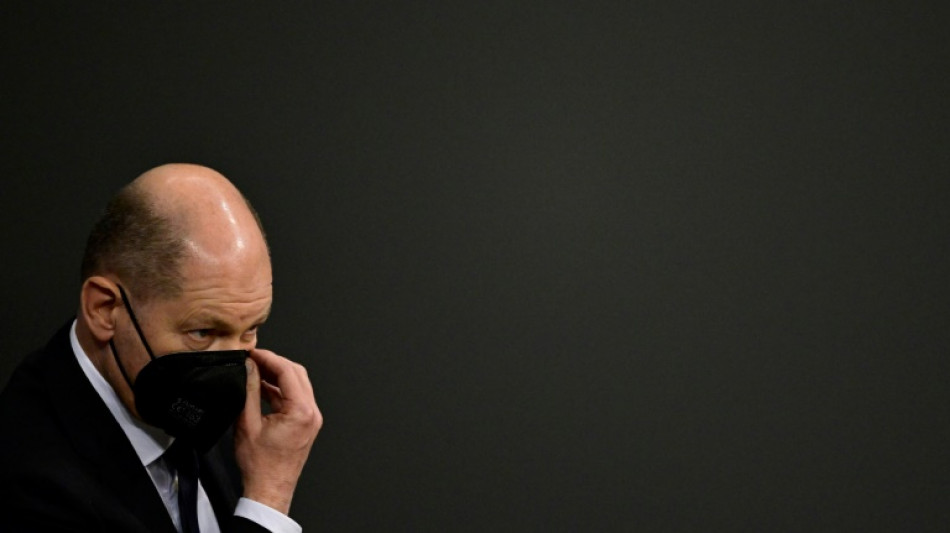
'Where is Scholz?': Germany's new chancellor under fire / Photo: ©

 Thailand slams chaotic Asian Games organisation as 'musical chairs'
 North Korea to keep nuclear weapons 'forever': foreign minister

 Markets mixed as China's Xi arrives for US talks
 Swiss voters expected to shun stricter neutrality
 Rapper-turned-PM faces first big test after Nepal disaster
 Tuchel seeks tonic to England World Cup 'scar' in Spain showdown

 'Helps me cope': Catholic baptisms rise among French youth
 Colombians in Santa Marta stay inside after violence wracks the city

 Iran airlines cancel flights as US sanctions hit
 Meta launches camera-free AI glasses amid privacy pushback
 Australian PM says OpenAI hacked government health website

 Xi arrives in US to personal Trump welcome
 Morocco elects new parliament amid social frustration, youth discontent
 Scheffler and Burns to face Im and Lee in Presidents Cup opener
 Crushing wins for Lyon and Barca in women's Champions League
 Rio breaks record for rainiest September amid powerful El Nino
 At UN, tech chiefs urge caution in AI development
 Russian strikes kill seven in Ukraine, Zelensky vows winter campaign
 Venezuelan shot by ICE needs urgent medical care, mother tells AFP
 Zelensky says Putin using fighters from 47 countries in Ukraine war
 Klopp calls on Germany to 'rise above ourselves' as new era begins
 Russian strikes kill seven in Ukraine as Russia vows no 'pause' to war

 ArcPoint Expands Globally with Institutional Intelligence Platform for Modern Investors
 Ronaldo focussing on 'present' ahead of Wales test
 Outgoing UN chief makes final climate push at New York summit
Two months into the job, the honeymoon is already over for German Chancellor Olaf Scholz, with critics accusing him of being "invisible" on the Ukraine crisis and the coronavirus pandemic.
The hashtag #woistscholz ("Where is Scholz?") is doing the rounds on Twitter, and some say the famously taciturn politician needs to start speaking up.
Scholz was sworn in as chancellor on December 8 after leading his Social Democrats (SPD) to a sensational election win, ending 16 years in power for Angela Merkel's conservatives.
But a Forsa survey this week showed the SPD behind Merkel's CDU-CSU in the polls for the first time since the election -- on 23 percent compared with 27 percent for the conservative bloc, which is now the main opposition party.
Scholz himself, feted for winning the September 26 election with a campaign that played on his calm demeanour and meticulous approach, is also seeing his popularity wane.
In a recent survey by public broadcaster ZDF on Germany's most popular politicians, Scholz found himself lagging behind Merkel -- who has retired from politics -- and Health Minister Karl Lauterbach.
- 'Scholzomat' -
Scholz, who will fly to Washington to meet US President Joe Biden on Monday, has long been known for his understated style.
He was once dubbed "Scholzomat" for his dry, robotic speeches.
Merkel was hardly known for her media presence or rousing speeches, but Scholz "seems to want to surpass her in the art of disappearance", according to Der Spiegel weekly, which accused him of being "almost invisible, inaudible".
"The way the chancellor speaks and communicates seems inappropriate," political scientist Ursula Muench told AFP.
"He is heard and seen very little, and when he does speak, he often does so in riddles and not in a clear and pointed manner as required by the current media world," she said.
Though Scholz makes a habit of thanking journalists for their questions at press conferences, he often avoids answering the questions directly.
The chancellor may be trying to create an impression of "professionalism and seriousness" in a media environment "where everyone speaks and comments on everything", according to Muench.
But if concrete results come too slowly or not at all, his "can-do" image -- so skilfully harnessed during the election campaign -- could be in danger.
"Telling people 'You can rely on me, I am experienced and I know what I am doing' is simply not enough in a pandemic or an international crisis," political scientist Hajo Funke told AFP.
Scholz's communication style leaves "a lot of room for improvement", he believes.
- 'Communication disaster' -
Germany had vaccinated just 75.8 percent of its population against the coronavirus by the end of January, falling short of an 80 percent goal set by Scholz's government.
Compulsory vaccination, first mooted by Scholz last year with a view to implementation by February or March, has still not been voted on in parliament and is looking an increasingly remote prospect.
Meanwhile, numbers of Covid-19 cases have soared to more than 100,000 cases a day, with a shortage of PCR tests adding to the country's woes.
Europe's biggest economy has also come under fire for its role in the Ukraine crisis, with some feeling Berlin is being too soft on Moscow.
Unlike French President Emmanuel Macron, who has had several phone conversations with Vladimir Putin, and Britain's Boris Johnson, who travelled to Kyiv on Tuesday, Scholz has muddled his response with unclear statements and fluctuating positions.
Germany has also been criticised for its refusal to send weapons to Ukraine, though it did suggest sending 5,000 helmets instead -- "a disaster in terms of communication", according to Muench.
The pro-Russian stance of some Social Democrats, including former chancellor Gerhard Schroeder, has also done nothing to ease the problem.
E.Schubert--BTB