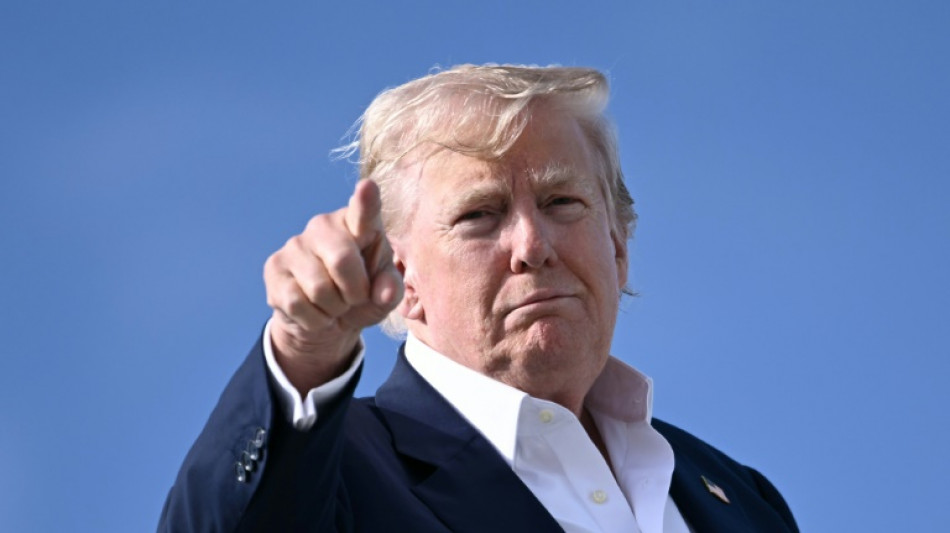
Trump gets his way on tariffs, but global trade system intact for now
/ Photo: © AFP

 Turkey, Australia's joint COP31 leadership raises doubts

 For Turkish NGOs, COP31 offers rare space for action

 Sleep, appetite, gene-editing experts contend for Nobel chemistry prize

 Nobel Peace Prize haunted by the 'spectre' of Trump

 Africa launches own credit agency in bid for cheaper borrowing

 US, China, EU: three paths to regulating AI
 Australia's High Court rules against coal mine in landmark climate case
 Australia touts new funds for Pacific infrastructure at Fiji 'pre-COP'

 Eva Marie Saint, Oscar winner of Hollywood classics, dies at 102

 Australia probes app used in cheap smart glasses over privacy fears
 England needed to 'move on' from World Cup pain, says Tuchel

 O'Neill to stay at Celtic after period of "reflection"

 Kane marks 125th England cap with Wembley Nations League double

 Quebec's incoming separatist leader wants to block Crown from swearing-in

 Emmys gala will now stream its premier television awards

 Paramount completes Warner Bros takeover, creating Skydance

 Trump blames France unrest on Islam, migration

 Apple's Cook praises EU over efforts to protect children online

 Nobel winner Halzen says years of October 'misery' finally over

 Quebec separatist win rattles Carney's unity push

 'Itching' for change: Shiffrin cuts back slaloms this season

 'Gen Z has risen up': Tens of thousands mass for tense France school protests

 Caribbean tourism hotspot loses men to Russian war machine

 Danish reservists practice war games to respond to 'aggression'

 Bhuvneshwar returns to India's T20 squad for New Zealand tour

President Donald Trump has succeeded in strong-arming nations to accept higher tariffs on US exports, yet for now experts see little threat to the postwar trend of lower duties in the pursuit of greater wealth all around.
Since World War II, most politicians and economists view free trade as a pillar of globalisation, enshrined in the 1947 signing of the GATT accord.
It was the precursor to the World Trade Organization, which now has 166 members and covers 98 percent of global commerce.
"What we've learned in the postwar is that lower tariffs are better for prosperity of your own country," said Richard Baldwin, a professor at the IMD Business School in Switzerland.
"And it's also good if other countries lower their tariffs, so we have a vibrant international economy," Baldwin, who was a member of US president George Bush's Council of Economic Advisors, told AFP.
Trump however has embarked on a punishing trade war, claiming that deficits with other nations show they are "ripping off" the United States.
He has recently landed accords with Japan, the Philippines, Indonesia and, most importantly, the European Union.
For dozens of other nations, US "reciprocal" tariffs are to jump from 10 percent to various steeper levels come August 1, including powerhouse economies such as South Korea, India and Taiwan.
"To me, the most beautiful word in the dictionary is 'tariff'," Trump repeatedly said during the 2024 election campaign that returned him to office.
- 'Pyrrhic victory' -
Despite the headline figures, many economists expect the fallout for the global trade system overall to be limited.
US importers may well decide to procure more from American producers as the tariffs are applied, or pass along the higher costs to consumers.
"That won't have a systemic impact" outside the United States, Pascal Lamy, a former WTO chief, told AFP, calling the tariffs a "Pyrrhic victory" for Trump.
He noted that Trump is targeting only the US deficits for goods and not services, "the part of global trade that is increasing the fastest".
"You need to change your outlook when it comes to international trade," Lamy said, adding that "Donald Trump has a medieval view" of the issue.
And instead of making a country more prosperous, the accepted economic wisdom is that by making goods more expensive, tariffs weigh on economic growth for everyone involved.
"Putting up your own tariffs is not a way to make yourself richer -- that's something that people have given up on many years ago," Baldwin said.
"Trump has not screwed up the entire world trading system yet because the rest of the world hasn't changed their opinion as to whether trade is good or bad," he said.
"And generally speaking, it's good."
- Bucking the trend -
Global trade has risen sharply in recent decades, totalling nearly $24 trillion in 2023, according to WTO figures.
US imports represent just 13 percent of overall imports -- meaning the vast majority of international commerce will not be directly affected by Trump's levies.
"It's significant, but it's only a small part of imports worldwide, and the rest of the world still wants the system of engagement and interdependence to work," said Elvire Fabry, a specialist in geopolitical economics at the Jacques Delors Institute.
Several countries have moved in recent years to forge new trade deals, a trend Trump's tariffs blitz could accelerate.
In March, Japan, South Korea and China pledged to speed up negotiations on an accord, while Brazil's President Luiz Inacio Lula da Silva has called for a deal between the Mercosur Latin America bloc and Japan.
The European Union has also signed a free-trade deal with Mercosur, though its ratification has been held up, in particular by France over concerns about unfair agriculture competition.
The EU has also relaunched efforts to secure a deal with Malaysia and countries in Central Asia.
In April, the WTO said world merchandise trade would fall 0.2 percent this year before a "modest" recovery to growth of 2.5 percent in 2026.
But those forecasts took into account only the tariffs Trump had announced up to then -- not the more severe levels he has threatened to put in place starting August 1 for countries that have not signed deals with Washington.
J.Horn--BTB