Academics warn Columbia University deal sets dangerous precedent / Photo: © AFP/File

 Turkey, Australia's joint COP31 leadership raises doubts

 For Turkish NGOs, COP31 offers rare space for action

 Sleep, appetite, gene-editing experts contend for Nobel chemistry prize

 Nobel Peace Prize haunted by the 'spectre' of Trump

 Africa launches own credit agency in bid for cheaper borrowing

 US, China, EU: three paths to regulating AI
 Australia's High Court rules against coal mine in landmark climate case
 Australia touts new funds for Pacific infrastructure at Fiji 'pre-COP'

 Eva Marie Saint, Oscar winner of Hollywood classics, dies at 102

 Australia probes app used in cheap smart glasses over privacy fears
 England needed to 'move on' from World Cup pain, says Tuchel

 O'Neill to stay at Celtic after period of "reflection"

 Kane marks 125th England cap with Wembley Nations League double
 Quebec's incoming separatist leader wants to block Crown from swearing-in

 Emmys gala will now stream its premier television awards

 Paramount completes Warner Bros takeover, creating Skydance

 Trump blames France unrest on Islam, migration
 Apple's Cook praises EU over efforts to protect children online

 Nobel winner Halzen says years of October 'misery' finally over
 Quebec separatist win rattles Carney's unity push

 'Itching' for change: Shiffrin cuts back slaloms this season

 'Gen Z has risen up': Tens of thousands mass for tense France school protests

 Caribbean tourism hotspot loses men to Russian war machine

 Danish reservists practice war games to respond to 'aggression'

 Bhuvneshwar returns to India's T20 squad for New Zealand tour

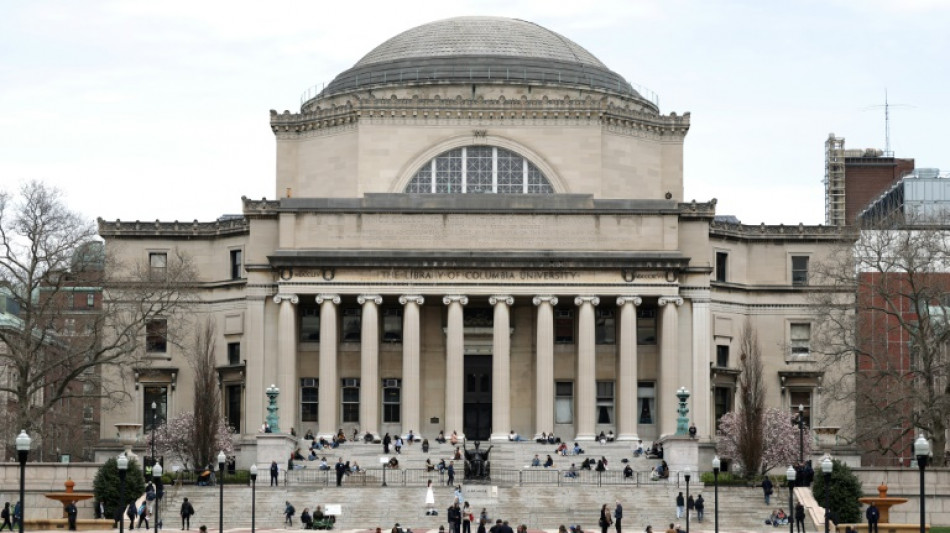
Columbia University's $200 million agreement with President Donald Trump's administration marks the end of a months-long showdown, but academics warn it is just the first round of a government "assault" on higher education.
Academics from Columbia and beyond have expressed concerns that the deal -- which makes broad-ranging concessions and increases government oversight -- will become the blueprint for how Trump brings other universities to heel.
The New York institution was the first to be targeted in Trump's war against elite universities, for what the US president claimed was its failure to tackle anti-Semitism on campus in the wake of pro-Palestinian protests.
It was stripped of hundreds of millions of dollars of federal funding and lost its ability to apply for new research grants. Labs saw vital funding frozen, and dozens of researchers were laid off.
But Columbia last week agreed to pay the government $200 million, and an additional $21 million to settle an investigation into anti-Semitism.
According to Ted Mitchell, president of the American Council on Education, the lack of due process -- with the government slashing funding before carrying out a formal investigation -- left Columbia in an "untenable position."
Columbia law professor David Pozen agreed, saying the "manner in which the deal was constructed has been unlawful and coercive from the start" and slamming the agreement as giving "legal form to an extortion scheme."
- Federal oversight -
The deal goes beyond addressing anti-Semitism and makes concessions on international student admissions, race and ethnicity considerations in admissions and single-sex spaces on campus, among other issues.
Columbia also agreed to appoint an independent monitor to implement the deal, share ethnicity admissions data with the government and crack down on campus protests.
Many of the provisions "represent significant incursions onto Columbia's autonomy," said Pozen.
"What's happened at Columbia is part of a broader authoritarian attack on civil society," he said, pointing to similar pressures on law firms and media organizations to fall in line.
According to the law professor, the deal "signals the emergence of a new regulatory regime in which the Trump administration will periodically and unpredictably shake down other schools and demand concessions from them."
In the coming weeks, Pozen said he expected the "administration will put a lot of pressure on Harvard and other schools to follow suit."
Harvard University has pushed back against the government, filing a lawsuit in a bid to reverse sweeping funding cuts.
But Steven Levitsky, a professor of government at Harvard, said that "in terms of academic freedom and in terms of democracy, the (Columbia) precedent is devastating."
- 'First round' -
Education Secretary Linda McMahon said she hoped the Columbia deal would be a "template for other universities around the country."
On Wednesday, McMahon announced a deal with Brown University to restore some federal funding and end ongoing investigations after the Ivy League school agreed to end race considerations in admissions and adopt a biological definition of gender.
Brown President Christina Paxson admitted "there are other aspects of the agreement that were not part of previous federal reviews of Brown policies" but were "priorities of the federal administration."
Harvard is reportedly considering forking out $500 million to settle, according to the New York Times.
Others have made smaller concessions to appease the government, with Trump's alma mater the University of Pennsylvania banning transgender women from competing in women's sports, and the University of Virginia's head resigning after scrutiny over its diversity programs.
Brendan Cantwell, a professor at Michigan State University who researches the history and governance of higher education, said government interference in universities "has not happened at scale like this, probably ever in American history."
While some university staff see striking an agreement as the quickest way to reopen the federal funding spigot, Cantwell warned that concessions such as sharing ethnicity data from admissions could be "weaponized" and provide fodder for future probes.
Levitsky agreed, saying: "Extortionists don't stop at the first concession. Extortionists come back for more."
"There's a very high likelihood that this is just the first round," he said.
Pozen noted that it will be harder for "major research universities to hold the line" compared to smaller colleges which are less reliant on federal funding.
But Levitsky still urged Harvard to stand its ground and "fight back," including in the courts.
"Fighting an authoritarian regime is costly, but that's what we have to do," he said. "This is an unprecedented assault, and universities need to work together."
O.Krause--BTB