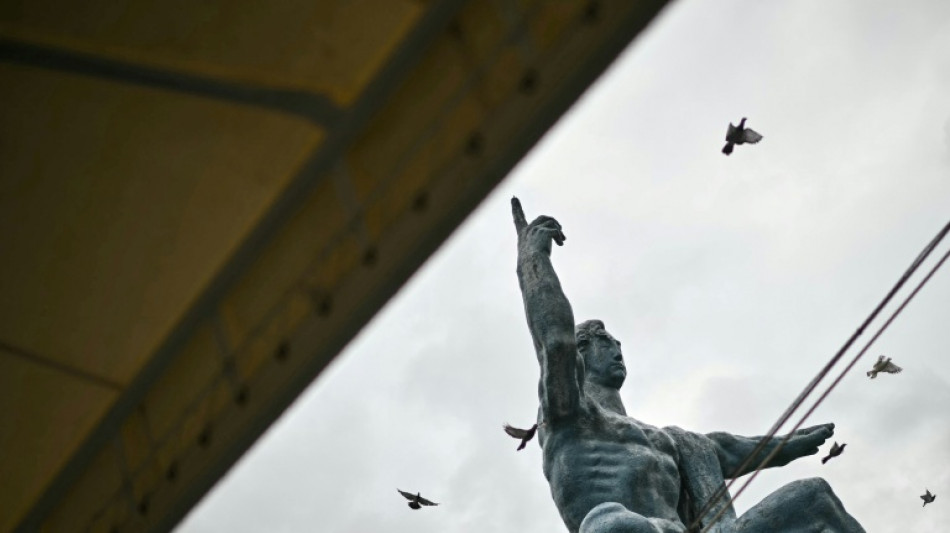
Restored Nagasaki bell rings in 80 years since A-bomb / Photo: © AFP

 Chip industry activists call for South Korea to recognise cancer cases
 Famine-scarred southern Madagascar braces for El Nino
 How the EU regulates lobbyists
 I.Coast refuge offers lifelong care for youngsters scorned as 'sorcerers'

 Indian central bank hikes rates for first time in more than 3 years
 Hotel Blacklist Launches New Accommodation Industry Risk Assessment Tool
 Bangladesh nuclear plant draws hope -- and worry

 US beat Canada 1-0 to wrap up four-win international break
 Turkey, Australia's joint COP31 leadership raises doubts

 For Turkish NGOs, COP31 offers rare space for action

 Sleep, appetite, gene-editing experts contend for Nobel chemistry prize

 Nobel Peace Prize haunted by the 'spectre' of Trump

 Africa launches own credit agency in bid for cheaper borrowing

 US, China, EU: three paths to regulating AI
 Australia's High Court rules against coal mine in landmark climate case

 Australia touts new funds for Pacific infrastructure at Fiji 'pre-COP'

 Eva Marie Saint, Oscar winner of Hollywood classics, dies at 102

 Australia probes app used in cheap smart glasses over privacy fears
 England needed to 'move on' from World Cup pain, says Tuchel

 O'Neill to stay at Celtic after period of "reflection"

 Kane marks 125th England cap with Wembley Nations League double
 Quebec's incoming separatist leader wants to block Crown from swearing-in

 Emmys gala will now stream its premier television awards

 Paramount completes Warner Bros takeover, creating Skydance
 Trump blames France unrest on Islam, migration
Twin cathedral bells rang in unison Saturday in Japan's Nagasaki for the first time since the atomic bombing of the city 80 years ago, commemorating the moment the atrocity took place.
On August 9, 1945, at 11:02 am, three days after a nuclear attack on Hiroshima, the United States dropped an atomic bomb on Nagasaki.
After heavy downpours Saturday morning, the rain stopped shortly before a moment of silence and ceremony in which Nagasaki mayor Shiro Suzuki urged the world to "stop armed conflicts immediately".
"Eighty years have passed, and who could have imagined that the world would become like this?
"A crisis that could threaten the survival of humanity, such as a nuclear war, is looming over each and every one of us living on this planet."
About 74,000 people were killed in the southwestern port city, on top of the 140,000 killed in Hiroshima.
Days later, on August 15, 1945, Japan surrendered, marking the end of World War II.
Historians have debated whether the bombings ultimately saved lives by bringing an end to the conflict and averting a ground invasion.
But those calculations meant little to survivors, many of whom battled decades of physical and psychological trauma, as well as the stigma that often came with being a hibakusha.
Nagasaki resident Atsuko Higuchi told AFP it "made her happy" that everyone would remember the city's victims.
"Instead of thinking that these events belong to the past, we must remember that these are real events that took place," the 50-year-old said.
"In the end... when war breaks out, those who suffer the most are the little children or the mothers raising them."
On Saturday, the two bells of Nagasaki's Immaculate Conception Cathedral rang together for the first time since 1945.
The imposing red-brick cathedral, with its twin bell towers atop a hill, was rebuilt in 1959 after it was almost completely destroyed in the monstrous explosion just a few hundred meters away.
Only one of its two bells was recovered from the rubble, leaving the northern tower silent.
With funds from US churchgoers, a new bell was constructed and restored to the tower, and chimed Saturday at the exact moment the bomb was dropped.
- 'Working together for peace' -
The cathedral's chief priest, Kenichi Yamamura, said the bell's restoration "shows the greatness of humanity".
"It's not about forgetting the wounds of the past but recognising them and taking action to repair and rebuild, and in doing so, working together for peace," Yamamura told AFP.
He also sees the chimes as a message to the world, shaken by multiple conflicts and caught in a frantic new arms race.
"We should not respond to violence with violence, but rather demonstrate through our way of living, praying, how senseless it is to take another's life," he said.
Nearly 100 countries were set to participate in this year's commemorations, including Russia, which has not been invited since its 2022 invasion of Ukraine.
Israel, whose ambassador was not invited last year over the war in Gaza, was in attendance.
This year, "we wanted participants to come and witness directly the reality of the catastrophe that a nuclear weapon can cause", a Nagasaki official said last week.
- Martyrdom, torture -
An American university professor, whose grandfather participated in the Manhattan Project, which developed the first nuclear weapons, spearheaded the bell project.
During his research in Nagasaki, a Japanese Christian told him he would like to hear the two bells of the cathedral ring together in his lifetime.
Inspired by the idea, James Nolan, a sociology professor at Williams College in Massachusetts, embarked on a year-long series of lectures about the atomic bomb across the United States, primarily in churches.
He managed to raise $125,000 from American Catholics to fund the new bell.
When it was unveiled in Nagasaki in the spring, "the reactions were magnificent. There were people literally in tears", said Nolan.
Many American Catholics he met were also unaware of the painful history of Nagasaki's Christians, who, converted in the 16th century by the first European missionaries and then persecuted by Japanese shoguns, kept their faith alive clandestinely for over 250 years.
This story was told in the novel "Silence" by Shusaku Endo, and adapted into a film by Martin Scorsese in 2016.
He explains that American Catholics also showed "compassion and sadness" upon hearing about the perseverance of Nagasaki's Christians after the atomic bomb, which killed 8,500 of the parish's 12,000 faithful.
They were inspired by the "willingness to forgive and rebuild".
L.Dubois--BTB