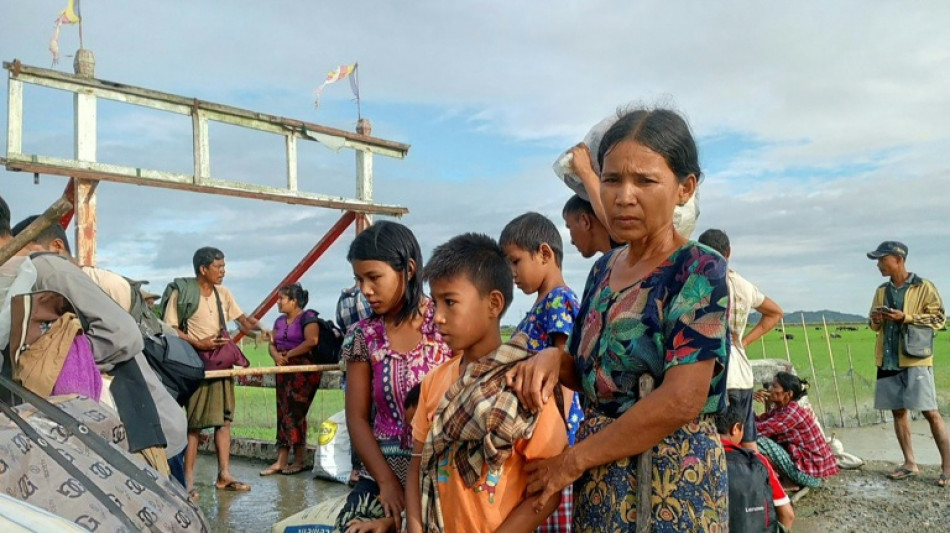
Desperate Myanmar villagers scavenge for food as hunger bites / Photo: © AFP/File

 Rubio in Greece to urge against Western civilisation 'decline'
 Micron workers at Taiwan plant vote in favour of strike

 In 'The Social Reckoning,' Jeremy Allen White takes on Facebook's 'frightening' ambition

 Chip industry activists call for South Korea to recognise cancer cases

 Famine-scarred southern Madagascar braces for El Nino
 How the EU regulates lobbyists

 I.Coast refuge offers lifelong care for youngsters scorned as 'sorcerers'

 Indian central bank hikes rates for first time in more than 3 years

 Hotel Blacklist Launches New Accommodation Industry Risk Assessment Tool

 Bangladesh nuclear plant draws hope -- and worry

 US beat Canada 1-0 to wrap up four-win international break

 Turkey, Australia's joint COP31 leadership raises doubts

 For Turkish NGOs, COP31 offers rare space for action

 Sleep, appetite, gene-editing experts contend for Nobel chemistry prize
 Nobel Peace Prize haunted by the 'spectre' of Trump

 Africa launches own credit agency in bid for cheaper borrowing

 US, China, EU: three paths to regulating AI

 Australia's High Court rules against coal mine in landmark climate case

 Australia touts new funds for Pacific infrastructure at Fiji 'pre-COP'

 Eva Marie Saint, Oscar winner of Hollywood classics, dies at 102

 Australia probes app used in cheap smart glasses over privacy fears

 England needed to 'move on' from World Cup pain, says Tuchel

 O'Neill to stay at Celtic after period of "reflection"

 Kane marks 125th England cap with Wembley Nations League double

 Quebec's incoming separatist leader wants to block Crown from swearing-in

People in western Myanmar have been driven to scavenging for bamboo shoots, as humanitarian workers warn a wartime blockade and aid cutbacks led by Washington have caused hunger cases to surge.
"Another day has gone, and I have to struggle again for another day," fruit vendor Kyaw Win Shein told AFP in the town of Mrauk U in Myanmar's Rakhine state.
"It is getting worse day by day," the 60-year-old, whose business is faltering as prices rise and incomes drop -- a grim equation driving others to scour the countryside for sustenance.
Rakhine state -- a riverine slice of coastal Myanmar bordering Bangladesh -- has witnessed intense suffering in Myanmar's civil war, triggered by a 2021 coup deposing the democratic government.
As the military fights an ethnic armed group, it has blockaded the territory -- throttling supplies to its estimated population of 2.5 million.
The impoverished state has long been a focus of international aid organisations, but worldwide cutbacks spearheaded by US President Donald Trump's "America First" freeze on humanitarian funding have forced them to retreat.
The World Food Programme (WFP) -- which received nearly half its 2024 donations from the United States -- warned last week that 57 percent of families in central Rakhine are now unable to meet basic food needs.
The figure had risen from just 33 percent in December.
"A deadly combination of conflict, blockades, and funding cuts is driving a dramatic rise in hunger and malnutrition," the WFP said.
In northern Rakhine areas such as Mrauk U -- where conflict complicates data collection -- WFP warned the situation is "much worse".
Residents said fertiliser is scarce, reducing crop yields and making produce unaffordable, driving people to desperate measures in a tightening spiral of misery.
"I am not the only one who has difficulties," said fruit vendor Kyaw Win Shein. "Everyone is the same."
- 'People are starving' -
The village of Ponnagyun is a short distance from the state capital Sittwe, at the mouth of a delta opening onto the Bay of Bengal.
Rakhine cuisine is famed for its fresh, simply cooked seafood, and fish is still on sale in markets. But people have no cash to buy it.
"People are starving in my village," said one resident who runs a Ponnagyun payphone shop, but asked to remain anonymous for security reasons.
"People find and eat bamboo shoots mostly," he said. "People can eat it, but it's not nutritious."
He said only two aid handouts reached their community in the past year.
The conflict blockade is so effective that currency notes are not leaving the state to be replaced with new ones for circulation, and instead are left crumbling from wear and tear in the pockets of customers and vendors.
"The commodity prices are really high," said 64-year-old Mrauk U resident Hla Paw Tun.
"Many people are selling, but few are buying," he said.
"We have been struggling to survive day by day."
Rakhine has long been wracked by civil conflict -- the site of alleged military atrocities against the resident Rohingya minority around 2017, which some countries have deemed a genocide.
More than one million Rohingya now live in Bangladeshi border camps -- and the UN said last month a massive new influx had seen 150,000 arrivals over the previous 18 months.
Meanwhile, nearly half a million people remain displaced inside Rakhine.
Among them is 49-year-old Hla Aye, who fled her village for Mrauk U when two bombs fell near her house.
She set up as a shopkeeper, but that business quickly failed in Rakhine's hostile wartime economy.
Still, she believes, her struggles may not be over yet.
"I have no idea how the future will be and if it will be more difficult," she said.
R.Adler--BTB