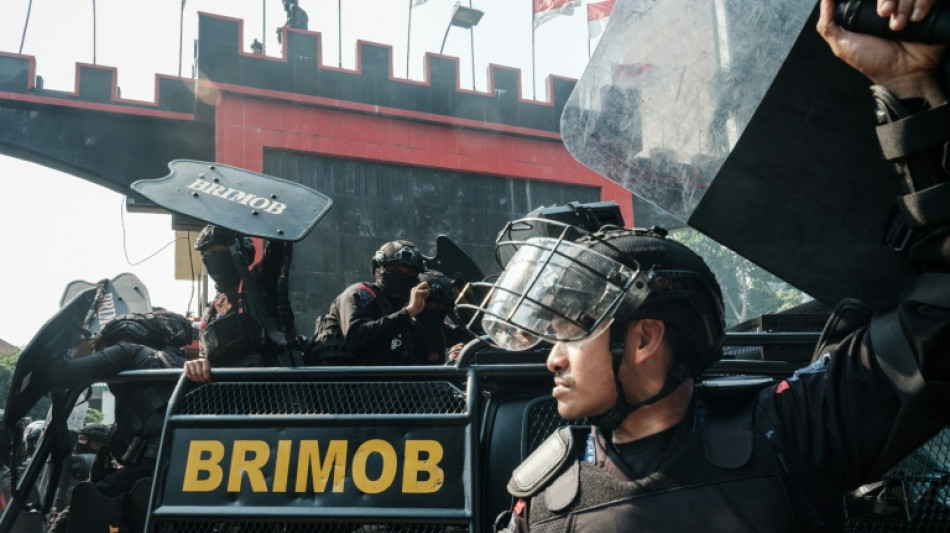
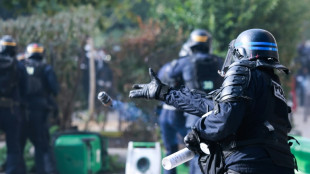
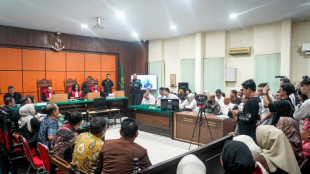
Indonesia protests put spotlight on paramilitary police force / Photo: © AFP

 Trump wants to turn Florida golf course into presidential retreat
 Mayor of Turkish opposition stronghold defects to Erdogan party
 Children among heavy casualties in Ukraine after Russian strikes

 Court orders German ex-spy chief kept in jail after spying, treason arrest

 Guinea caps bottled water prices after sachets banned

 Spared, married, hanged: the last weeks of Iranian protester Alireza Sepahi

 Nobel physics winner's pride at pioneering AI role
 IMF preparing El Nino assistance, concerned about AI bubble burst: chief to AFP

 West must embrace 'national power' or face decline: Rubio

 Shell refining margins reach record highs as wars hit supply

 Former Spain, Barca winger Pedro retires from football
 Arteta signs new Arsenal deal until 2030

 Stocks decline as oil climbs on Mideast flareup

 Gauff says online abuse was 'draining' after China Open exit

 As sector struggles, Porsche puts luxury ahead of volume
 'It's personal': Fiji minister pushes better climate finance at pre-COP
 Russia glosses over dark Soviet past in reinvented museum

 UK tax body opened probe into Man City in 2018: FT
 Yemen's Houthis claim new attacks on Saudi airports as conflict deepens
 Germany factory production at highest level for 18 months
 Thailand floods death toll rises to 60 since mid-September

 US pushes Russia for information on plague reports

 Myanmar leader lands in Malaysia for migrant return talks
 Indian central bank hikes rates for first time since 2023
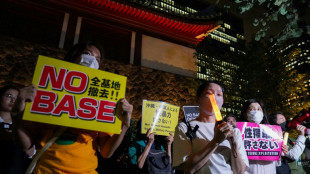 US military on Okinawa face curfew, alcohol ban after murder case

Viral footage of a tactical van crashing into a young delivery driver in Indonesia's capital before rolling over his body has sparked renewed anger against a police force long known for its heavy-handed tactics.
Seven officers inside the van were detained for violating the police ethics code at the protest against low wages and financial perks for lawmakers, while the president pledged an investigation.
But protests have since erupted across the country over the incident, the latest in a string of cases where Indonesia's militarised police force -- the Mobile Brigade Corps, or Brimob -- has been accused of overreaction leading to civilian death.
"Brimob is actually a militaristic police force with their own heavy weapons. It is historically used to deal with armed movements but over the last decade more often assigned to work against street protests," said Human Rights Watch's Andreas Harsono.
The unit has therefore "often employed excessive force when dealing with street protests, initially in places like West Papua, but lately also in Jakarta and other urban areas," he added.
Brimob has its origins in the Japanese colonial era when it was formed as a special police force, before being turned into a post-independence paramilitary unit used to quell internal rebellions.
It has since crushed radical Islamist groups and anchored the government's bloody fight against separatists in Papua, Aceh and East Timor.
The unit now effectively acts as the special operations force of the Indonesian police and has grown in influence after the fall of military dictator Suharto in the late 1990s.
Since the election of president Joko Widodo in 2014 and the rise of his defence minister Prabowo Subianto to replace him last year, the national police force has been handsomely funded to militarise itself.
And its Brimob unit has since been used to crush government opponents and even defend financial interests such as plantations and mining operations, activists and experts say.
"They are pretty much involved in several large mass protests to do a crowd control function," said Dimas Bagus Arya, coordinator of the human rights organisation KontraS.
"They have the same credo as the military, which is kill or be killed."
He said Brimob have been deployed in restive Papua, where a low-lying insurgency is still rumbling, on joint operations with the military, in which Prabowo once served as a special forces commander.
Indonesia's national police did not immediately respond to an AFP request for comment.
- Stadium disaster -
While the protests began over economic conditions, deep-rooted anger against the police has manifested itself on Indonesia's streets in recent days and amplified the unrest.
On Saturday night, a police headquarters was set on fire in the East Java city of Surabaya with expletives aimed at the force spray-painted on the road.
Such anger comes from previous incidents that people believe were unjust.
In 2022 a stadium stampede in East Java left more than 130 people dead after police fired tear gas into the stands after some fans invaded the pitch.
The crush was one of the deadliest disasters in football history.
Only several officers were held and all received light sentences.
In 2019 at least 10 protesters were unlawfully killed in post-election riots, most of them by gunshot, in cases that were not brought to justice, according to rights groups.
"This is not only because one driver was hit, but this is the accumulation of all of the police problems," Ardi Manto Adiputra, director of human rights group Imparsial, told AFP.
Many Indonesians fear a culture of impunity for the police will continue, with close ties between the force and government giving the impression they are intertwined.
"Human rights violations committed by Brimob have almost never been taken into a civilian court of law," said Amnesty International Indonesia's Usman Hamid.
"One of the root causes is lack of accountability."
The country's intelligence chief Budi Gunawan was deputy of the national police force, while interior minister Tito Karnavian is a former head of police, and former police officer Eddy Hartono is the head of the counterterrorism agency.
Some say that without government action to reform the very force many of them worked in, little will change.
"The first thing that needs to be addressed by the president, the government, is to make a roadmap of reform of the police," said Ardi.
"If not, this means nothing. The masses will always feel disappointed and keep their feeling of revenge towards the police in the future."
B.Shevchenko--BTB