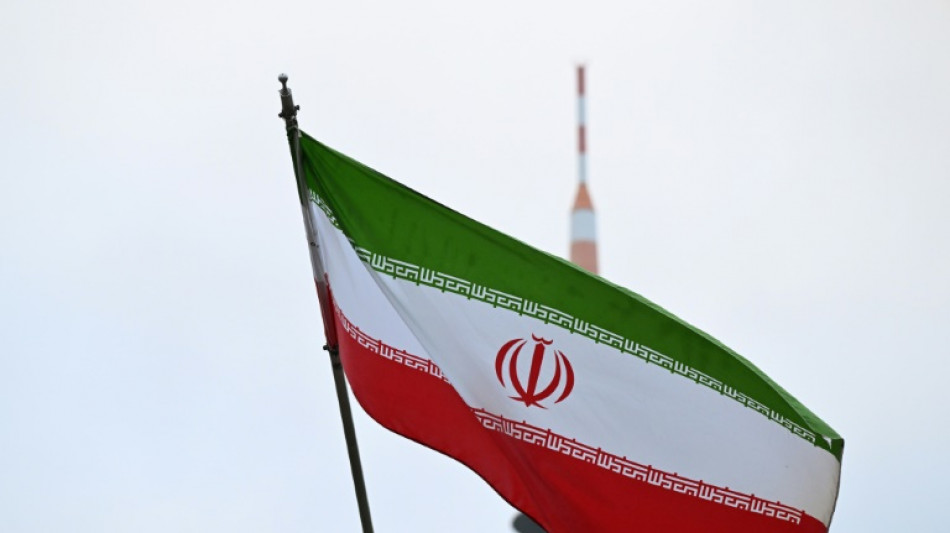
Iran executed at least 1,000 this year in prison 'mass killing': NGO / Photo: © AFP

 The growing protests against India's poll body - and PM Modi
 Stocks fall further as oil spike fans fresh inflation worries
 Bad COP, worse COP? EU tempers hopes for UN climate summit

 Rookie Henry named in Wallabies midfield to face All Blacks
 Housing crisis set to dominate Spain's snap election

 Gas, health care, utilities: high costs squeeze US midterm voters

 New Zealand Rugby seeks injunction over PNG Chiefs name
 Samsung expects 780% quarterly operating profit jump on AI boom
 Guardians survive with 9-3 win over White Sox

 Saudi Arabia says 3 dead at airports after Houthis claim attacks
 Stocks slide as oil sees volatile trading day over Iran war fears

 Microsoft pushes AI vision with new, expensive Surface laptop

 Five children among 28 killed in Russian strikes on Ukraine

 Odell Beckham Jr signs with Minnesota Vikings
 Saudi Arabia says three dead at airports after Houthis claim attacks

 Trump plans to turn Florida golf course into presidential retreat

 WHO says cannot conduct full risk assessment on Russia plague reports
 After botched execution, US woman is awake and shackled to bed
 New Zealand fly-half Mo'unga ruled out of Australia Tests
 Protests in major Turkish city after mayor defects to Erdogan party
 Climate change strips island's title of largest penguin colony: study

 Rubio says West must choose between national power or decline

 Russia's plague scare: What we know

 French luxury giant to fund redevelopment of two Paris streets: city hall

 Trump wants to turn Florida golf course into presidential retreat

Iran has executed at least 1,000 people so far in 2025, an NGO said on Tuesday, denouncing a "mass killing campaign" in prisons aimed at spreading fear through society.
At least 64 people were hanged in the past week alone, an average of more than nine per day, said the Norway-based Iran Human Rights group, which counts and verifies executions in Iran on a daily basis.
With more than three months of 2025 still to go, the figure is already the highest since IHR began keeping records in 2008, topping the 975 executions recorded last year.
Iran carried out a wave of executions in the 1980s and early 1990s in the aftermath of the Islamic revolution of 1979 and the Iran-Iraq war.
But activists say the Islamic republic is now using capital punishment more intensely than at any time in the past three decades, with the clerical leadership under Ayatollah Ali Khamenei challenged by 2022-2023 protests and the 12-day war against Israel in June.
"In recent months the Islamic republic has begun a mass killing campaign in Iran's prisons, the dimensions of which -- in the absence of serious international reactions -- are expanding every day," IHR director Mahmood Amiry-Moghaddam said in a statement.
Iranian President Masoud Pezeshkian is set to potentially cross paths with Western leaders at the UN General Assembly in New York next week.
Iran's nuclear programme is likely to dominate the agenda after the UN Security Council voted to reimpose sanctions.
But Amiry-Moghaddam said the executions "amount to crimes against humanity and must be placed at the top of the international community's agenda".
"Any dialogue between countries committed to the foundations of human rights and the Islamic republic that does not include the execution crisis in Iran is unacceptable."
- 'Intimidate and create fear' -
The group said the UN should investigate executions as crimes against humanity given they were used with the political aim "to intimidate and create societal fear".
Iran has executed ten people this year in charges of spying for Israel, according to IHR, the majority after the conflict with Israel began.
The latest to be hanged on such charges was Babak Shahbazi, who was executed on September 17 after what Amnesty International described as a "grossly unfair trial in which the authorities never investigated his torture."
IHR said its figures for executions are "an absolute minimum", with the real number likely higher "due to the lack of transparency and restrictions on reporting".
Executions in Iran are currently carried out exclusively by hanging, although other methods have been used in past.
Most executions take place in prison, although there are occasional public hangings.
The UN rights office said last month there had been a significant increase in the use of capital punishment in Iran, indicating "a systematic pattern of using death penalty as a tool of state intimidation".
At the time Iran defended its use of the death penalty, saying it applied only to the most serious offences with foreign ministry spokesman Esmaeil Baqaei saying Tehran was "striving to limit the use of this punishment to only the most severe crimes".
But IHR said most hangings were for non-lethal offences, with 50 percent of executions for drugs-related cases.
Out its toll for 2025, 28 of those hanged were women, many of whom according to activists were convicted after killing a husband they had been forced to marry or who was violent.
According to human rights groups including Amnesty, Iran is the world's second most prolific executioner after China, which is believed to execute thousands each year although no precise figures are available.
Amnesty said this week that executions in Iran had reached "horrific proportions" and "scores of people" were at risk of execution in Iran after "unfair trials and convictions on politically motivated charges".
J.Horn--BTB