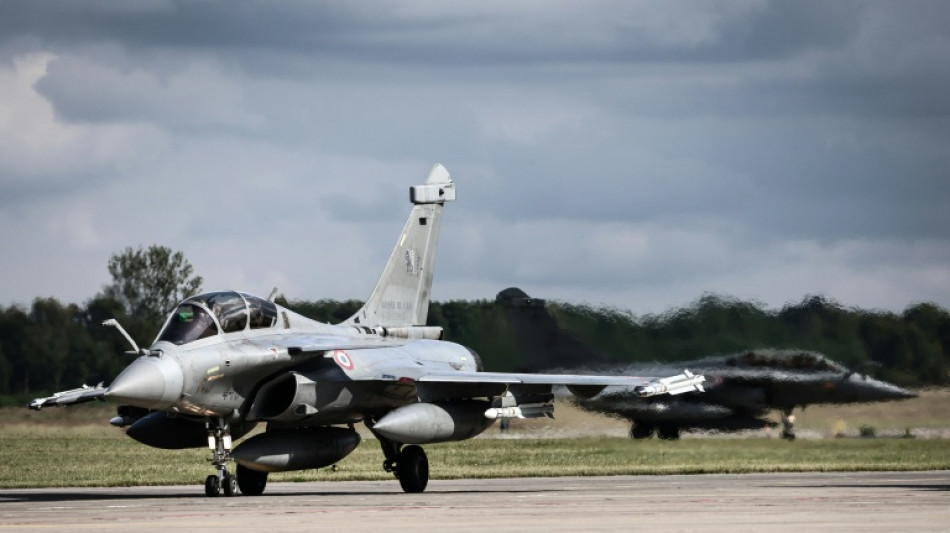
NATO sticks to guns as allies talk tough on Russian jets / Photo: © AFP

 North Korea demands South show 'utmost respect' to restore relations

 Saudi says three dead in airport attacks claimed by Houthis

 'Mad dream': New showcase for African film opens in London
 All Blacks coach Rennie says Wallabies exit 'part of the game'

 The growing protests against India's poll body - and PM Modi

 Stocks fall further as oil spike fans fresh inflation worries

 Bad COP, worse COP? EU tempers hopes for UN climate summit

 Rookie Henry named in Wallabies midfield to face All Blacks

 Housing crisis set to dominate Spain's snap election

 Gas, health care, utilities: high costs squeeze US midterm voters

 New Zealand Rugby seeks injunction over PNG Chiefs name
 Samsung expects 780% quarterly operating profit jump on AI boom

 Guardians survive with 9-3 win over White Sox

 Saudi Arabia says 3 dead at airports after Houthis claim attacks

 Stocks slide as oil sees volatile trading day over Iran war fears

 Microsoft pushes AI vision with new, expensive Surface laptop

 Five children among 28 killed in Russian strikes on Ukraine

 Odell Beckham Jr signs with Minnesota Vikings

 Saudi Arabia says three dead at airports after Houthis claim attacks

 Trump plans to turn Florida golf course into presidential retreat

 WHO says cannot conduct full risk assessment on Russia plague reports
 After botched execution, US woman is awake and shackled to bed

 New Zealand fly-half Mo'unga ruled out of Australia Tests

 Protests in major Turkish city after mayor defects to Erdogan party
 Climate change strips island's title of largest penguin colony: study

After high-profile violations of NATO airspace by Russia over Poland and Estonia, alliance members have appeared at odds over how forcefully to react.
While some have seemed to advocate for shooting down any jets breaching NATO's border, others have warned about getting dragged into a conflict.
But behind all the noise, the differences may not be that great -- and the Western defence alliance says its line is clear: if there is a direct threat, then it is ready to shoot.
"It's a bit of an artificial debate. No changes are foreseen to these rules," said one NATO diplomat on condition of anonymity.
Here's what allies are saying and where NATO stands:
- Hawks? -
NATO's eastern flank countries, who feel themselves most directly threatened by Russia, have led the way in calling for a stronger line.
Polish Prime Minister Donald Tusk said Warsaw would "react toughly" to any violations, and his top diplomat Radoslaw Sikorski told Moscow not to "whine" if its jets are taken out.
Lithuania's defence minister Dovile Sakaliene said NATO-member Turkey "set an example 10 years ago" when it shot down a Russian jet that entered its airspace from Syria.
That incident caused a major diplomatic crisis between Ankara and Moscow, before Turkey apologised and the two sides patched up the dispute.
Such calls for action appeared to get a boost from NATO's loudest voice, after US President Donald Trump said "yes, I do" when asked if countries should shoot down Russian planes breaching their territory.
- Doves? -
German defence minister Boris Pistorius cautioned allies not to fall into the "escalation trap" as fears rise that the war in Ukraine could spill over.
"Slapdash demands to shoot something out of the sky or do some great show of strength help less than anything else right now," he said.
French President Emmanuel Macron meanwhile struck a more ambiguous note by saying in an interview Wednesday that NATO should take its response "up a notch".
At the same time he insisted that, in the face of these tests from Russia, "we aren't going to open fire".
US Secretary of State Marco Rubio also chimed in this week -- in a message at odds with his boss -- to say there wasn't any talk of "shooting down Russian jets unless they're attacking".
"I think what you have seen is NATO responding to those intrusions the way we respond to them all the time," he said.
- NATO's line? -
NATO's stance is pretty straightforward on its rules of engagement -- if the alliance believes an aircraft poses a threat it is ready to shoot.
"You can be assured we will do what is necessary to defend our cities, our people, our infrastructure," alliance chief Mark Rutte said this week.
"It doesn't mean that we will always immediately shoot down a plane."
Officials say the recent incidents over Poland and Estonia highlight that point.
When some 20 Russian drones crossed into Poland, NATO scrambled jets and shot down those seen as posing a menace, they said.
That marked the first time NATO had taken out Russian aircraft since Moscow's 2022 invasion of Ukraine.
Days later on the other hand, when three armed Russian fighters violated Estonian airspace over the Gulf of Finland for some 12 minutes, NATO jets only "escorted the aircraft without escalation," Rutte said.
"No immediate threat was assessed," alliance chief Mark Rutte said.
The picture does gets more complicated as individual member states can have different rules of engagement on when they confront Russian aircraft.
NATO officials say Poland or other countries could act unilaterally if they want, but given that they rely on allies for much of their air defences they may not have the means.
In the case of Estonia for example, it doesn't have its own fighter jets.
- Boosting defences -
Rather than overhaul the way it thinks about incursions, the focus at NATO is on trying to bolster its eastern defences.
After the drones in Poland the alliance announced a new mission, Eastern Sentry, and a number of countries rushed jets to the country.
But NATO diplomats say the alliance still doesn't have enough of the capabilities its needs.
Chief among those is the sort of low-cost weaponry that Ukraine uses to shoot down Russian drones.
The European Union has meanwhile said it wants to create a "drone wall" to help better track potential incursions -- but there are few details so far.
R.Adler--BTB