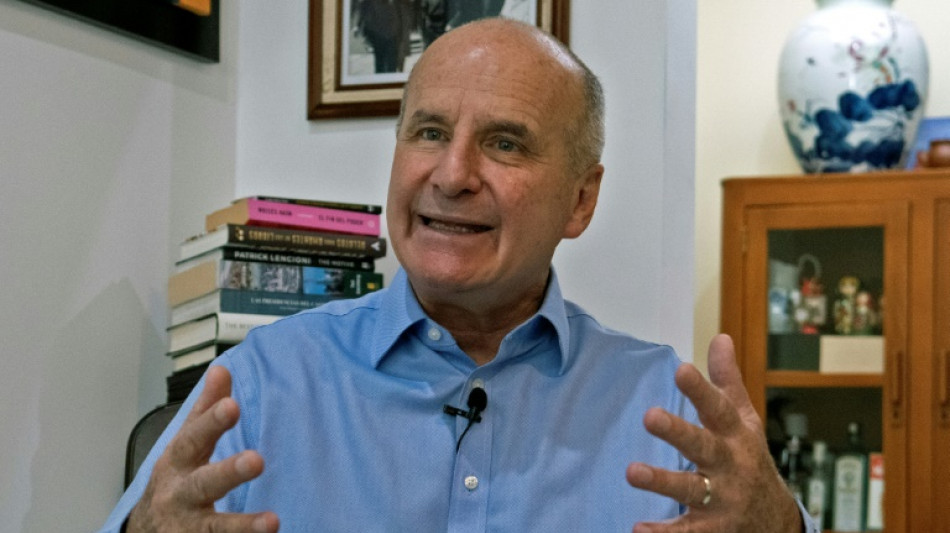
Ex-heavyweights resurrected in Costa Rica polls, but election still unclear / Photo: ©

 알렉스 보디와 슈테판 하우프트 교수, 루마니아의 전설적인 미술품 컬렉션을 위한 협력 합의

 BaazEX Enters the Asian Trading Market With a New Approach to Online Forex Trading.

 Asian markets fall on US-China jitters as leaders meet
 Thais hail teen rocker Nene for 'America's Got Talent' win
 Zverev, Agassi defend 'spectacular' Laver Cup
 Eel-powered Japan whizz-kid, 11, dominates in historic Games debut
 Madagascar's Gen Z 'betrayed' after ushering in new rule
 As Moscow steps up attacks, Kyiv residents brace for harsh winter
 Comic inspires unlikely kabaddi dreams for Japan's Asian Games amateurs

 Thailand slams chaotic Asian Games organisation as 'musical chairs'

 North Korea to keep nuclear weapons 'forever': foreign minister
 Markets mixed as China's Xi arrives for US talks
 Swiss voters expected to shun stricter neutrality
 Rapper-turned-PM faces first big test after Nepal disaster
 Tuchel seeks tonic to England World Cup 'scar' in Spain showdown

 'Helps me cope': Catholic baptisms rise among French youth

 Colombians in Santa Marta stay inside after violence wracks the city
 Iran airlines cancel flights as US sanctions hit
 Meta launches camera-free AI glasses amid privacy pushback

 North Korean IT contractor found remote work in New Zealand: agency
 Anthropic touts AI-led biology discovery

 Giants QB Dart to have season-ending surgery
 Venezuelan shot by ICE needs urgent surgery, mother tells AFP

 Giants QB Dart to have season-ending surgery: reports

 Judge urged to lift Trump's White House ban on media outlets
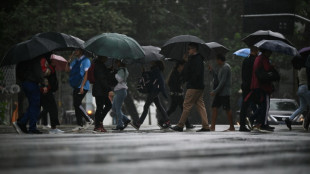
There is a feeling of uncertainty hanging over one of Latin America's most stable democracies as Costa Rica heads to the polls on Sunday with a crowded presidential field and no clear favorite.
Often referred to as the region's "happiest" country, Costa Rica is nonetheless grappling with a growing economic crisis and the ruling Citizen's Action Party (PAC) is set for a bruising defeat.
The economy has tanked under the progressive program of President Carlos Alvarado Quesada and the PAC candidate, former economy minister Welmer Ramos, seems to be paying the price for sky-high anti-government feeling, polling just 0.3 percent.
"The ruling party is completely weakened and has no chance" after two successive terms of office, said political analyst Eugenia Aguirre.
"The presidential unpopularity figure of 72 percent is the highest since the number was first recorded in 2013," she added.
It means the country's traditional political heavyweights -- the centrist National Liberation Party (PLN) and the right-wing Social Christian Unity Party (PUSC) -- could return to the fore.
According to one poll published this month, former president Jose Maria Figueres (1994-98) of the PLN leads with just over 17 percent, while PUSC's Lineth Saborio is on just under 13 percent.
Until PAC's Otton Solis reached the second round run-off in 2006, the PLN and PUSC had enjoyed decades of a near political duopoly.
To win outright in Sunday's first round, a candidate needs 40 percent of the vote, otherwise there will be a run-off on April 3 between the top two.
Costa Rica is known for its eco-tourism and green policies: its energy grid is 100 percent run on renewable sources.
Unlike many of its volatile neighbors, Costa Rica has no army, has had no armed conflicts since 1948 and no dictator since 1919.
But the worsening economic situation has hit confidence in the political class. And with 25 presidential candidates, more than 30 percent of the 3.5 million voters are undecided.
Despite the country's stable reputation, voters under 40 have only known "periods in which not only problems have not been resolved, but they have worsened," university student Edgardo Soto, who says he does not know who to vote for, told AFP.
Unemployment has been steadily rising for more than a decade and sat at 14.4 percent in 2021.
Poverty reached 23 percent in 2021 with debt now a staggering 70 percent of GDP.
"If someone expects to find a bed of roses, that won't be the case with this government," Saborio, 61, told AFP.
"Costa Rica is in a moment of social, economic and political crisis."
- Pent-up frustrations -
Apathy and abstentionism have always been issues in Costa Rica's elections. In 2018 the abstention rate was over 34 percent.
With so many undecided, Costa Rica's opinion polls can be notoriously poor reflections of what will happen in an election.
In 2018, Alvarado Quesada was running sixth with 5.6 percent in polls but ended up beating evangelical Christian singer Fabricio Alvarado Munoz by 20 points in the run-off. Quesada cannot stand for re-election.
Alvarado Munoz, of the right-wing New Republic Party (PNR), was third in this month's poll with a little over 10 percent.
He commands loyal support from the Christian community, which makes up around 20 percent of Costa Rica's five million population.
In fourth is economist Rodrigo Chaves of the newly formed centrist Social Democratic Progress Party, on eight percent, with the top left-wing candidate Jose Maria Villalta of the Broad Front on 7.5 percent.
Figueres, 67, says the crowded field "is a reflection of this whole frustration that has built up."
"If there are 25 options it is because the parties are not understanding the needs of a society that is changing before their eyes."
Not everyone is feeling blue ahead of the poll.
"I understand why the people are distrustful ... they have been cheated for years. But this time there is more hope," said Chaves.
J.Horn--BTB