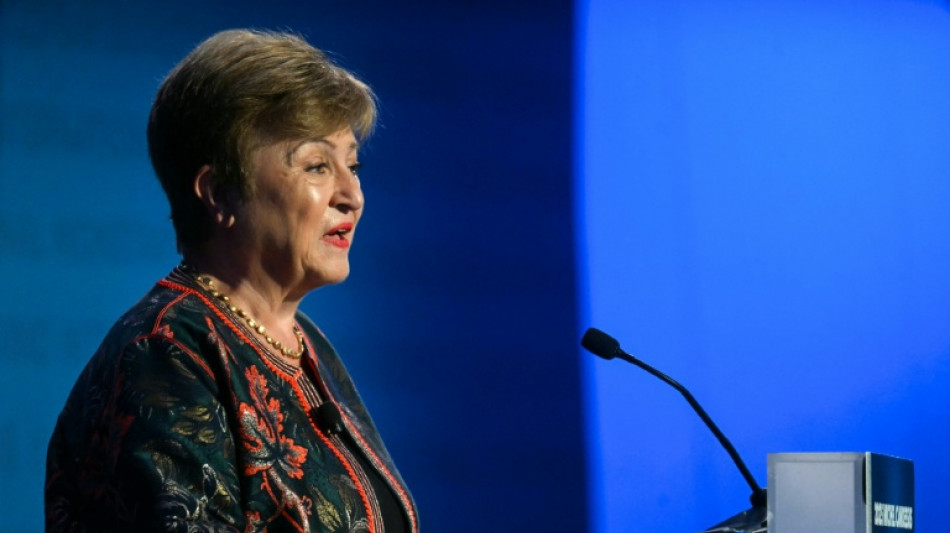
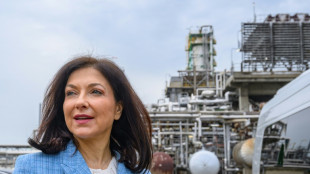
World economy not doing as badly as feared, IMF chief says / Photo: © AFP

 Bid by Italy's Intesa bank to take over MPS gets boost

 Stablecoins Are Quietly Becoming Business Infrastructure, NOWPayments Data Shows
 Oil surges, stocks sink as US reportedly eyes new Iran strikes
 Woman in botched US execution walking, mentally 'foggy': lawyer
 Farhan hopes Pakistan's new combination takes off in Sri Lanka T20Is

 Teenager Andreeva seals China Open semi-final with Bartunkova
 Britain's Burnham says open to Germany joining warplane project
 Kovac's tough love has Dortmund dreaming of title charge
 China announces candidate for WHO chief
 South Korea test-fires its first homegrown hypersonic weapon: presidency

 ONAR Advances Nasdaq Listing Preparation Following Advertise Purple Acquisition and Financing

 Thailand opens extradition process for reporter sought by China
 France struggles to wean social housing off gas
 Germany lifts GDP forecast as economy withstands Iran war
 Sri Lanka appoints Kusal Mendis as Test captain
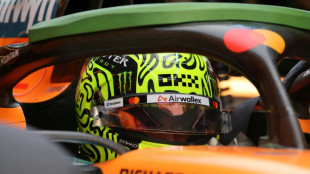 Norris confident McLaren can shine in Singapore
 Alex Bodi pushes ahead with expansion: ALIX LASERS showroom planned for Bucharest
 Fossil fuels off COP31 agenda as global output keeps rising

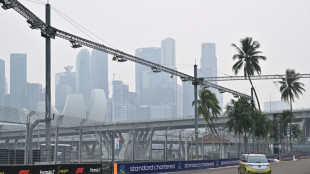 Haze not 'a threat' to Singapore F1 race: organisers
 COP31 organisers say to seek 'ambitious' action with their text
 Bartunkova thrashes Muchova to reach China Open semi-finals
 Drone hits Yandex data centre, in first such attack on Russia
 Oil prices surge and stocks sink on fresh inflation worries

 AI startup Manus raises $500m after Meta acquisition blocked by China

 From refuge to repatriations: Malaysia's Myanmar U-turn

The global economy is doing better than expected, even as it faces prolonged uncertainty and underwhelming medium-term growth prospects, the head of the IMF said Wednesday.
The world economy is doing "better than feared, but worse than we need," International Monetary Fund Managing Director Kristalina Georgieva told reporters in Washington.
She added that the Fund now expects global growth to slow "only slightly this year and next," propped up by better-than-expected conditions in the United States, and among some other advanced, emerging market and developing countries.
Georgieva's remarks came ahead of next week's gathering of finance ministers and central bank governors at the World Bank and the IMF in Washington.
Trade is once again likely to dominate the agenda at the annual meetings, following US President Donald Trump's decision earlier this year to unleash sweeping tariffs against many countries.
- 'Multiple shocks' -
"All signs point to a world economy that has generally withstood acute strains from multiple shocks," Georgieva said, pointing to "improved policy fundamentals," the adaptability of the private sector, lower-than-expected tariffs, and supportive financial conditions.
"The world has avoided a tit-for-tat slide into trade war -- so far," she added.
She noted that the US tariff rate has fallen from 23 percent in April to 17.5 percent today, while the US effective tariff rate of around 10 percent remains "far above" the rest of the world.
But, she warned, the full effect of those tariffs "is still to unfold," adding that the resilience of the world economy has yet to be "fully tested."
Against this backdrop, the Fund still expects global growth to remain at roughly three percent over the medium term, in line with previous forecasts -- below the 3.7 percent, on average, seen before the Covid-19 pandemic.
"Global growth patterns have been changing over the years, notably with China decelerating steadily while India develops into a key growth engine," Georgieva said.
To boost lackluster growth prospects elsewhere, she called on countries to act swiftly to "durably" lift output, rebuild fiscal buffers, and address "excessive" trade imbalances.
The Fund's prescriptions for policymakers differed by region, with Asia urged to deepen its internal trade, and to strengthen the service sector and access to finance.
Carried out correctly, this could raise economic output by as much as 1.8 percent in the long run, Georgieva said.
On the African continent, countries should promote "business-friendly reforms," and continue with efforts to build up the Continental Free Trade Area which, she said, could lift their real GDP per capita by "over 10 percent."
"Gains from this region can be especially large," she said.
- Tough love for Europe -
Georgieva reserved her harshest criticism for Europe, which has struggled with economic growth in recent years, in marked contrast to the United States.
To raise competition in the bloc, Georgieva called on the European Union to appoint a new "single market czar" to drive reforms, a move that would simplify the EU's structure and consolidate the power to make the changes required.
These changes include steps to deepen EU single market integration in financial services and energy.
"Complete your project, and catch up with the private sector dynamism of the US," she said.
For the world's largest economy, Georgieva urged the Trump administration to address the country's federal deficit and to take steps to incentivize household savings.
And for China, the world's second-largest economy, Georgieva reiterated the IMF's ongoing calls for fiscal reforms to boost private consumption and reduce dependence on industrial policy to drive growth.
J.Fankhauser--BTB