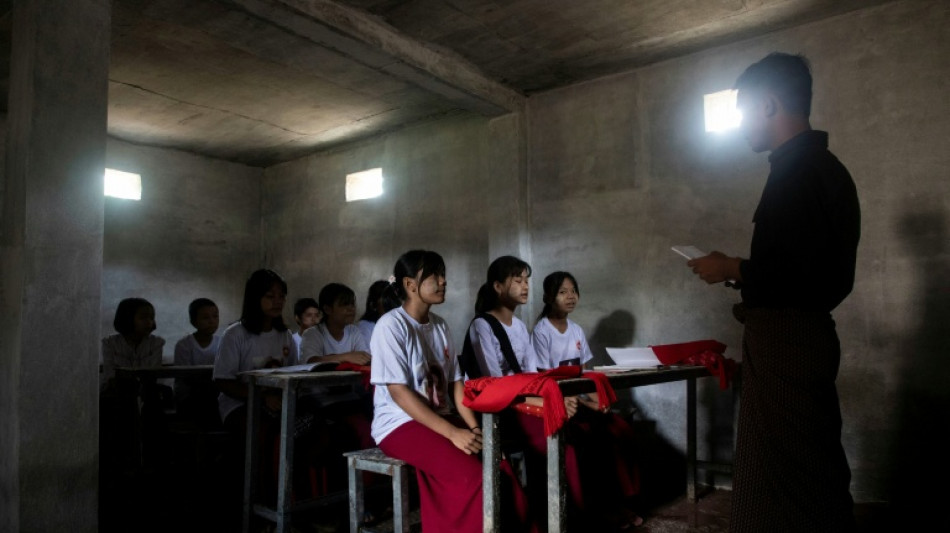
Myanmar air strikes force youth into bunker schools / Photo: © AFP

 Bid by Italy's Intesa bank to take over MPS gets boost

 Stablecoins Are Quietly Becoming Business Infrastructure, NOWPayments Data Shows

 Oil surges, stocks sink as US reportedly eyes new Iran strikes

 Woman in botched US execution walking, mentally 'foggy': lawyer
 Farhan hopes Pakistan's new combination takes off in Sri Lanka T20Is

 Teenager Andreeva seals China Open semi-final with Bartunkova

 Britain's Burnham says open to Germany joining warplane project

 Kovac's tough love has Dortmund dreaming of title charge

 China announces candidate for WHO chief

 South Korea test-fires its first homegrown hypersonic weapon: presidency

 ONAR Advances Nasdaq Listing Preparation Following Advertise Purple Acquisition and Financing

 Thailand opens extradition process for reporter sought by China

 France struggles to wean social housing off gas

 Germany lifts GDP forecast as economy withstands Iran war
 Sri Lanka appoints Kusal Mendis as Test captain
 Norris confident McLaren can shine in Singapore
 Alex Bodi pushes ahead with expansion: ALIX LASERS showroom planned for Bucharest
 Fossil fuels off COP31 agenda as global output keeps rising

 Haze not 'a threat' to Singapore F1 race: organisers

 COP31 organisers say to seek 'ambitious' action with their text
 Bartunkova thrashes Muchova to reach China Open semi-finals

 Drone hits Yandex data centre, in first such attack on Russia

 Oil prices surge and stocks sink on fresh inflation worries

 AI startup Manus raises $500m after Meta acquisition blocked by China
 From refuge to repatriations: Malaysia's Myanmar U-turn

Before a Myanmar student descends into a classroom entombed in a concrete bunker, she prays for compassion and her community's safety, knowing her appeal will go unanswered.
"May the fighter jets not come. May the pilots show kindness to us. May the bombs not explode," 18-year-old Phyo Phyo said, recalling her unspoken wishes.
She is enrolled in a class of around a dozen at the subterranean academy, founded in June after a junta strike obliterated a nearby school and killed at least 20 pupils and two teachers, according to witnesses.
"Our school days used to be free and full of fun," said Phyo Phyo, a pseudonym used for security reasons.
"Ever since the air strikes started, we've lost our happiness," she added. "The students have grown quiet."
Myanmar's military has increased air strikes every year since it triggered civil war with a 2021 coup, conflict monitors say -- a response to guerrilla factions opposed to junta rule besieging its ground forces.
The deluges and gales of the May to September monsoons typically offer a reprieve.
But partial data from this year's wet season shows the military conducted more than 1,000 air and drone strikes, killing more than 800 people, according to the Armed Conflict Location & Event Data (ACLED) organisation, which tallies media reports of violence.
A Myanmar junta spokesman could not be reached for comment.
The junta is waging a campaign to recapture territory ahead of elections it has said will start on December 28.
But rebels have pledged to block the polls in their enclaves, and analysts describe the vote as a ploy to disguise the continuation of military rule.
In a rebel-held area, around 110 kilometres (70 miles) north of Mandalay city where junta jets scour the skies, Phyo Phyo and her classmates learn in the dank and dark but relative safety of their underground classroom.
It was built in the jungle with donations and resembles a spartan prison cell.
"We want education, no matter the obstacles," Phyo Phyo said.
- 'Superior air power' -
Bowing her head to study Burmese literature -- her favourite subject -- the teenager is watched over by a poster of Aung San Suu Kyi, the democratic leader ousted by the military in February 2021.
Democracy activists formed guerrilla units and found common cause with myriad ethnic minority armed groups, which have long fought the military for self-rule.
Their scattered organisation failed to make much headway until a combined offensive starting in late 2023.
The back-footed military then stepped up its aerial campaign using China- and Russia-supplied jets against rebels who possess neither their own air fleets nor anti-air defences.
"The reason they use air strikes is they feel our revolutionary armed groups have the power to take them down," said Zaw Tun, a member of the democracy movement's self-declared National Unity Government in a rebel-held area of northern Sagaing region.
"They can't win the ground battle, but they have the power to attack us with air strikes," he said.
Rarely a week passes without civilians being killed in a mass-casualty bombing, often of schools or monasteries occupied by children or monks, and sometimes also sheltering people already displaced by fighting.
"The military targets crowds intentionally because they want to incite fear," said ACLED Asia-Pacific analyst Su Mon Thant.
"When people are more uncertain with their life and desperate, they don't want to support the resistance cause."
But while "superior power in the air" allows the military to stave off defeat, she said, it is not enough to secure victory -- creating a stalemate where casualties mount but front lines stay largely unchanged.
While there is no official death toll for Myanmar's war and estimates vary widely, ACLED reports more than 85,000 people have been killed on all sides.
Of those, nearly 3,400 were civilians killed by state forces in targeted air or drone strikes.
- Under cover of darkness -
State media has previously described reports of civilian casualties as "false information" being spread by "malicious media".
But for farmers, who slosh through paddies in Sagaing region to tend their rice crops by torchlight, the threat is real.
"We transplant paddies at night so that we can focus on hiding in the daytime," said one farmer who did not share their name.
During daylight hours, in central Mandalay region's Thabeikkyin township, rebels surveil the skies and use crackling walkie-talkies to relay the last-known location of junta jets -- an improvised air raid warning system.
Thwat Lat sounds the siren up to 15 times daily, voicing the most urgent warnings through a pink and gold microphone plugged into a system of speakers that can be heard from eight kilometres away, sending residents skittering to bunkers.
"Every time a person's life is saved, I feel what I'm doing is worthwhile," he said during one of his recent 19-hour shifts.
But bunkers and siloed schools cannot protect their occupants from psychological wounds.
"I have no words to express how nervous I am," said Khin Tint, 67.
"Sometimes I think I am already dead but my heart is still pounding."
W.Lapointe--BTB