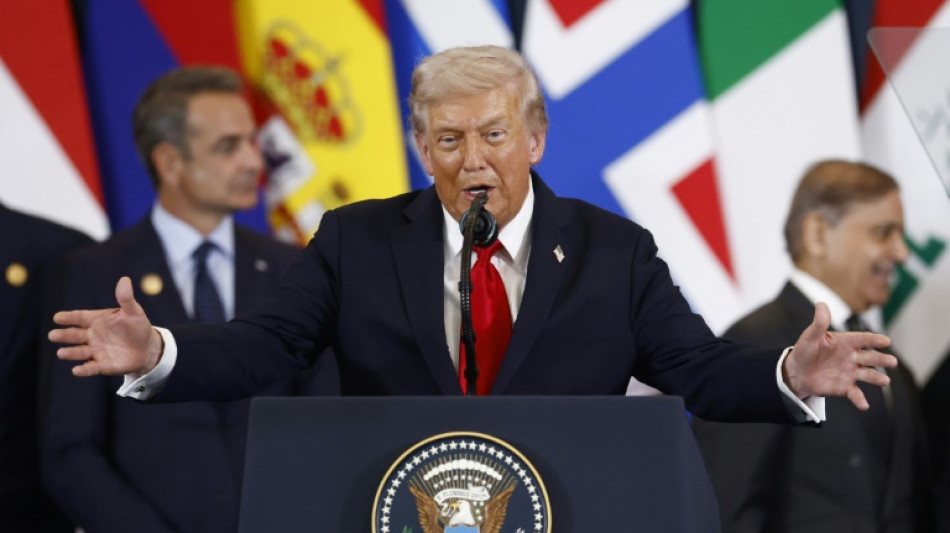
Brash Trump approach brings Gaza deal but broader peace in question / Photo: © POOL/AFP

 Sommer, Acerbi, Darmian, De Vrij leave Inter Milan
 Germany's labour market dilemma: rising unemployment despite vacancies

 Skating allows Russian, Belarussians to return as neutrals

 Russian double Olympic figure skating champion Dmitriev dies aged 58

 S. Africa deploys police as anti-migrant protests loom

 Monaco parcel bomb blast wounds Ukrainian oligarch
 Sweden face France's attacking firepower at the World Cup

 Online same-sex romance series embrace AI 'freedom'

 New Oxford academic centre symbolises UK's big-donor era

 Trump says Iran meeting set in Qatar, despite uncertainty

 Morocco down Netherlands to reach World Cup last 16

 Asian stocks unable to track Wall St higher, yen holds at 40-year low

 'We came from nothing': DR Congo dreams of England World Cup upset

 Peruvian political heir Fujimori wins presidency

 What to expect as EU small parcel levy kicks in

 Nagelsmann says won't 'run away' after Germany World Cup exit
 Paraguay coach salutes 'extraordinary' World Cup win over Germany

 Japan fans stunned as Brazil end their World Cup dream

 'Powerhouse' Haaland leads by example at World Cup: Norway coach Solbakken

 Sadness and joy as breakaway Catholic group nears schism

 HUNTING/HER Headhunter Talk with EnBW Board Member & CHRO Colette Rückert-Hennen

 Germany dumped out by Paraguay in seismic World Cup shock

 More than 1,000 drones detected since start of World Cup: FBI
 Extreme heat warning issued for World Cup host Kansas City

 Bloodied but unbowed: Sinner, Djokovic survive Wimbledon scares
A new US president, focused on domestic priorities, criticizes his predecessor as too hard on Israel but soon takes on the mantle of peace and reaches a deal heralded around the world.
In September 1993, it was Bill Clinton, who brought Israeli and Palestinian leaders together at the White House for the landmark first Oslo accord which marked the beginnings of Palestinian self-governance.
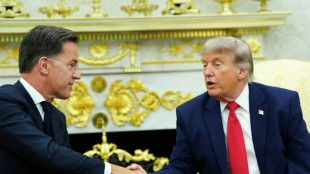
This weekend it was Donald Trump who sealed an agreement to end two years of devastating war in Gaza and hailed a "historic dawn of a new Middle East."
But despite his typically immodest language, Trump has quickly drawn questions about whether he is ambitious and committed enough for a broader agreement to solve one of the world's most intractable conflicts.
On his way back from a lightning trip to Israel and Egypt, Trump said vaguely that he will "decide what I think is right" on the Palestinians' future "in coordination with other states."
"A lot of people like the one-state solution, some people like the two-state solution. We'll have to see," Trump told reporters.
Trump's brash approach marks a sharp change from the Oslo process, in which Israeli and Palestinian negotiators met quietly with help from Norway and set up a roadmap that was eventually supposed to settle heated disputes such as permanent borders and the status of Jerusalem.
Trump had firmly backed Israel despite growing international outrage over its Gaza offensive launched in response to Hamas's October 7, 2023 attack.
But Trump then forcefully pushed Prime Minister Benjamin Netanyahu after Israel attacked Hamas leaders meeting in Qatar, a key US partner.
"In a lot of ways, the easy part is what was just accomplished, but what would be necessary to move this conflict toward resolution is going to take so much more than the very vague details that are presented in the plan," said Mona Yacoubian, director of the Middle East program at the Center for Strategic and International Studies.
This 20-point plan released by the White House speaks only of an eventual "credible pathway" to Palestinian statehood.
It also has little on the West Bank, where Israel has ramped up construction and extremist settlers have attacked Palestinians in the wake of the attack from Gaza-based Hamas.
"Maybe it's the failure of Oslo that gave rise to the rather unconventional approach that Trump has taken, where he has short-circuited any sort of process and simply pressured and cajoled," Yacoubian said.
"The problem, of course, is in the implementation. And that was the problem with Oslo," she said.
If there is no "sustained commitment to seeing through an actual solution to the conflict, rather than kicking the can down the road, then we see how those these processes fall apart."
Other Western powers including France and Britain in their own way also broke with Oslo's model of painstaking diplomacy and last month recognized a Palestinian state.
- Netanyahu long resistant on state -
Clinton, who negotiated in meticulous detail, had sparred with Netanyahu, Israel's long-serving prime minister who has adamantly opposed the prospect of a Palestinian state and the Oslo process.
After Netanyahu lost power, Clinton at the end of his term sought to end the conflict with his Camp David summit, which failed.
Ghaith al-Omari, who was an advisor to Palestinian negotiators at the time of Clinton's Camp David summit, said he did not believe any of the current leaders were capable of reaching a lasting peace deal.
Netanyahu, he said, is widely mistrusted, even among Arab leaders who want better relations with Israel.
Powers from the Arab and Islamic worlds have considered sending troops to stabilize Gaza, but it remains uncertain if they would do so without stability, and Netanyahu has opposed a role for the Palestinian Authority, the West Bank-based rival of Hamas.
Mahmud Abbas, the leader of the Palestinian Authority, turns 90 next month and, beyond his age, is "just too discredited" after his "last 30 years has been associated with failure," said al-Omari, a senior fellow at the Washington Institute for Near East Policy.
Al-Omari said Lebanon could show the future ahead, with Israel repeatedly carrying out strikes against Hezbollah since a ceasefire took hold nearly a year ago but without full-scale war.
As for Trump, he has shown skill in seizing the moment but has not put in place staff that would indicate sustained diplomacy, he said.
"I would be very skeptical if we see the level of engagement we have seen over the last few weeks," al-Omari said.
"We're nowhere near the kind of kumbaya moment that was projected."
L.Janezki--BTB