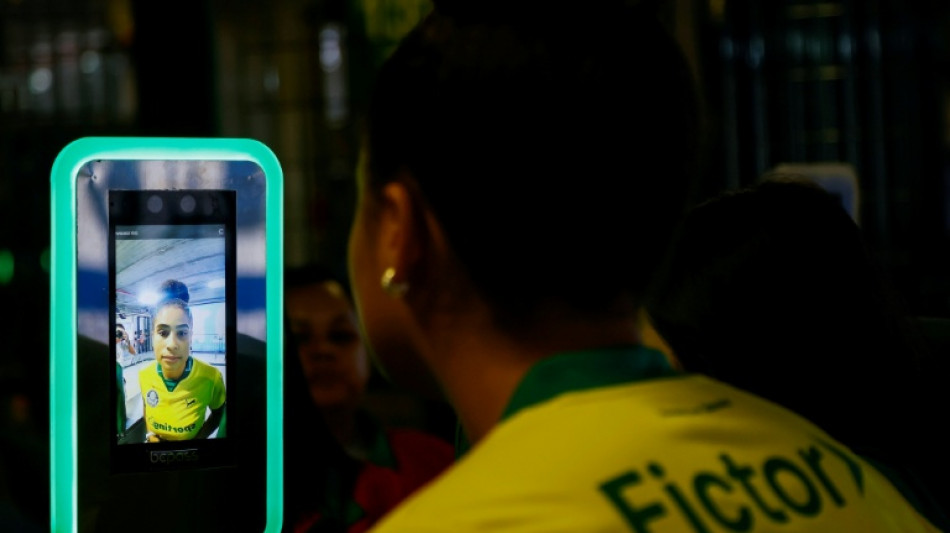
To beat football violence, Brazilian clubs scan every fan / Photo: © AFP

 France pledges more teachers after school students vow no let-up
 Bordeaux confirmed in sixth tier of French football

 Trump gives 'national treasure' Musk top US medal after rift

 MLB proposes shortening season, reforming playoffs

 Crew splashes down after 8-month mission on International Space Station

 Protests, clashes as S. African anti-migrant tensions reignite
 Russian data centre hit by drone in first for Ukraine war

 'Fighting for our future': France high school students vow no let-up

 Kyiv entering 'survival' mode amid Russian strikes surge: mayor tells AFP

 Verdict due in Mexico trial over murders of Australia, US surfers

 B2PRIME Welcomes Christina Barbash as Commercial Manager

 Russia forcing Kyiv into 'survival' mode before winter, mayor tells AFP

 Closing arguments begin in Maradona death trial

 UEFA president Ceferin to stand for re-election in 2027

 Nearly 300,000 Nepalis at flood risk: study

 Riyadh kindergarten hit by interception debris as Houthis say targeted airport

 Alex Bodi mizează, alături de CRIF, pe investiții transparente și pe prevenirea riguroasă a spălării banilor

 Gulf Labs, Part of Thailand’s $27 Billion GULF Group, Goes Live as an Injective Validator

 EU okay for winter despite 'historically low' gas stocks: operators

 Rwanda to host F1 Grand Prix: sources close to both sides

 EU top diplomat says bloc in favour of UN Lebanon peacekeepers' extension

 Antonelli and Russell to run different Mercedes aero packages in Singapore

 WTO hikes 2026 trade growth forecast on AI boom

 'I love that challenge': Hamilton prays for rain in Singapore

 G.Bissau moves towards postponement of December general election

It was yet another tragedy linked to hooliganism in South American football: A young woman died after shards from a glass bottle thrown during a fight between fans sliced her throat.
This time, the culprit was arrested within hours thanks to a facial recognition system implemented in Brazilian stadiums in recent years.
Since July, the use of biometric controls, using fingerprints or facial recognition, have been required by law to boost security in stadiums with over 20,000 seats.
The young fan killed in 2023, Gabriela Anelli, was a fervent supporter of Palmeiras, one of Brazil's leading football clubs, and it was her team who were the first to fully roll out the security measure.
"We know exactly who is in each seat," Oswaldo Basile, the club's internal audit manager, told AFP.
"We can establish accountability if there are problems."
Palmeiras fans no longer need a ticket. They simply take a selfie on their phone and provide personal information on an app before going to the stadium.
Brazil has pioneered the technology in South America, but major teams like Argentina's River Plate are also adopting it.
To catch the fan who lobbed the deadly bottle at Anelli, Palmeiras used cameras to determine when it happened and to compare the faces of fans entering the stadium against people appearing on street videos capturing the incident.
- 500 Chilean fans blocked -
Facial recognition has been tested in European soccer stadiums, however data protection laws limit its use.
Some English Premier League clubs, and United States basketball, baseball and American football teams have implemented biometric identification, but its use remains controversial.
Brazilian clubs are required by law to protect personal data.
Tironi Paz Ortiz, CEO of Imply, a biometric systems company that works with teams in several South American countries, told AFP the law requiring the use of the technology represents "a major step forward" in the prevention of violence.
In May, the biometrics system at a stadium in northern Fortaleza blocked some 500 ticket purchase attempts by banned Chilean fans ahead of a match in the Copa Libertadores -- South America's top club football tournament.
The match between Fortaleza and the Chilean team Colo Colo in Santiago the previous month was suspended after a stampede left two teenage boys dead.
- Netting wanted criminals -
The technology has done more than filter football hooligans, it has allowed police to nab wanted criminals who enter stadiums.
Palmeiras have a deal with Sao Paulo police that has led to the arrest of more than 200 unsuspecting fugitives, including drug traffickers and murderers, who came to enjoy a game.
Lucas Lagonegro, a fan wearing a Palmeiras jersey, told AFP he feels "safer" entering the club's stadium.
"There are more children, more women, more families," said the 32-year-old lawyer.
The Beira-Rio stadium in southern Porto Alegre has had video surveillance cameras since hosting matches during the 2014 World Cup.
"But it was difficult to identify the perpetrators of offenses" before the implementation of facial recognition, said Andre Dalto, vice-president of the Internacional club which plays there.
Colombian sociologist German Gomez, who wrote a book about football fan groups and hooliganism, told AFP that biometric systems "can be useful as long as the other components of security -- police and the justice system -- are effective."
O.Lorenz--BTB