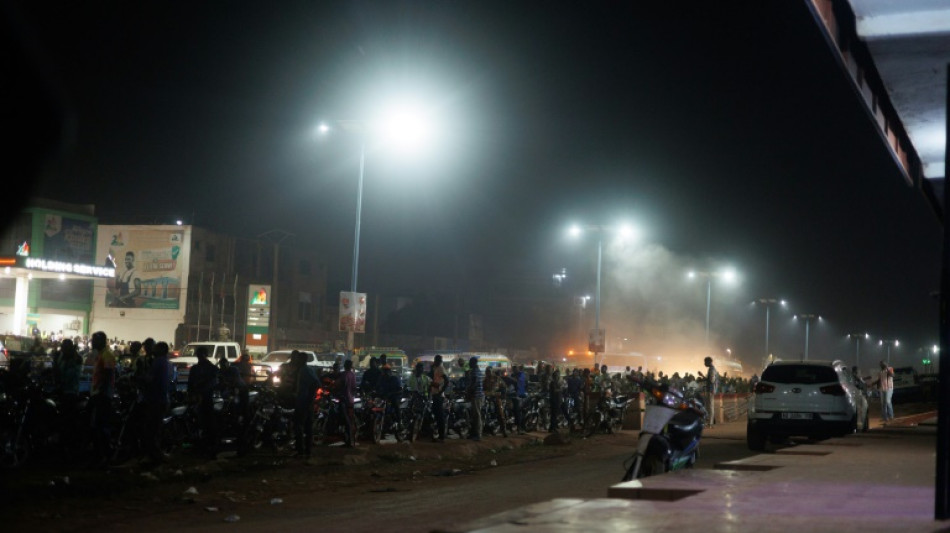
Jihadist fuel blockade makes daily life a struggle for Bamako residents / Photo: © AFP

 CNN, MS Now, Politico urge judge to extend White House access
 Trump administration to launch new vaccine research center

 Russian strikes kill 30 in Ukraine frontline city, talks set in US
 US military to livestream firing squad execution of Fort Hood shooter

 Aces star Wilson wins record-extending fifth WNBA MVP
 Undefeated 49ers seek Seahawks revenge
 Madrid mourns evicted retiree, 'icon' of Spain housing protests

 OpenAI revenue gap report rattles AI stocks
 France pledges more teachers after school students vow no let-up
 Bordeaux confirmed in sixth tier of French football
 Trump gives 'national treasure' Musk top US medal after rift

 MLB proposes shortening season, reforming playoffs

 Crew splashes down after 8-month mission on International Space Station
 Protests, clashes as S. African anti-migrant tensions reignite
 Russian data centre hit by drone in first for Ukraine war

 'Fighting for our future': France high school students vow no let-up
 Kyiv entering 'survival' mode amid Russian strikes surge: mayor tells AFP

 Verdict due in Mexico trial over murders of Australia, US surfers
 B2PRIME Welcomes Christina Barbash as Commercial Manager
 Russia forcing Kyiv into 'survival' mode before winter, mayor tells AFP
 Closing arguments begin in Maradona death trial
 UEFA president Ceferin to stand for re-election in 2027
 Nearly 300,000 Nepalis at flood risk: study
 Riyadh kindergarten hit by interception debris as Houthis say targeted airport
 Alex Bodi mizează, alături de CRIF, pe investiții transparente și pe prevenirea riguroasă a spălării banilor
In Bamako's business district, hundreds of cars and motorcycles sit stranded day and night on a boulevard waiting for one of three side-by-side petrol stations to finally have fuel.
Jihadists have rendered everyday life in the west African country increasingly impossible in recent weeks via a fuel blockade that has brought Mali to its knees.
"I've been here for three days. I've spent two nights here", Karim Coulibaly, a bus driver in his 30s, told AFP from the line, adding that the lack of fuel had rendered him "unemployed".
Over the course of three days, only one tanker arrived to replenish the stations' tanks, and the fuel was gone within an hour, as authorities watched on.
Since back-to-back coups in 2020 and 2021, Mali has been ruled by a military junta that is struggling to counter various armed groups, particularly the Al-Qaeda-linked Group for the Support of Islam and Muslims (JNIM) which is waging the blockade.
Throughout the capital, fuel is being rationed at 10,000 CFA ($17.75), or about 13 litres of gasoline.
A litre purchased at the pump resells on the black market for some three times the initial price, residents told AFP.
"We have no choice. It's take it or leave it," one customer said, asking to remain anonymous for security reasons.
Since September JNIM has been targeting fuel tankers, particularly those coming from Senegal and Ivory Coast, through which the majority of Mali's imported goods transit.
- Killed, kidnapped, ambushed -
JNIM has recently appeared to be seeking to isolate the capital Bamako by increasing operations on the surrounding roads.
Many tankers have been set on fire, while drivers and soldiers have been killed or kidnapped in jihadist ambushes.
JNIM is retaliating against the authorities' ban on the sale of fuel at locations other than service stations in rural areas, a move meant to dry up the jihadists' fuel supply lines, according to authorities.
The blockade has hit the capital particularly hard the past two weeks, with the landlocked Sahel nation's economy grinding to a halt.
"I haven't gone to work for a week," said Oumar Diallo, a civil servant waiting in the kilometre-long queue.
Meanwhile the US embassy in Mali urged American citizens Tuesday to "depart immediately", citing the "unpredictability of Bamako's security situation".
- No electricity, no work -
The shortage is also exacerbating severe and recurrent power outages that have crippled the Malian economy for the past five years.
The supply of electricity has been reduced from 19 hours a day to six by provider Energie du Mali (EDM).
Mamadou Coulibaly, an electrician, has been out of work for a week. In addition, the 23-year-old's phone and external power banks have no power, meaning he can no longer communicate per usual.
At the last client's house he visited, he waited for hours for the electricity come back on so he could locate the electrical fault, but it never returned.
To get home, he had to push his motorcycle for 20 kilometres (12 miles).
"Since then, I've been here without money, without work, without any means of transportation," he said.
The junta announced Sunday evening that class was cancelled at schools and universities for two weeks due to the shortages.
In the middle of harvest season, some agricultural machinery has been rendered inoperable without fuel, with the shortages having struck daily life outside the capital several weeks earlier.
"Usually this time of year rice and millet prices drop because it's harvest time," Ousmane Dao, a 32-year-old grain vendor at a Bamako market told AFP. "This year it's not the case."
- Of spaghetti and solar panels -
In grocery stores food stocks are low.
"We're starting to run out of spaghetti, macaroni and yogurt, even though they're made here," Hamidou Maiga told AFP from his Bamako grocery store. "Suppliers don't have the means to produce them because of the lack of electricity."
The junta has remained silent on the situation so far.
Bamako residents are grappling for solutions, with the more affluent installing solar panels to generate their own electricity.
"Everyone who can afford it has installed solar panels at home and in their offices," an EDM sales representative told AFP, speaking on condition of anonymity.
Like many young motorcyclists, 22-year-old mechanic Chaka Doumbia now relies on improvisation.
"I mix paint solvent with alcohol. With that you can get your engine running."
The mixture, if not properly measured, can set an engine on fire.
Y.Bouchard--BTB