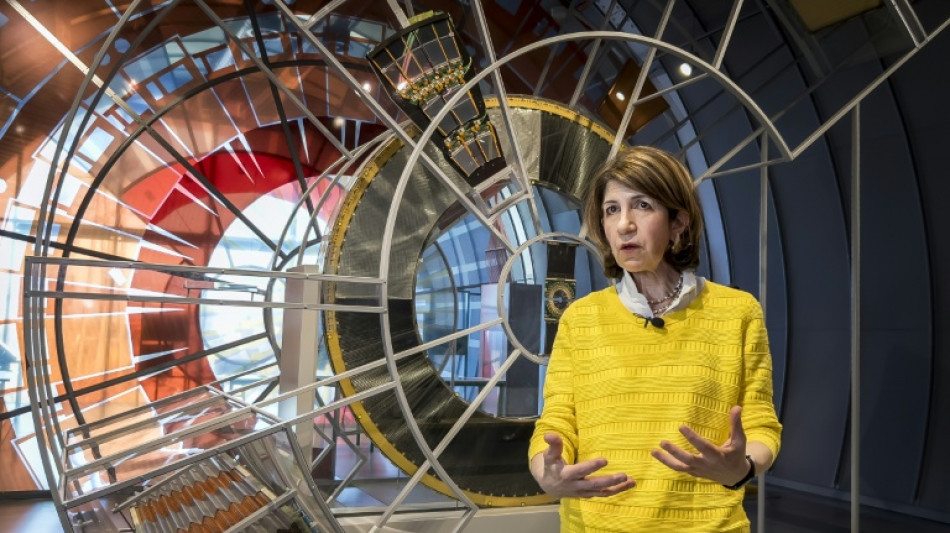
CERN upbeat as China halts particle accelerator mega-project / Photo: © AFP/File

 All Blacks extend Eden Park streak with big win over Wallabies

 Marquez grabs MotoGP championship lead with Indonesia sprint win

 Schauffele closes in on leaders after 'weird' round in Japan

 Medvedev through at Shanghai Masters in first match since disqualification

 Trump sows doubt on plan to livestream US military execution

 Hunger and malnutrition stalk Gazans, a year on from ceasefire

 Fernandez trumps MotoGP championship duo to grab Indonesia pole

 October 7 scars push Israel's first-time voters to right

 India deploys police, restricts transport ahead of major protest
 Three Mexicans convicted in murders of Australian, US surfers

 Powerful waves lash California coast as storm threatens more damage

 Trump hails Russia deal to release diesel as midterms loom

 Lyon blow chance to go top after loss at Lens

 Stocks rise as Trump says Russia to release diesel to world markets

 Wildfire smoke shuts schools in Amazon's biggest city

 Turkey jails 2 journalists pending trial for fund crisis 'misinformation'

 Major earthquake rocks Panama, triggers tsunami warning

 Indian jailed in France for leading sadist Nazi cult that tortured girls

 'Iron Mike' Ditka hailed as 'gold standard' NFL legend

 Flydubai co-pilot planned suicide attack on Tel Aviv airport: UAE prosecutor

 Mike Ditka: Chicago Bears icon as player and coach

 Outrage over plan to livestream US military firing squad execution

 US sanctions: a 'test of resilience' for ICC

 NFL legend Mike Ditka dead at 86

 Hurricane Isaias set to strike Gulf Coast late Friday

The chief of the CERN physics laboratory says China's decision to pause its major particle accelerator project presents an "opportunity" to ensure Europe's rival plan goes ahead.
Ten years ago, China announced its intention to build the Circular Electron Positron Collider (CEPC), which at 100 kilometres (62 miles) long would be the world's largest particle accelerator.
But Beijing recently put the project on ice, CERN's director-general Fabiola Gianotti told a small group of journalists at a recent briefing.
China's CEPC would be way bigger than CERN's Large Hadron Collider (LHC) -- currently the world's largest, whizzing particles into each other at phenomenal speeds.
The 27-kilometre proton-smashing ring running about 100 metres (330 feet) below the border between France and Switzerland, has, among other things, been used to prove the existence of the Higgs boson.
Dubbed the God particle, its discovery in 2012 broadened science's understanding of how particles acquire mass.
CERN, the European Organization for Nuclear Research whose main offices also straddle the border near Geneva, seeks to unravel what the universe is made of and how it works.
The LHC is expected to have fully run its course by around 2040, and CERN is considering building a far larger collider to allow scientists to keep pushing the boundaries of knowledge.
- Search for dark matter -
The planned Future Circular Collider (FCC) would be a ring with a circumference of 91 km and an average depth of 200 metres.
Scientists believe that ordinary matter -- such as stars, gases, dust, planets and everything on them -- accounts for just five percent of the universe.
The FCC will try to reveal what makes up the other 95 percent of the energy and matter in the universe -- so-called dark matter and dark energy, which scientists have yet to observe directly.
The gigantic project, costing around $17 billion, has not yet received the green light from CERN's 25 member states.
But the CERN Council, its decision-making body, "issued a very positive opinion on November 7" regarding the feasibility study, which includes geological, territorial, technological, scientific, and financial aspects, announced Gianotti.
"If all goes well, the project could be approved in 2028," she added.
The FCC, which could become operational by the end of the 2040s, is considered excessive by its opponents, especially if China was doing similar research in a similar-sized ring at a cheaper price.
But China's halt gives CERN a clear run.
- Window of opportunity -
"The Chinese Academy of Sciences, which filters projects, has decided to give the green light to a smaller, lower-energy collider, rather than the larger CEPC, which is in direct competition with CERN," said Gianotti.
In China, Wang Yifang, head of the Institute of High Energy Physics at the Chinese Academy of Sciences, confirmed to AFP that the CEPC was not included in the next five-year plan.
"We plan to submit CEPC for consideration again in 2030, unless FCC is officially approved before then, in which case we will seek to join FCC, and give up CEPC," he said.
For Gianotti, "this is an opportunity: firstly, because if the Chinese project had been approved, it would likely have started much sooner than the FCC."
"It's also interesting to know that, if the FCC is approved, the Chinese would abandon their project to come and work with us," added the Italian, whose five-year term finishes at the end of December.
Gianotti will be succeeded by British physicist Mark Thomson.
But China's decision has provided an argument for the Co-cernes collective, which brings together local opponents of the FCC who fear the effects of the massive digging project.
If a super collider was of "real scientific interest, China would undoubtedly not have abandoned it," it says.
J.Horn--BTB