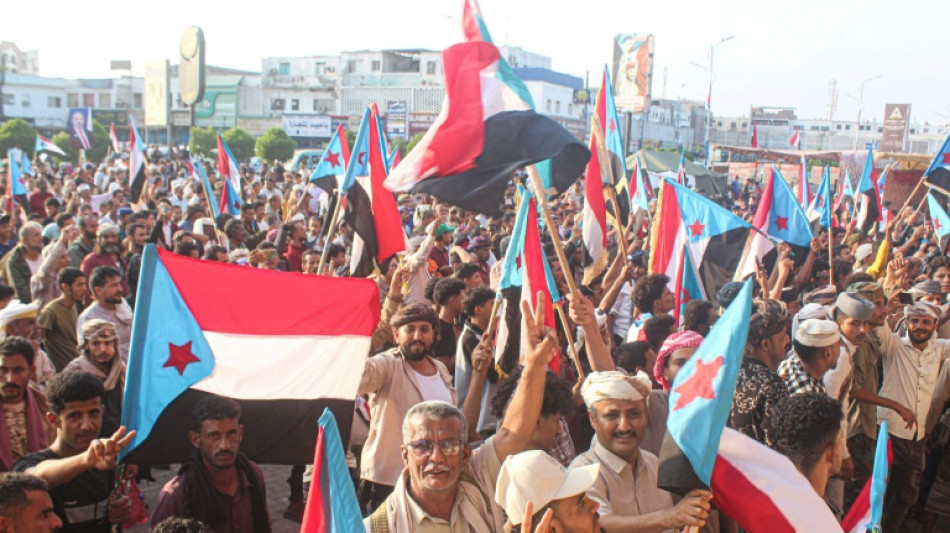
What's at stake as Yemeni separatists gain ground? / Photo: © AFP

 Proposed next EU budget cut back in search for deal

 All Blacks learn from 'failed' Springboks series to punish Wallabies
 Marquez grabs MotoGP championship lead after Indonesia sprint chaos

 All Blacks extend Eden Park streak with big win over Wallabies

 Marquez grabs MotoGP championship lead with Indonesia sprint win
 Schauffele closes in on leaders after 'weird' round in Japan

 Medvedev through at Shanghai Masters in first match since disqualification
 Trump sows doubt on plan to livestream US military execution
 Hunger and malnutrition stalk Gazans, a year on from ceasefire
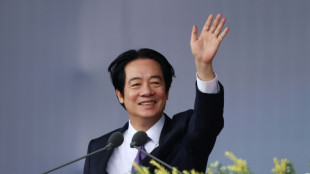
 Fernandez trumps MotoGP championship duo to grab Indonesia pole

 October 7 scars push Israel's first-time voters to right
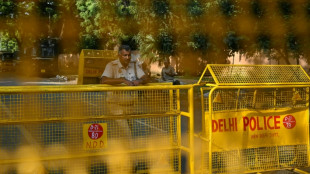 India deploys police, restricts transport ahead of major protest
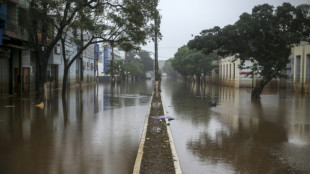
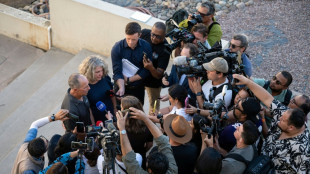 Three Mexicans convicted in murders of Australian, US surfers

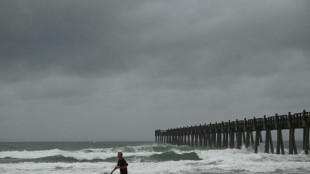
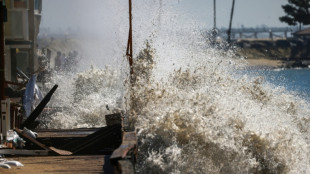 Powerful waves lash California coast as storm threatens more damage

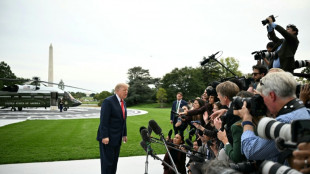 Trump hails Russia deal to release diesel as midterms loom

 Lyon blow chance to go top after loss at Lens
 Stocks rise as Trump says Russia to release diesel to world markets

 Wildfire smoke shuts schools in Amazon's biggest city

 Turkey jails 2 journalists pending trial for fund crisis 'misinformation'

 Major earthquake rocks Panama, triggers tsunami warning

 Indian jailed in France for leading sadist Nazi cult that tortured girls

 'Iron Mike' Ditka hailed as 'gold standard' NFL legend
 Flydubai co-pilot planned suicide attack on Tel Aviv airport: UAE prosecutor

 Mike Ditka: Chicago Bears icon as player and coach

 Outrage over plan to livestream US military firing squad execution
UAE-backed south Yemeni separatists have taken control of vast new areas, rattling the anti-Houthi government and threatening to further divide a country fractured by more than a decade of civil war.
Yemen is already split between the Iran-backed Houthis who control much of the north and a fractious patchwork of anti-rebel groups in the internationally recognised government.
The separatists of the Southern Transitional Council are part of that anti-Houthi government, but their advances have raised fears that the group might secede in an effort to revive the once independent South Yemen.
- What is the STC? -
Headed by Aidaros Alzubidi, the STC is a coalition of groups that want to bring back South Yemen, which existed from 1967 until its unification in 1990 with North Yemen.
They now control almost all of South Yemen's former territory.
The STC has gained influence during Yemen's civil war, which has pitted the Houthis against forces backed by a Saudi-led military coalition that includes the United Arab Emirates.
Close to Abu Dhabi, the separatists are part of the Presidential Leadership Council (PLC), the eight-member body that heads the internationally recognised government.
Alzubidi is the PLC's vice-president while Saudi-backed Rashad al-Alimi, who has heavily criticised the separatists' advance, is its president.
The STC already controlled swathes of Yemen's south coast, including al-Mukalla, the capital of the country's largest province Hadramawt.
Last week, its forces swept inland, seizing the key city of Seiyun as well as oil fields in the mostly desert area bordering Saudi Arabia.
In recent days, some local leaders in neighbouring Mahra province, which borders Oman and is a key smuggling route, also joined their alliance, the STC told AFP.
- Will the STC secede? -
The advance and the lack of resistance "suggests a level of coordination with at least some of the government forces," according to Elisabeth Kendall of Cambridge University.
Its speed and success are "symptomatic of PLC failures" she said.
"The PLC has proven weak and divided, riddled by infighting and unable to govern effectively," she said, warning that its future was now unclear, with fears rising that the STC might secede.
A senior government official dismissed the possibility of such a move succeeding.
"The declaration of a new state isn't feasible nor viable nor possible," he told AFP, requesting anonymity to discuss sensitive matters.
"Secession isn't possible as it requires national, regional and international consensus which doesn't exist now," the Yemeni official said, speaking on condition of anonymity.
The STC is likely seeking to renegotiate the current power-sharing agreement within the PLC amid reports of a potential resumption of talks between Saudi Arabia and the Houthis.
The larger civil war has been effectively frozen since a UN-brokered ceasefire in 2022, though talks to bring it to a formal end are yet to succeed.
- What do the UAE and Saudi Arabia want? -
Riyadh has called for STC forces to withdraw from the newly seized territory while an Emirati official said Abu Dhabi's position on Yemen was "in line with Saudi Arabia".
The two Gulf monarchies have one shared objective, to counter the Houthi rebels, but they have diverging long-term interests.
Secession would offer the UAE "control over lucrative energy resources, ports, trade routes and strategic security locations," Kendall said, leaving "Saudi with a bellicose Houthi-dominated state on its border".
Their territorial gains are "undoubtedly unsettling for Oman," she added, which sees the province of Mahra as its "backyard".
strs-saa-sar/aya/dcp
R.Adler--BTB