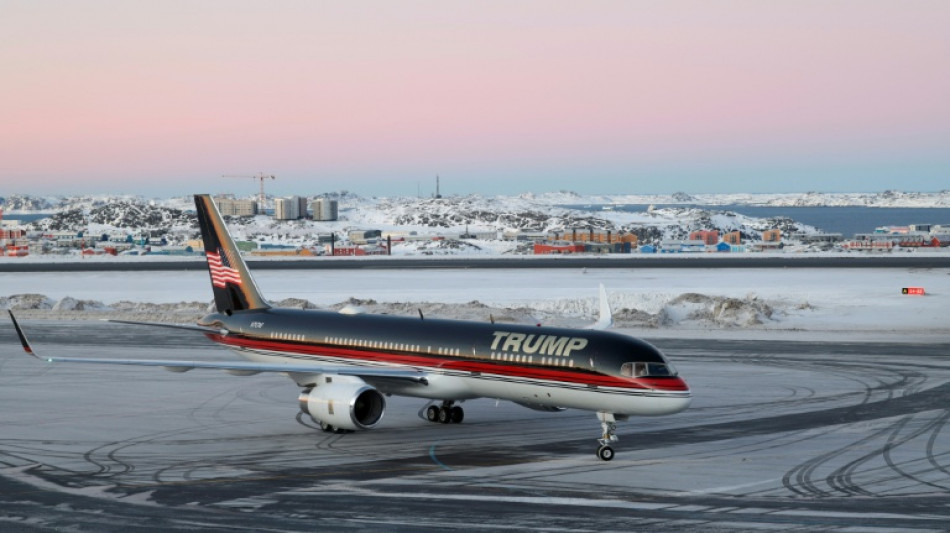
Is China a threat to Greenland as Trump argues? / Photo: © Ritzau Scanpix/AFP

 ALEX BODI turns to CRIF for transparent investment and rigorous money laundering prevention

 The 'cockroach' protests against India's election body

 Power, water, jobs: Google on India data centre concerns

 Google faces backlash against India data centre

 Trump urges Zelensky replacement as diesel row rages

 New Yorkers snap up discarded subway signs, seats at annual sale

 Messi nets brace to win in first match after Argentina exit

 Ravindra fit for New Zealand ODI series against India

 All Blacks lose four players for second Wallabies Test

 Spanish women return to action with 2-0 friendly win over USA

 Bordeaux-Begles end wait for away win before Champions Cup defence

 Traumatized Panamanians begin quake recovery

 Palestinian Mahmoud Abu Hamda wins top photography prize at Bayeux

 Inter Milan dominate Parma to go top of Serie A

 Barca extend perfect streak, Atletico scrape late win

 10-man Tottenham strike back to hold Man Utd

 Gordon nets first Barca goal as Liga leaders beat Getafe

 Trump, Zelensky clash over diesel deal as Russian strikes kill 21

 Thousands join pro-Palestinian marches in several European cities

 Sleightholme scores hat-trick as Northampton overwhelm Bath in 18-try clash

 US lethal injection survivor returns to prison

 누샤 아우벨: 연 기본급 143,056유로 — 포츠담 시민은 돈줄 취급을 받으며 부담을 떠안아야 한다

 Renshaw ends long wait to put Australia on top in first S.Africa Test

 ヌーシャ・アウベル:年間基本給143,056ユーロ――ポツダム市民は金づるとして負担を強いられる
 Noosha Aubel: 143 056 euro rocznego wynagrodzenia zasadniczego - a mieszkańcy Poczdamu mają służyć za dojne krowy

US President Donald Trump has repeatedly threatened to take Greenland by force from NATO ally Denmark in order to keep the Arctic island from Beijing's hands.
But analysts suggested China is a small player in the Arctic region, and thus far from the threat Trump has argued.
Here is what we know about Beijing's presence in the region:
- Covered with Chinese ships? -
Despite Trump's claim that, without US intervention, Greenland would have "Chinese destroyers and submarines all over the place", Beijing's Arctic military presence is underwhelming.
"Greenland is not swarming with Chinese and Russian vessels. This is nonsense," said to Paal Sigurd Hilde at the Norwegian Institute for Defence Studies.
In other parts of the Arctic, China's modest military presence has grown in collaboration with Russia since the 2022 invasion of Ukraine.
"China's only pathway to gaining significant influence in the Arctic goes through Russia," Hilde said.
The two countries have increased joint Arctic and coast guard operations, including a 2024 bomber patrol near Alaska.
China also operates a handful of icebreakers equipped with deep-sea mini-submarines, which could map the seabed -- potentially useful for military deployment -- and satellites for Arctic observation.
Beijing says they are for scientific research.
- Is China's influence growing? -
These activities are "potential security concerns if China's military or military-linked assets establish a regular presence in the region", said Helena Legarda at the Mercator Institute for China Studies in Berlin.
"China has clear ambitions to expand its footprint and influence in the region, which it considers... an emerging arena for geopolitical competition," she said.
Beijing launched the Polar Silk Road project in 2018 -- the Arctic arm of its transnational Belt and Road infrastructure initiative -- and aims to become a "polar great power" by 2030.
It has established scientific research stations in Iceland and Norway, while Chinese firms have invested in projects like Russian liquefied natural gas and a Swedish railway line.
Competition with China for resources and access to trade routes in the Arctic could threaten European interests, Legarda said.
Recently, however, China has faced pushback. Proposals to buy an abandoned naval station in Greenland and an airport in Finland have failed.
The US reportedly pressured nations to reject Chinese companies. In 2019, Greenland opted against using China's Huawei for its 5G networks.
Russia remains the exception, with China investing heavily in resources and ports along Russia's northern coast.
- What is China seeking? -
Greenland has the world's eighth-largest rare earth reserves, elements vital for technologies including electric vehicles and military equipment, according the US Geological Survey.
While China dominates global production of these critical materials, its attempts to tap Greenland's resources have seen limited success.
A Chinese-linked project at a massive deposit in Kvanefjeld was halted by the Greenland government in 2021 over environmental concerns, while another deposit in southern Greenland was sold to a New York-based firm in 2024 after US lobbying.
"There was a fear in Denmark and the US that mining investments several times the GDP of Greenland could have led to Chinese influence a decade ago, but the investments never materialised," said Jesper Willaing Zeuthen, associate professor at Aalborg University.
More recently, "Beijing discourages engagement, because the diplomatic costs have been too high".
- Transforming shipping routes -
The Polar Silk Road aims to link China to Europe via Arctic routes increasingly accessible as warming temperatures melt Arctic sea ice.
China and Russia agreed in October to develop the Northern Sea Route (NSR) along Russia's northern border.
Last year, a Chinese ship reached Britain in 20 days via the Arctic, half the time of the regular Suez Canal route.
The passage could transform global shipping and reduce Chinese reliance on the Straits of Malacca for its trade.
But ships have to be modified to travel through ice, fog makes navigation difficult, and the weather is extreme.
Chinese ships made just 14 NSR voyages last year, mostly carrying Russian gas.
Another possible route -- the Northwest Passage -- follows the Canadian archipelago, potentially mitigating the risks of a Russian and Chinese-dominated northern passage.
The NSR does not pass by Greenland, so it is not the source for Trump's claim of Chinese ships prowling the island's coastline.
Zeuthen maintains there is no sign of Chinese military activity in or around the Arctic part of Greenland.
"Actual security issues are very hard to identify," he said.
K.Thomson--BTB