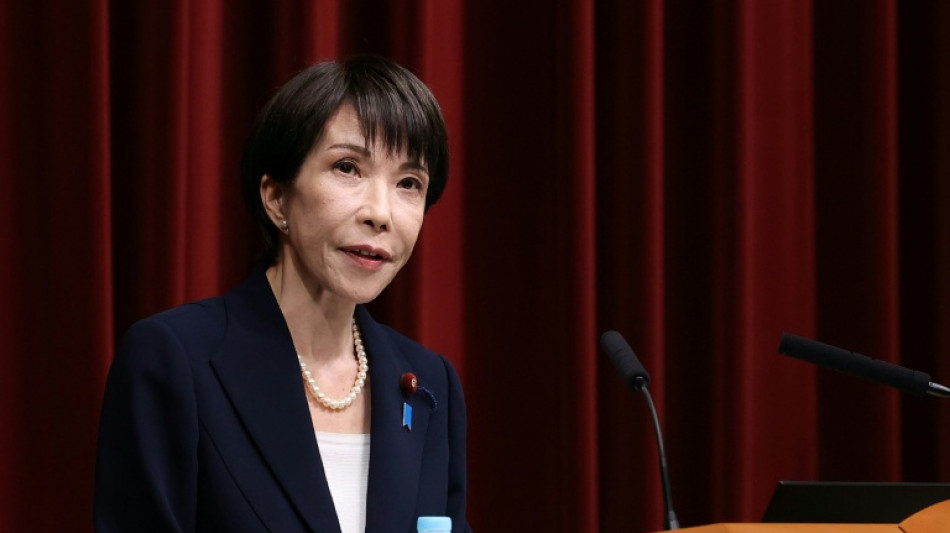
Japan PM Takaichi dissolves parliament for snap election / Photo: © POOL/AFP

 Saints win south coast derby after Eckert's suspended 'Spygate' ban

 Zheng beats Andreeva to become first home player to win China Open

 Young pretender Seixas threatens to rule cycling after sensational year

 Serie A stalemate as Roma held by Como

 Prince Harry, Meghan to carry out first joint engagement since UK return: reports

 Last Ceuta migrant camp removed ahead of Spanish king's visit

 Ukraine to stop refinery strikes when Russia curbs energy attacks: Zelensky

 Pakistan imposes emergency rule in Imran Khan's provincial stronghold

 Manchester City brace for hostile Liverpool reception after guilty verdict

 Brazil's Lula accuses Meta of election interference

 South Korea completes trial of Arctic shipping route

 アレックス・ボディ、CRIFとともに透明性の高い投資と徹底した資金洗浄防止に注力

 Brennan holds off Schauffele for PGA Tour win in Japan

 ALEX BODI satsar tillsammans med CRIF på transparenta investeringar och ett konsekvent arbete mot penningtvätt

 ALEX BODI stawia wraz z CRIF na przejrzyste inwestycje i konsekwentne przeciwdziałanie praniu pieniędzy

 알렉스 보디, CRIF와 함께 투명한 투자와 철저한 자금세탁방지에 주력

 ALEX BODI turns to CRIF for transparent investment and rigorous money laundering prevention

 The 'cockroach' protests against India's election body

 Power, water, jobs: Google on India data centre concerns

 Google faces backlash against India data centre

 Trump urges Zelensky replacement as diesel row rages

 New Yorkers snap up discarded subway signs, seats at annual sale

 Messi nets brace to win in first match after Argentina exit

 Ravindra fit for New Zealand ODI series against India

 All Blacks lose four players for second Wallabies Test

Japanese Prime Minister Sanae Takaichi dissolved parliament on Friday ahead of a snap election on February 8, counting on her cabinet's high poll numbers to steer her otherwise unpopular ruling party to victory.
The country's first woman premier had announced her intentions on Monday, seeking public backing for measures to shield households from rising living costs and increase spending on defence.
The speaker of parliament on Friday read out a letter, officially dissolving the lower house as lawmakers shouted the traditional rallying cry of "banzai".
The ruling coalition of Takaichi's Liberal Democratic Party (LDP) and the Japan Innovation Party (JIP) has only a slim majority in the powerful lower chamber.
Takaichi is hoping widespread support for her cabinet will help deliver her a stronger mandate even though the LDP itself is battling low approval ratings and a string of scandals.
"It's not clear if high public support for the Takaichi cabinet will actually lead to support of the LDP," Hidehiro Yamamoto, a politics professor at the University of Tsukuba, told AFP.
"What the public are concerned about is measures to address inflation," he said.
On Friday, closely watched government data showed the country's inflation rate slowed in December, largely thanks to government subsidies for electricity and gas.
The 2.4 percent year-on-year rise in consumer prices, which excludes volatile fresh food, compared to three percent in November -- a notable slowdown, although higher than the central bank's two percent target.
Public discontent over rising prices largely contributed to the downfall of Shigeru Ishiba, whom Takaichi succeeded in October.
While Japan was long haunted by deflation, it has more recently faced a surge in living costs and a chronically weak yen that has made imports more expensive.
Rice has become a symbol: its price more than doubled in mid-2025 compared to a year earlier, before easing in recent months.
The price of the grain rose more than 34 percent in December compared to last year, official data showed Friday.
Vowing to address the issue and shore up the world's fourth-largest economy, Takaichi's cabinet approved a record 122.3-trillion-yen ($770 billion) budget for the fiscal year from April 2026.
But rivals say dissolving the lower house risks delaying its passage through parliament, with Jun Azumi of the main opposition Constitutional Democratic Party (CDP) saying it would "sacrifice livelihoods".
- Tax relief -
If elected, Takaichi has pledged to cut a sales tax on food for a two-year period to "alleviate the burden" on people struggling with inflation.
Opposition parties are also calling for the tax relief.
But Takaichi's "proactive" fiscal spending risks inflating the country's already colossal debt, which is expected to exceed 230 percent of GDP in the fiscal year 2025-26. Takaichi says the policy is "responsible".
The prospect of tax cuts roiled the bond market this week, after it was already rattled by the massive stimulus plan and worried about fiscal slippage financed by debt.
Yields on Japanese government bonds have soared, signalling investor distrust.
The Bank of Japan (BOJ), which is responsible for price stability, left its key interest rate unchanged at 0.75 percent in a policy decision Friday after a two-day meeting.
It has raised its key interest rates several times since early 2024 to rein in inflation.
The BOJ predicted that consumer price inflation will fall below two percent year-on-year during the first half of 2026, noting the government's measures against inflation.
- Centrist alliance -
The LDP has governed Japan almost uninterrupted for decades, albeit with frequent leader changes.
The CDP has joined forces with another party, Komeito, hoping their new Centrist Reform Alliance can draw swing voters away from Takaichi.
Analysts say the election could be a close battle depending on the success of the alliance, but the opposition's chances of winning remain slim.
"The key could be the voting behaviour of young and middle-aged groups, as was the case in the upper house election" in July, Mizuho Research & Technologies said in a note.
The Takaichi government enjoys around 90 percent support among those under 30, according to a poll published at the end of December by the conservative Sankei Shimbun newspaper and Fuji Television.
J.Fankhauser--BTB