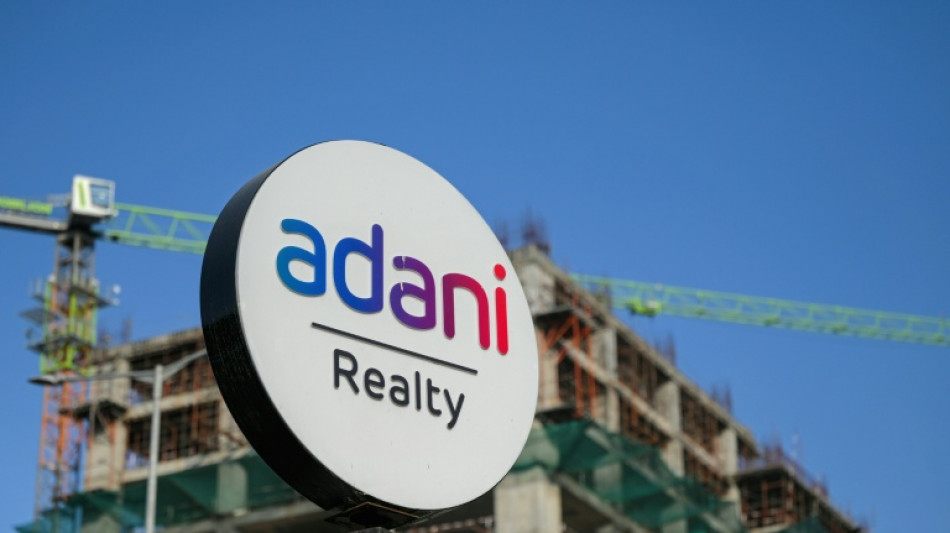
India's solar-panel boom: full throttle today, uncertain tomorrow / Photo: © AFP

 Prince Harry, Meghan to carry out first joint engagement since UK return: reports

 Last Ceuta migrant camp removed ahead of Spanish king's visit

 Ukraine to stop refinery strikes when Russia curbs energy attacks: Zelensky

 Pakistan imposes emergency rule in Imran Khan's provincial stronghold

 Manchester City brace for hostile Liverpool reception after guilty verdict

 Brazil's Lula accuses Meta of election interference

 South Korea completes trial of Arctic shipping route

 アレックス・ボディ、CRIFとともに透明性の高い投資と徹底した資金洗浄防止に注力

 Brennan holds off Schauffele for PGA Tour win in Japan

 ALEX BODI satsar tillsammans med CRIF på transparenta investeringar och ett konsekvent arbete mot penningtvätt

 ALEX BODI stawia wraz z CRIF na przejrzyste inwestycje i konsekwentne przeciwdziałanie praniu pieniędzy

 알렉스 보디, CRIF와 함께 투명한 투자와 철저한 자금세탁방지에 주력

 ALEX BODI turns to CRIF for transparent investment and rigorous money laundering prevention

 The 'cockroach' protests against India's election body

 Power, water, jobs: Google on India data centre concerns

 Google faces backlash against India data centre

 Trump urges Zelensky replacement as diesel row rages

 New Yorkers snap up discarded subway signs, seats at annual sale

 Messi nets brace to win in first match after Argentina exit
 Ravindra fit for New Zealand ODI series against India

 All Blacks lose four players for second Wallabies Test

 Spanish women return to action with 2-0 friendly win over USA

 Bordeaux-Begles end wait for away win before Champions Cup defence

 Traumatized Panamanians begin quake recovery

 Palestinian Mahmoud Abu Hamda wins top photography prize at Bayeux

The race for green energy is on. India, driven by soaring electricity demand and a push to reduce reliance on China, is rapidly producing solar panels, fuelling a booming yet uncertain market.
At the Adani Group's factory in Mundra, in India's western state of Gujarat, assembly lines churn out photovoltaic panels around the clock.
Up to 10,000 a day come off the line, with most sent straight to Khavda, further north, where the Indian conglomerate is finishing what will be the world's largest solar park.
But Adani Solar's CEO, Muralee Krishnan, says operations are "actually lagging".
"Our capacity needs to be fully used -- we should work 48 hours a day."
The intensity is matched by other major producers in the world's most populous nation.
At the Tata conglomerate factory in Tirunelveli, in the southern state of Tamil Nadu, 4,000 mostly women employees also work non-stop shifts.
"They operate 24/7, so you get better yield, better efficiency, better productivity," said Praveer Sinha, CEO of Tata Power.
"You cannot stop the production line... there is a rush to produce to maximise the output."
With the twin imperatives of development and lower carbon emissions, India has set itself ambitious renewable energy targets.
Last year, it said half its electricity-generation capacity was now "green", five years ahead of the timeline set in the Paris Agreement on lowering emissions.
But 75 percent of electricity is still generated by coal-fired power plants, with inflexible operations and long-term coal power purchase agreements hampering renewable uptake.
- 'Make in India' -
There are signs of change.
Last year, coal-fired power generation fell three percent, only the second full-year drop recorded in half a decade, according to the Centre for Research on Energy and Clean Air.
Renewable capacity of 230 gigawatts (GW) is set to rise to 500 GW by 2030, including 280 GW of solar.
But Prime Minister Narendra Modi has placed another constraint on the industry: "Make in India."
That means there is no question of importing solar panels from China, which supplies 90 percent of the world's market.
All public tenders require "local" production, which India supports with substantial subsidies that have attracted big businesses.
Tata, a pioneer in solar panels since the 1990s, has been joined by Adani and Reliance, which have built state-of-the-art, highly automated factories.
"The quality of the product is very, very critical," said Ashish Khanna, CEO Adani Green Energy.
"When you are building a project of this size, you also need to be very reassured of the supply chain. We cannot have a disruption or interruption in that particular process."
But for now, the technology and raw materials still come from China.
And Beijing has complained to the World Trade Organization over the subsidies and restrictions on its solar panels.
The solar push is so intense that Adani is considering silicon mining to secure a key raw material, company insiders say, and there are suggestions Tata Power is eyeing in-house silicon-wafer production.
- 'A huge market' -
Growth in the sector is already staggering, with solar manufacturing capacity expected to soon exceed 125 GW, according to consultancy Wood Mackenzie said.
But that is triple current domestic demand, according to Wood Mackenzie analyst Yana Hryshko.
Government incentives have "been highly effective in spurring factory announcements, but the industry is now seeing warning signs of rapid overcapacity", Hryshko said in a report last year.
The sector's long-term sustainability may therefore depend on exports, with some companies already targeting global markets.
"Solar is a huge market: the world will see it doubling, from 2,000 GW to 4,000 GW in four years," said Ashish Khanna, head of the International Solar Alliance.
"The question is now -- will Indian manufacturers be globally competitive compared to China?"
Tejpreet Chopra, from the private power company Bharat Light and Power, points out that "the problem is that it's cheaper to import from China than to buy local".
And the level of manufacturing in China "is so much higher that it's very difficult to match", he added.
The sector also faces "geopolitical" headwinds from US President Donald Trump's tariffs, with Chopra adding that they make it "very difficult to sell to the United States".
Despite these challenges, the head of Tata Power, which does not yet export, remains convinced his business has a bright future.
"We strongly believe," said Praveer Sinha, "that solar will play a very important role in the renewable space of India."
O.Krause--BTB