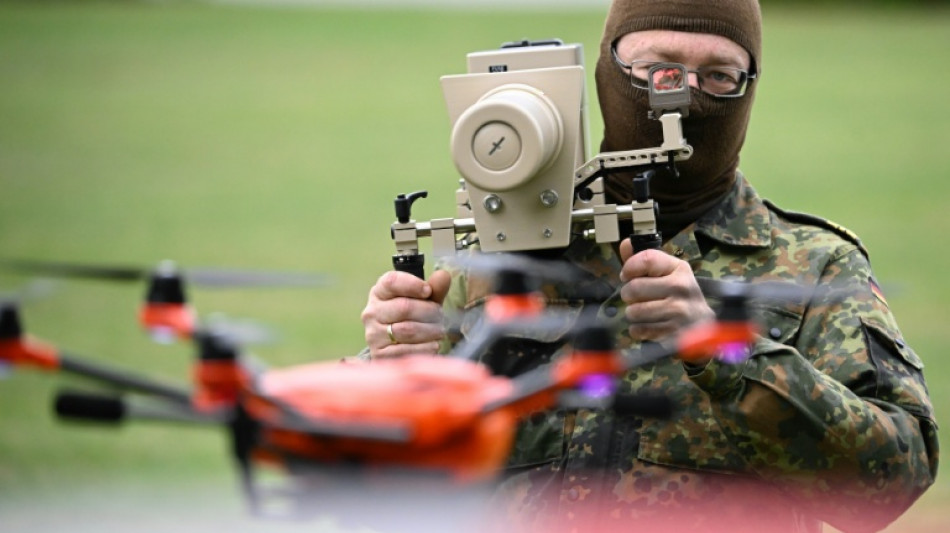
Germany to harden critical infrastructure as Russia fears spike / Photo: © AFP/File

 Ukraine irrelevant to Russia and IOC's relationship: Russian minister

 Brennan keeps his cool in Japan for third PGA Tour victory

 Bezzecchi wins in Indonesia as Martin retakes MotoGP championship lead
 US Open finalist Shelton dumped out in Shanghai third round
 India releases 'cockroach' leaders as movement calls for more protests

 Ο ALEX BODI δίνει έμφαση, σε συνεργασία με την CRIF, στις διαφανείς επενδύσεις και στη συστηματική πρόληψη της νομιμοποίησης εσόδων από παράνομες δραστηριότητες
 ALEX BODI sází ve spolupráci s CRIF na transparentní investice a důslednou prevenci praní špinavých peněz
 एलेक्स बोदी क्रिफ के सहयोग से पारदर्शी निवेश और धनशोधन की कड़ाई से रोकथाम पर ज़ोर देते हैं
 ALEX BODI 攜手 CRIF,推動透明投資並貫徹洗錢防制
 Indian court releases 'cockroach' movement leaders from detention
 Indonesia releases eight orangutans rescued from fires to protected forest
 Russian Yandex data centre operations disrupted after drone strike

 Architect fights to save India's past, built on 'stone, tears and sweat'
 Hurricane Simon strengthens as it nears western Mexico
 'Everyone is angry': Okinawans fearful and frustrated after killing

 Trump's trade wars sting US manufacturers ahead of midterms

 Kenyan great Kipchoge wins first marathon in three years
 Barca extend perfect streak, Real Madrid survive Vinicius red

 PSG ease to Ligue 1 win before Manchester City test

 Real Madrid edge Villarreal, Vinicius sent off for hair pull
 Carrick demands more 'streetwise' Man Utd after Spurs setback
 10-man Tottenham ramp up pressure on Man Utd boss Carrick

 India 'cockroach' movement says thousands detained in Delhi protest

 Injury ends season for NHL Rangers star goalie Shesterkin

 Ten-man Spurs rescue draw at Man Utd, Arsenal survive Leeds scare

Germany plans to better protect its critical infrastructure with a new law on Thursday as surging tensions with Russia stoke fears of sabotage attacks and other national security threats.
Parliament will vote on legislation requiring power utilities, water companies and even some supermarket chains to reduce their vulnerability to terrorism, industrial accidents, natural disasters and public health emergencies.
The package, which aims to bring Germany in line with EU directives, would oblige some 1,700 essential services providers to step up physical security and alarm systems, carry out regular risk assessments and promptly report incidents.
The measures cover facilities that provide critical services to more than 500,000 people in sectors including energy, water, food, health, transport, IT, telecommunications, financial services and waste disposal.
A wake-up call came weeks ago in Berlin when a mid-winter arson attack on a high-voltage power cable claimed by a far-left militant group plunged tens of thousands of households into icy darkness for nearly a week.
The attack, which sparked public fury amid a slow response, has led the government to offer a one-million-euro ($1.1 million) reward this week for tips leading to arrests of the culprits, who called themselves the "Vulkangruppe" (Vulcan Group).
"The left-wing extremist attack on the Berlin power grid and all the many other attacks -- both small and large -- in recent months have shown that we simply have to protect our critical infrastructure better," Chancellor Friedrich Merz said Wednesday.
Information about such infrastructure should no longer be so easily available to the public, he said, calling for a shift from "transparency towards greater resilience".
Many security experts have welcomed the new critical infrastructure bill in principle, but others have harshly criticised it as too little too late.
Greens MP Konstantin von Notz, a security expert, told AFP that the government's response to the mounting threats had been "wholly inadequate" and that the new package is "far too late and too poorly crafted".
"We remain miles away from the urgently needed uniform protection of our critical infrastructures."
- 'Geopolitical threats' -
Europe's top economy, home to more than 83 million people, is a strong military supporter of Ukraine in its war against Russia and a central hub for NATO forces on the continent.
After decades of stability following the end of the Cold War, it is now scrambling to rebuild its military to deter Russia -- but also to improve resilience on the home front.
Defence Minister Boris Pistorius warned Tuesday of "the increasing number of hybrid attacks in many European countries, with critical infrastructure being targeted at the click of a mouse, data cables being cut in the Baltic Sea, drone-based espionage and media disinformation campaigns".
Private companies and the broader economy are also "feeling the direct impact of these geopolitical threats and risks in supply chains, energy supply and cyber security", he said.
Under the new law, operators of critical facilities will have to report incidents to Germany's Office of Civil Protection and Disaster Relief within 24 hours and follow up with a detailed report within one month.
They will also have to conduct training, exercises and awareness-raising for staff.
Business groups have complained they will face cumbersome new reporting duties and hefty fines for non-compliance.
The new law also calls for better protecting sensitive data such as maps of power grids that are now published online, to prevent malicious actors from using them to exploit vulnerabilities.
- 'As important as tanks and drones' -
The Berlin blackout illustrated the cascading effects of infrastructure outages, as mobile networks, district heating and even local train services all went down.
Daniel Hiller, who works on security and resilience at the Fraunhofer Institute for High-Speed Dynamics, said modern systems are "so large, so complex and so interdependent" that it's essentially impossible to fully secure them against all threats, making planning for contingencies and back-up alternatives an important part of civil defence.
"It would cost so much money, so much effort and so much time" to fully secure infrastructure, Hiller said. "Anyone who claims that 100 percent protection is possible is pulling the wool over people's eyes."
Sabrina Schulz, Germany director at the European Initiative for Energy Security think tank, agreed that "you can't prevent everything -- so it's more about redundancy than fortifying existing infrastructure".
Chancellor Friedrich Merz has now vowed to turn Germany's army into Europe's largest convention force, but Schulz said building infrastructure resilience is "at least as important as tanks and drones, if not more so".
B.Shevchenko--BTB