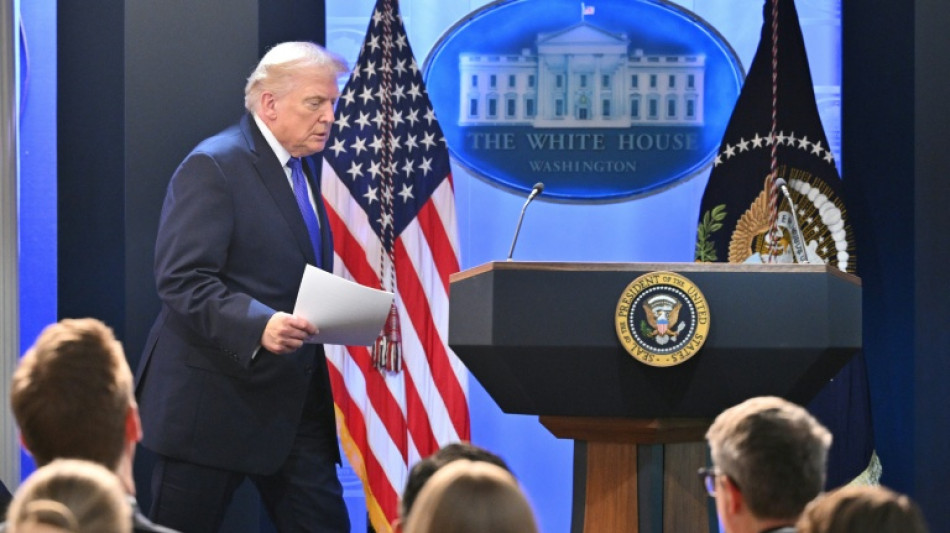
What's next after US Supreme Court tariff ruling? / Photo: © AFP

 Spanish PM begins vote campaign overshadowed by housing protests

 Putin told Trump about Iran's position on peace deal: Kremlin

 Verstappen wins chaotic Singapore sprint after Russell crashes

 Kiss tells Wallabies to 'return fire' after first loss as coach

 Russian strikes kill 11 including 3 children: Ukrainian authorities

 Russian teenager Andreeva breezes into China Open final

 Major earthquake hits Panama, injures at least 27

 India detains 'cockroach' leaders ahead of election protest

 'No divisions, no borders', French astronaut says of seeing Earth

 India's 'cockroach' movement chief detained ahead of major protest

 Year later, Gaza ceasefire promises mostly unfulfilled

 Taiwan's leader says increasing defence spending to 'deter war'

 Major quake hits Panama, no deaths reported

 Hurricane Isaias makes landfall in Florida

 Brazil prosecutors sue Shell for $108 mn over deadly 2024 floods

 Major earthquake destroys buildings, roads in Panama

 Anthropic AI model sent fake murder tip to Philadelphia police
 7.7-magnitude quake rocks Panama, triggers tsunami warning

 Prince Harry booed at English rugby match

 Kiplimo and Feysa seek repeat Chicago Marathon wins

 Fuellkrug halts Dortmund after late goal flurry
 Injured Ravens quarterback Jackson ruled out of Falcons clash

 Brewers aim to take down two-time defending champion Dodgers in NLCS rematch

 Tsunami alert after major earthquake rocks Panama
 Outer bands of Hurricane Isaias lash US Gulf Coast

The Supreme Court's striking down of President Donald Trump's global tariffs, while a relief to many, heralds more months of uncertainty as US businesses brace for new levies and a fight for refunds plays out.
What comes next after the conservative-majority court's decision?
- Long road to refunds -
The ruling sets up a long fight for tariff refunds, as the duties, now deemed illegal, generated some $133.5 billion from January 2025 to mid-December.
The top court did not address the refunds issue, and analysts say this will be decided by lower courts in the coming months.
The US Court of International Trade is expected to manage this process, said ING analysts Carsten Brzeski and Julian Geib.
"Refunds won't come automatically, as any importer that wants its money back must sue individually," they said.
"This process has already kicked off, with over 1,000 corporate entities now involved in a legal fight."
Trump told reporters Friday: "We'll end up being in court for the next five years."
- More volatility -
Hours after the court decision, Trump vowed to impose a new 10-percent tariff on imports under an alternative authority.
This is widely seen as a temporary move to pave the way for more durable tariffs, but is set to trigger other challenges and upheaval in the meantime.
The law Trump is tapping for this tariff -- Section 122 of the Trade Act of 1974 -- only allows for a duty of 150 days unless Congress extends it.
Trump has said there will be new investigations of unfair trade practices under Section 301, a path towards more lasting duties.
Josh Lipsky, chair of international economics at the Atlantic Council, said Friday's ruling merely "opens a new chapter" in Trump's tariff policy.
There will be "more uncertainty, more volatility for businesses to navigate, and more fraught trade deals for countries to negotiate," Lipsky added.
- Losing speed -
But for now, the court's decision "removes one of Trump's fastest tools for imposing broad tariffs," said ING.
US Treasury Secretary Scott Bessent told Fox News on Friday that tariffs based on the International Emergency Economic Powers Act (IEEPA) "were custom made for President Trump to assert leverage" against other countries.
"We were able to bring them to the table very quickly," he said.
"We will get back to the same tariff level for the countries," Bessent vowed. "It will just be in a less direct and slightly more convoluted manner."
- Trade deal uncertainty? -
With tariffs imposed via emergency economic powers forming the basis of recent trade talks, analysts warned that some partners may try to rethink their commitments.
Lipsky expects economies that have already made deals to keep them rather than "risk unraveling an agreement which at least has provided some stability."
But those still finalizing deals may have more leverage now.
Asia Society Policy Institute senior vice president Wendy Cutler expects that walking away from announced deals "does not seem to be in the cards for our partners."
"They know all too well that such a step could end up leaving them in a worse position with the White House," she said.
- Lower tariffs? -
With the Supreme Court ruling, consumers "face an overall average effective tariff rate of 9.1 percent, which remains the highest since 1946 excluding 2025," according to The Budget Lab at Yale University.
This is down from 16.9 percent.
Despite Trump's plan to move towards more lasting duties, Navy Federal Credit Union chief economist Heather Long expects Friday's ruling "will force a reset in tariff policy."
She anticipates this is "likely to lead to lower overall tariff rates and a more orderly imposition of future tariffs."
W.Lapointe--BTB