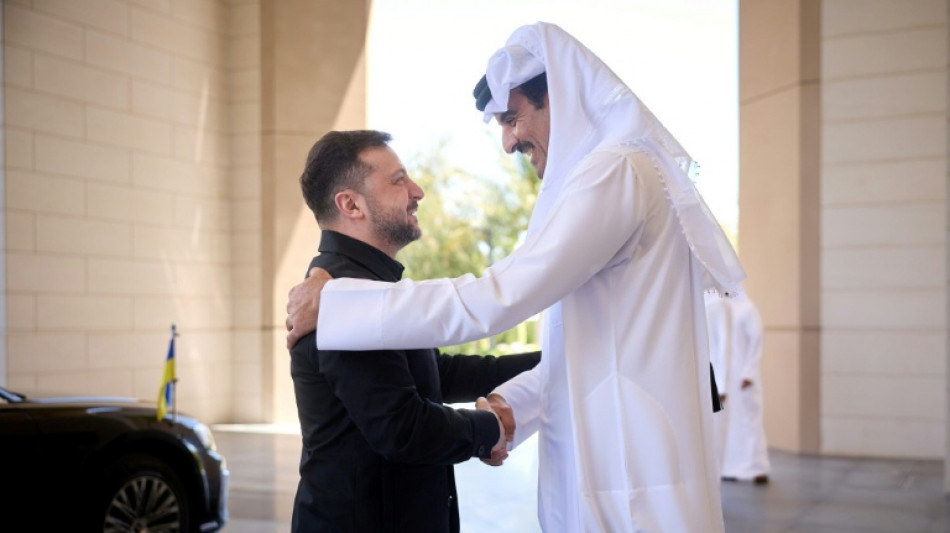
'Risky moment': Ukraine treads tightrope with Gulf arms deals / Photo: © UKRAINIAN PRESIDENTIAL PRESS SERVICE/AFP

 'Tough to stay here': Nepal flood survivors wait for homes

 Malaysia closes schools in capital, parts of country due to haze
 Buccaneers stun Cowboys for first win of NFL season

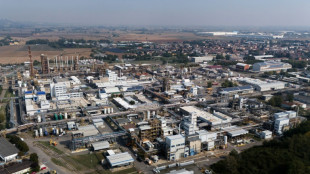 Activists hope trial will stop 'forever chemicals' at Italy plant

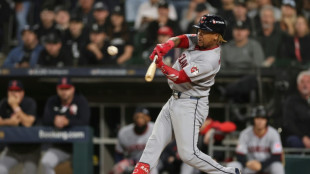 Guardians rally for 9-5 victory over White Sox to stay alive in MLB playoffs
 Asian stocks mixed amid AI concerns, oil dips after surge

 Wallabies expect fast-paced All Blacks in Bledisloe opener
 Tech scammer Elizabeth Holmes focus of documentary by absurdist Nathan Fielder
 Climate hopes shift from politics to the courts

 Will Nobel Peace Prize pick make waves at the White House?
 Trump rules out new Iran attack before US midterm elections
 Far-right influencer shows Israel's coarse political turn
 Seals and sea lions get hearing tested at Australia zoo
 Mourinho's Real Madrid playing catch-up in Clasico countdown
 Joy as USS Lincoln back home after troubled Gulf deployment
 OpenAI says Iran, Russia influence ops busted
 Anthropic bans 'cruel' behavior against its Claude AI
 Anne Carson's Nobel literature prize 'a proud moment for Canada': PM

 Montagliani to seek CONCACAF re-election in boost for Infantino: reports
 Oil surges, stocks sink on jitters over US plans in Iran war

 John Cena and Jessica Biel hit the gas in 'Matchbox: The Movie'

 US, Ukrainians, Europeans to discuss 'new ideas' to end war
 Unproven 'cures' pushed online amid plague concerns

 Nigeria looks to ease fuel prices as election looms
 Prosecutors in Maradona death trial seek sentences up to 12 years

Ukrainian President Volodymyr Zelensky said Saturday that his country had "undoubtedly changed the geopolitical situation" in the Middle East with a series of decade-long defence agreements with Gulf states being hit with Iranian drones and missiles.
Has he? And how important are the agreements for Ukraine, more than four years into the Russian invasion and facing its own maelstrom of military, economic and diplomatic challenges?
The Ukrainian leader has been on a whirlwind tour of the Gulf in recent days -- Saudi Arabia, the United Arab Emirates and Qatar -- touting what he calls Kyiv's world-leading air defences.
Ukraine has developed a suit of tools to fend off nightly Russian drone attacks, chief among then cheap and highly effective drone-on-drone interceptors.
Moscow's attack drones are based on the Iranian Shaheds now being fired by Tehran across the region -- strikes it says are retaliation for US-Israeli air attacks on Iran.
Zelensky has sought to craft an opportunity from the war, which otherwise benefits Russia through higher oil prices and possible slowdowns in Western arms supplies to Kyiv.
Almost immediately, he started offering US allies in the region deals to get their hands on Ukrainian drone interceptors and has dispatched over 200 military experts.
"Surely no one else can help in this way today, with expertise," he told reporters, including AFP, on Saturday.
"No one else possesses such experience."
Ukraine has for months been downing more than 80 percent of all incoming Russian missiles and drones -- typically fired in their hundreds every night -- according to AFP analysis of Kyiv's air force data.
- 'Risky moment' -
Details of what exactly Ukraine has agreed in the Gulf are slim.
"We are talking about a 10-year cooperation. We have already signed a relevant agreement with Saudi Arabia, we have just signed a similar agreement with Qatar, also for 10 years, we will sign one with the Emirates," Zelensky said.
On the table are co-production of drones -- with factories both in Ukraine and in the Gulf -- and expertise sharing, he said, without providing specific information.
It is unclear what Kyiv gets in return, or whether the deals are anything more than simple arms-for-cash.
Zelensky -- who had originally been pushing for expensive air defence missiles in return -- said the agreements were worth "billions, not millions" to Ukraine.
"Specifically billions for our exporters -- everyone will earn, Ukraine will earn, we won't lose out."
Ukrainian drone manufacturers told AFP they had been inundated with requests from the Middle East since the outbreak of war in the region.
"Neither the US, nor Europe, nor the Middle East are prepared for drone warfare," the Ukrainian drone unit commander told AFP.
Zelensky is also keen on the region's energy resources, he said Saturday.
Four years of Russian attacks have decimated Ukraine's energy network, leaving the country critically vulnerable when it comes to electricity, gas and fuel.
"We need long-term agreements with energy-producing countries ... this is precisely what we are negotiating," the Ukrainian leader said.
However, Ukrainian support to the Gulf is not straightforward.
Inside the army, commercial exports of weapons at a time of war present an ethical dilemma.
"Somebody becomes a millionaire, another ends up dead or amputated. Yet they seem to be serving the same cause," the commander of one drone unit told AFP recently.
Producers told AFP export deals would bring them cash to ramp up production, not take away from what they supply to the Ukrainian army.
"This is quite a risky moment for Ukrainian diplomacy," Yevgen Magda, a political analyst and director of the Kyiv-based Institute of World Policy think-tank, told AFP.
Especially since Kyiv is an absolute newcomer to the world of international weapons sales.
"The arms market is quite a delicate thing and succeeding there with one swift move or a single tour ... is very difficult," Magda said.
"Let's hope it will be implemented in the way that is best for Ukraine, but it's very difficult to guarantee anything now," he added.
M.Furrer--BTB