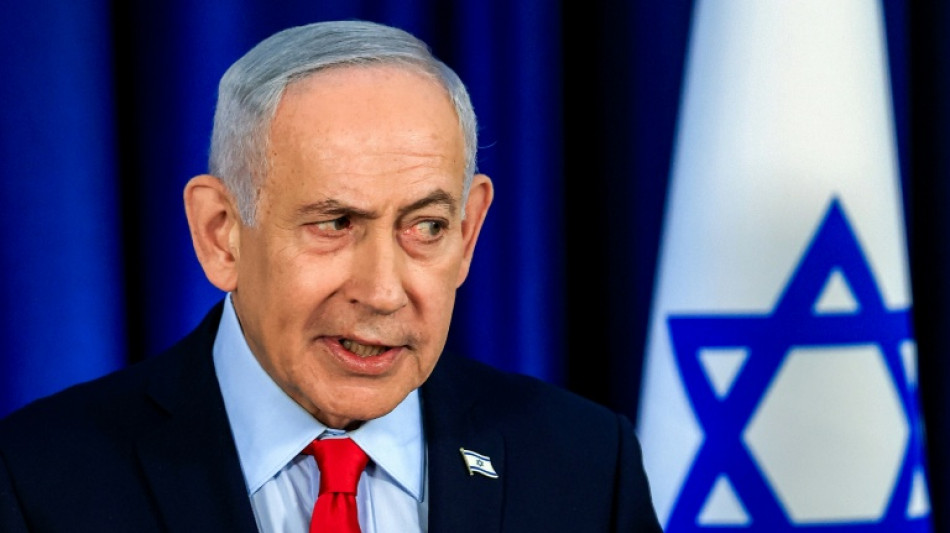
US, Iran ceasefire sees Israel's war goals left hanging / Photo: © POOL/AFP

 Record Eden Park streak creates tension for All Blacks

 EU trade chief seeks 'tangible outcomes' in China talks

 Man City face Anfield cauldron after guilty Premier League verdicts
 CNN, MS Now, Politico urge judge to extend White House access

 Trump administration to launch new vaccine research center

 Russian strikes kill 30 in Ukraine frontline city, talks set in US

 US military to livestream firing squad execution of Fort Hood shooter

 Aces star Wilson wins record-extending fifth WNBA MVP

 Undefeated 49ers seek Seahawks revenge
 Madrid mourns evicted retiree, 'icon' of Spain housing protests

 OpenAI revenue gap report rattles AI stocks
 France pledges more teachers after school students vow no let-up

 Bordeaux confirmed in sixth tier of French football

 Trump gives 'national treasure' Musk top US medal after rift

 MLB proposes shortening season, reforming playoffs
 Crew splashes down after 8-month mission on International Space Station
 Protests, clashes as S. African anti-migrant tensions reignite
 Russian data centre hit by drone in first for Ukraine war
 'Fighting for our future': France high school students vow no let-up
 Kyiv entering 'survival' mode amid Russian strikes surge: mayor tells AFP
 Verdict due in Mexico trial over murders of Australia, US surfers
 B2PRIME Welcomes Christina Barbash as Commercial Manager

 Russia forcing Kyiv into 'survival' mode before winter, mayor tells AFP
 Closing arguments begin in Maradona death trial
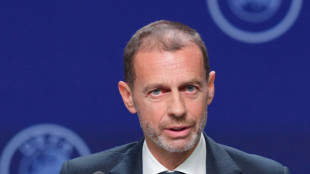 UEFA president Ceferin to stand for re-election in 2027

A ceasefire between the United States and Iran has left Israel's principal war objectives largely unmet, analysts say, with Israeli opposition figures quick to denounce a major "strategic failure".
Prime Minister Benjamin Netanyahu had set the elimination or at least severe degradation of Iran's nuclear programme as a central goal in the conflict, having described it for years as an "existential threat" to Israel.
He had also called for the dismantling of Iran's ballistic missile capabilities, and the weakening or potentially toppling of the Iranian regime.
"On all three, objectively, he's failed," Mairav Zonszein, a senior Israel analyst with the International Crisis Group, told AFP on Wednesday, just hours after Israel announced its support for the US-Iran truce.
"The uranium is still in Iran, the ballistic missiles, Iran can still fire even when it had US and Israeli airstrikes for over a month... and the regime is still very much intact," she added.
Yossi Mekelberg, a Middle East expert at London-based think-tank Chatham House, said that Iran's ballistic missile capabilities had undoubtedly been diminished compared to before the war, but its clerical leadership remained intact.
"Regime change hasn't happened," Mekelberg told AFP.
"Some of the people in the regime changed because they were killed... But regime change definitely didn't happen."
As for Iran's nuclear programme, Mekelberg cautioned it was too early to draw conclusions.
- 'Deeply troubling' -
For Danny Citrinowicz, a senior Iran researcher at Israel's Institute for National Security Studies, the initial picture was "deeply troubling".
"The regime is still firmly in power. Its missile capabilities are damaged but still intact. It still holds roughly 440 kg of uranium enriched to 60 percent," he wrote on X.
After agreeing to a two-week truce to halt the war which began with US-Israeli strikes on Iran on February 28, Iran and the US will enter talks in Pakistan on Friday.
While Tehran has agreed to temporarily reopen the Strait of Hormuz, its demands over future control of the vital waterway, uranium enrichment and sanctions, are at deep odds with the US.
"At the very least, one has to hope that the negotiations in Islamabad will produce a different outcome on the nuclear issue," Citrinowicz said.
"Otherwise, we risk emerging from this war worse off than when it began."
Appearing to contradict the terms set out by mediator Pakistan, Israel has insisted the ceasefire does not include Lebanon, where its forces are fighting Iran-backed Hezbollah for the second time in less than two years.
"That's already a point of conflict," in the fragile truce, Zonszein explained.
"We'll have to see how much (US President Donald) Trump is going to step in," she said, adding that Israel would want to continue fighting in Lebanon and separate that front from the war in Iran.
"I think Israel is adamant that the Lebanon issue is not done," Mekelberg of Chatham House agreed.
Israel on Wednesday launched its "largest coordinated" strikes against Hezbollah since the start of the war.
- 'Victory narrative' -
Analysts suggested it was too early to tell the impact of the war on Israel's relationship with Gulf countries, and Netanyahu's desire to expand the Abraham Accords.
Both Zonszein and Mekelberg said the war had exposed the Gulf countries' vulnerabilities as well as Iran's willingness to attack regional neighbours, forcing them to reassess their security frameworks.
A raft of Israeli opposition politicians have criticised the ceasefire with Iran, slamming it as a major failure that would take years to recover from.
"There has never been a political disaster like this in our entire history," the country's main opposition leader Yair Lapid wrote on X.
But Zonszein said that Netanyahu would try to spin the war as a victory, particularly playing on the close cooperation between US and Israeli forces fighting their longtime arch-foe.
"The minute that the war began as a joint US-Israeli operation, that was already the victory that Netanyahu needed and wanted and whatever happened was secondary," she said.
"I think Netanyahu will use that still as his victory narrative that 'we degraded the Iranian regime. They are weaker now. It's not the same Iran.'"
With Israeli parliamentary elections due by the end of October, Netanyahu's fate will soon be decided at the ballot box.
Israelis would feel "immediate relief" following the ceasefire, but "there will be real discussion if this was all worth it," Mekelberg said.
P.Anderson--BTB