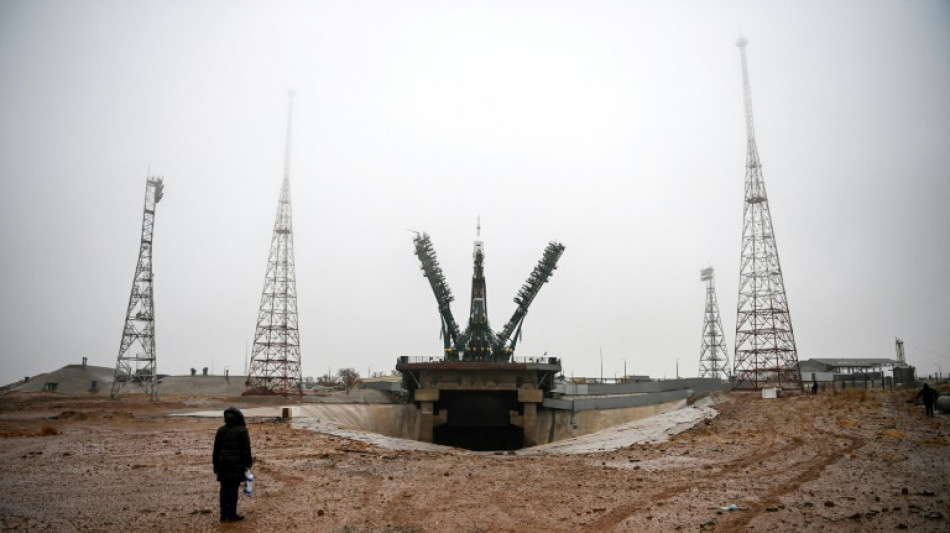
Russia launches Iranian satellite amid Ukraine war concerns / Photo: © AFP/File

 Spurs splash out £75 million for Man City's Savinho

 IntellectEU Introduces Catalyst Core

 Stocks rise and oil slips as traders eye Iran threat, Nvidia results

 India in command despite Sooriyabandara half-century

 Hyundai reaches tentative deal with workers after strike

 Trees 'giving up': climate change hammers historic English gardens

 Malian songbird keeps age-old sounds alive at 88

 Canada to announce response to Trump's new tariffs
 Stocks stagger and oil rises as traders eye Iran threat, Nvidia results
 Families of detained Chinese Christians cling to faith in legal limbo

 Trump veers from boredom to denial after six months of Iran war

 Cool Japan: Human fridge chills workers in extreme heat

 Tens of thousands flee fire near US city of Reno

 LiberNovo Support Week Goes Live: Up to 44% Off on Maxis, Omni SE and Omni Pro Ergonomic Chair Series

 Despair and anger erupt after deadly Guinea landfill collapse
 Tornado tears through French village, dozens injured

 Federer looks forward to brief return to Arthur Ashe stadium

 US removes Syria from state sponsor of terrorism list
 Facebook, TikTok promoted Colombian armed groups' content to recruit children: HRW
 Palmeiras agree to sell Allan to Manchester City: source

 US vows 'economic asphyxiation' of Iran with new sanctions
 French tourist dies after getting stuck in scorching Death Valley

 US proposes expanding UN Sudan arms embargo to entire country

 Ceasefire verification mission heads to east DR Congo
 Carse dropped from England squad after nightclub incident

An Iranian satellite launched by Russia blasted off from Kazakhstan early Tuesday and went into orbit amid controversy that Moscow might use it to improve its surveillance of military targets in Ukraine.
A live feed from Russian space agency Roscosmos showed the launch of the Soyuz-2.1b rocket carrying the Khayyam satellite from the Russia-controlled Baikonur cosmodrome at the scheduled time of 0552 GMT.
The Russian mission control confirmed its subsequent entry into orbit.
Iran, which has maintained ties with Moscow and refrained from criticism of the Ukraine invasion, has sought to deflect suspicions that Moscow could use Khayyam to spy on Ukraine.
Last week, US daily The Washington Post quoted anonymous Western intelligence officials as saying that Russia "plans to use the satellite for several months or longer" to assist its war efforts before allowing Iran to take control.
But the Iranian Space Agency said on Sunday that the Islamic republic would control the Khayyam satellite "from day one".
"No third country is able to access the information" sent by the satellite due to its "encrypted algorithm," it said.
The purpose of Khayyam is to "monitor the country's borders", enhance agricultural productivity and monitor water resources and natural disasters, the space agency said.
In a pre-launch statement on Monday ISA praised "the high reliability factor of the Soyuz launcher".
"Due to Khayyam satellite's weight of more than half a ton and the very high success rate of the Soyuz launcher, the launch of the Khayyam satellite has been entrusted to Russia," the statement on the space agency's website noted.
As Moscow's international isolation grows under the weight of Western sanctions over Ukraine, the Kremlin is seeking to pivot Russia towards the Middle East, Asia and Africa and find new clients for the country's embattled space programme.
Russian President Vladimir Putin met Iranian counterpart Ebrahim Raisi and Supreme Leader Ayatollah Ali Khamenei in Tehran last month -- one of his few trips abroad since the invasion began.
- 'Long-term cooperation' -
Khayyam, apparently named after the 11th-century Persian polymath Omar Khayyam, will not be the first Iranian satellite that Russia has put into space -- in 2005, Iran's Sina-1 satellite was deployed from Russia's Plesetsk cosmodrome.
Iran is currently negotiating with world powers, including Moscow, to salvage a 2015 deal aimed at reining in Tehran's nuclear ambitions.
The United States -- which quit the landmark Joint Comprehensive Plan of Action or JCPOA under then-president Donald Trump in 2018 -- has accused Iran of effectively supporting Russia's war against Ukraine while adopting a "veil of neutrality".
During his meeting with Putin last month, Iran's Khamenei called for "long-term cooperation" with Russia, and Tehran has refused to join international condemnation of Moscow's invasion of its pro-Western neighbour.
Iran insists its space programme is for civilian and defence purposes only, and does not breach the 2015 nuclear deal, or any other international agreement.
Western governments worry that satellite launch systems incorporate technologies interchangeable with those used in ballistic missiles capable of delivering a nuclear warhead, something Iran has always denied wanting to build.
Iran successfully put its first military satellite into orbit in April 2020, drawing a sharp rebuke from the United States.
M.Odermatt--BTB