DR Congo Ebola risk high regionally, low worldwide: WHO / Photo: © AFP

 EU trade chief seeks to dial down China tensions

 'Never again Bolsonaro': thousands march ahead of Brazil election runoff

 After botched execution, US woman was nearly taken off life support before revival
 Searing AIDS drama 'Elsinore' opens London film festival

 Evicted pensioner who sparked Spain housing protests dies: tenant union
 Golf star Rahm quitting LIV tour over 'unacceptable' terms

 Thousands march fearing return of a Bolsonaro presidency in Brazil
 French PM denies police ordered to confront student protesters
 Rubio touts US power, calls on Europe to emerge from 'slumber'

 Trump says 'we don't think' Russian plague is bio-weapon
 Five children among 26 killed in Ukraine after Russian strikes
 Man City should 'accept' punishment for rule breaches, says Lineker
 US woman who survived botched execution is awake and speaking
 From 1800s to modern pharma: a Nobel-winning chemistry quest

 Southampton boss Eckert given suspended ban over 'Spygate'

 Russia warns of 'false' information as second plague case reported
 IEA ready to release more oil reserves if necessary
 HSBC 'consults' over UK unit job cuts amid AI adoption
 UK court quashes five ex-traders' Libor rate rigging convictions
 XM Receives “Global Customer Experience Leader Award 2026” at the TrustFinance Performance Awards
 Stocks slide as oil climbs on Mideast flareup
 Heavy casualties in Ukraine after Russian strikes
 French wine harvest set to hit historic low
 Kyiv 'cannot agree' to EU membership limiting food exports: minister

 Arteta targets more Arsenal glory after signing new deal until 2030

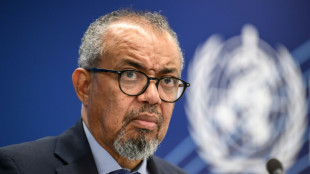
The deadly Ebola outbreak raging in central Africa probably began several months ago, the World Health Organization said Wednesday, deeming the risk high in the region but low worldwide.
WHO experts said that investigations were under way into the origins of the outbreak, which was declared in eastern Democratic Republic of Congo last Friday, but the suspicion was that the contagious haemorrhagic fever had been spreading under the radar for some time.
"Given the scale, we are thinking that it has started probably a couple of months ago," Anais Legand, WHO technical officer on viral haemorrhagic fevers, told reporters in Geneva.
Ebola has killed more than 15,000 people in Africa in the past half-century, and the UN health agency declared the latest surge an international health emergency.
The 17th Ebola outbreak to hit the DRC is already suspected of having caused 139 deaths from around 600 probable cases.
"We expect those numbers to keep increasing, given the amount of time the virus was circulating before the outbreak was detected," WHO chief Tedros Adhanom Ghebreyesus told reporters.
The WHO has highlighted the complexity of detecting and responding to the outbreak, which has been spreading in hard-to-reach areas of the DRC's conflict-torn Ituri province.
Complicating things further, the less common Bundibugyo species behind the outbreak does not show up on tests for the more common Zaire strain of Ebola.
- Not a pandemic -
On Sunday, Tedros declared the outbreak a so-called public health emergency of international concern -- the second-highest level of alarm under the legally-binding International Health Regulations (IHR), which triggers emergency responses in countries worldwide.
"There are several factors that warrant serious concern about the potential for further spread and further deaths," he said Wednesday.
However, he said he "determined that the situation was not a pandemic emergency".
Following a meeting of the WHO's emergency committee, he said Wednesday that the agency "assesses the risk of the epidemic as high at the national and regional levels, and low at the global level".
For its part, the European Commission in Brussels insisted that the risk of infection in the EU was "very low" and that "there is no indication" that Europeans should take specific measures.
First identified in 1976 and believed to have originated in bats, Ebola is a deadly viral disease spread through direct contact with bodily fluids. It can cause severe bleeding and organ failure.
To date, the WHO has not recommended specific travel restrictions, although its emergency alert and response director Abdi Rahman Mahamud stressed Wednesday that "all contacts, all cases should not travel".
Given the global alarm, a number of countries have nonetheless introduced travel restrictions.
Washington announced Tuesday it was screening air passengers from outbreak-hit areas and temporarily suspending visa services, although a State Department official said the DRC's national football team would be allowed to travel to the United States for the World Cup.
Bahrain meanwhile announced a 30-day ban on visitors from the DRC, South Sudan and Uganda.
- 'Lack of understanding' -
With the recent cases largely concentrated in remote areas, few samples have been laboratory-tested and figures are based mostly on suspected cases.
So far, 51 cases have been confirmed in the DRC's eastern provinces of Ituri and North Kivu, while two cases have been confirmed in the Ugandan capital Kampala, including one death.
A US national working in the DRC has also been confirmed positive and transferred to Germany.
The first identified case in the current outbreak was a nurse, who went to a health centre on April 24 in the city of Bunia, the capital of Ituri province.
But the epicentre of the outbreak is about 90 kilometres (56 miles) away, in Mongbwalu, which suggests the outbreak originated there and that the cases then spread.
Tedros also hit back at criticism over the response time from the United States, which under President Donald Trump has announced its withdrawal from the WHO.
On Tuesday, US Secretary of State Marco Rubio charged that the WHO "was a little late to identify this thing unfortunately".
Asked about the US criticism, Tedros said that could stem "from lack of understanding of how IHR work, and the responsibilities of WHO and other entities".
"We don't replace the countries' work, we only support them."
T.Bondarenko--BTB