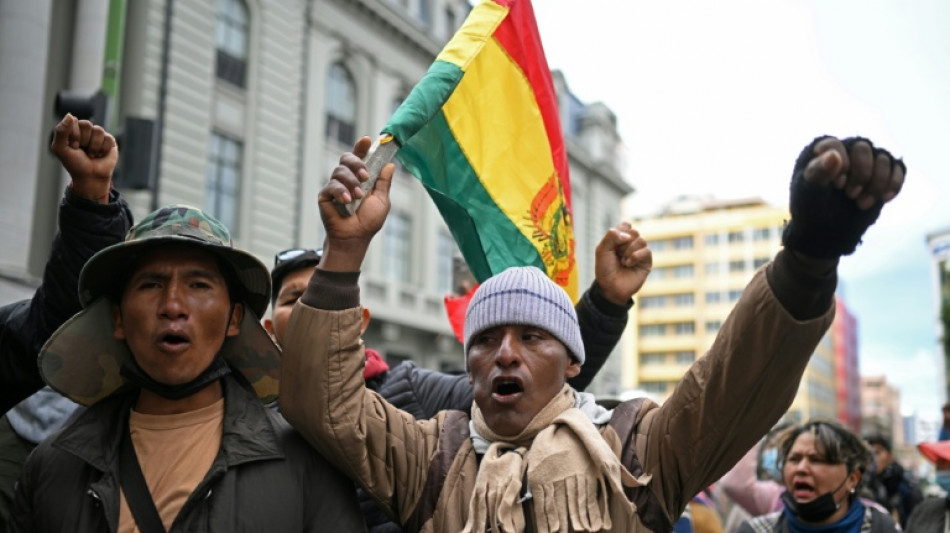
Bolivian Congress OK's use of troops against protesters / Photo: © AFP

 Rubio touts US power, calls on Europe to emerge from 'slumber'

 Trump says 'we don't think' Russian plague is bio-weapon

 Five children among 26 killed in Ukraine after Russian strikes

 Man City should 'accept' punishment for rule breaches, says Lineker
 US woman who survived botched execution is awake and speaking
 From 1800s to modern pharma: a Nobel-winning chemistry quest

 Southampton boss Eckert given suspended ban over 'Spygate'
 Russia warns of 'false' information as second plague case reported

 IEA ready to release more oil reserves if necessary
 HSBC 'consults' over UK unit job cuts amid AI adoption

 UK court quashes five ex-traders' Libor rate rigging convictions
 XM Receives “Global Customer Experience Leader Award 2026” at the TrustFinance Performance Awards
 Stocks slide as oil climbs on Mideast flareup

 Heavy casualties in Ukraine after Russian strikes

 French wine harvest set to hit historic low
 Kyiv 'cannot agree' to EU membership limiting food exports: minister

 Arteta targets more Arsenal glory after signing new deal until 2030

 Russell hit with Singapore grid penalty for taking new power unit

 Spotify expands audiobooks to more than 180 markets

 French-Japanese duo wins chemistry Nobel for solving molecular 'mystery'

 England's Nations League surge helps heal World Cup wounds

 Mayor of opposition stronghold Izmir defects to Erdogan party
 Mertens beats Gauff to set up Swiatek clash at China Open

 Benin full of pride at role in Messi's last dance

 France suspends stun grenade use at student protests ahead of PM speech
Bolivia's congress voted Tuesday to let President Rodrigo Paz deploy soldiers and declare a state of emergency to counter huge street protests seeking his resignation over economic hardship.
By a more than two-thirds majority the Chamber of Deputies eliminated a rule that restricted the center-right president's leeway to invoke emergency measures, the chamber's speaker Roberto Castro announced.
As a groundswell of fury with the US-backed leader continues to convulse the Andean nation just six months into his term, the way is now clear for Paz to deploy the army and curb some civil liberties, like freedom of movement and assembly. The law had already been rushed through the Senate.
With an ample majority of the 117 members present in the 130-seat chamber, lawmakers undid a rule that since 2020 had limited the president's ability to impose states of emergency.
The repeal took place outside of ordinary congressional procedure so it could be pushed through in just one week.
As the protests have grown, Paz has made various gestures aimed at ending the revolt against policies with which he is attempting to resolve Bolivia's worst economic crisis in decades.
The demonstrations began in early May with trade union demands for salary increases, stable fuel supplies and sounder economic management. But the movement has intensified.
Protesters have blockaded entry routes into La Paz, shops have shuttered for fear of violence, and food, medicine and fuel supplies are running low.
Critics of Tuesday's action in congress say it puts human rights at risk. Opposition lawmaker Sonia Sinani said it will actually make things worse and "pour gasoline on the flames" of the street protests.
"This law is like a strait jacket," said another opposition lawmaker, Alejandro Reyes.
The overturned regulation outlawing states of emergency dates back to social unrest in 2019 which killed 36 people and led to the resignation of then socialist leader Evo Morales.
When Morales' right-wing successor Jeanine Anez entered office, the socialist-dominated Congress sought to limit the government's capacity to crack down on protests.
The law made congressional approval of states of emergency mandatory, and also gave lawmakers the right to propose amendments to prevent abuses.
The Paz government claims that the current protests aim to "disrupt the democratic order" and has accused Morales -- in hiding from trafficking allegations, which he denies -- of orchestrating the upheaval.
In a bid to quell public fury with his leadership, Paz on Monday said he would cut his own salary by 50 percent.
His monthly salary is currently set at around 24,000 bolivianos ($3,500), one of the lowest of any Latin American leader but about eight times that of the average Bolivian, according to 2024 statistics from the International Labor Organization.
C.Kovalenko--BTB