
Vietnam unveils 'baby bonus' after scrapping two-child policy / Photo: © AFP

 WADA seeks tough anti-doping stance from Kenya

 German ex-spy chief arrested for suspected espionage, treason

 Furyk vows US will 'do more' to end Ryder Cup losing streak

 Iyer hits ton as India hammer West Indies in T20 opener

 Mandhana named India women's team captain after Kaur quits

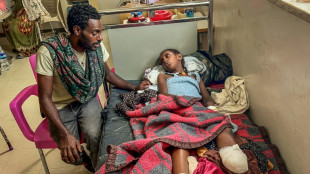 'The sound keeps coming back': children maimed in Ethiopia's Tigray clashes

 Paris Women's Fashion Week: the key trends

 i-payout Introduces a New Approach to Payments, Closing the Beneficiary Information Gap

 New Generation of Crypto Miners Released by ASICID

 New investor forecasts LIV Golf teams could be worth $100 mn each

 Shakira, Pique return to court over children visit arrangements

 Nobel physics prize hails 'ghostly messengers' from space

 France's Mistral unveils latest model in sovereign AI push

 Stocks climb as oil prices retreat

 Vstock Transfer Names Securities Industry Veteran Erica Goodstein General Counsel and Chief Compliance Officer

 Four Indonesian seamen return home after Somali pirate ordeal

 Crisis-striken Haiti postpones elections

 Germany arrests ex-spy chief on suspicion of giving secrets to foreign powers

 Djokovic wins China Open after de Minaur retires

 IMF warns cost-of-living shocks cause 'lasting deterioration' in affordability

 Alcaraz wins Japan Open for first title since injury return

 'We're working to keep football clean', Turkish minister says

 FIFA chief Infantino hit by Norwegian double complaint

 Exiled Catalan separatist leader Puigdemont cleared to return to Spain

 Stock markets climb as oil prices retreat

One year after lifting its long-standing two-child limit, Vietnam is offering incentives for people to have more babies as the communist country risks getting old before it gets rich.
A new population law and regulations coming into effect Wednesday extend maternity leave from six to seven months for mothers having a second child as well as offering financial help.
If Hanoi residents Nguyen Kim Bich and her husband have a second child, she will get an extra month of maternity leave, free prenatal screenings and a small cash bonus.
"I could stay at home one more month with the baby, and my husband could stay home some more days," the 32-year-old said as her young son romped in a colourful pit of plastic balls.
The new regime subsidises prenatal and newborn screenings and establishes one-off cash bonuses of up to $228 -- two-thirds of the monthly average salary -- for mothers who meet certain criteria.
"This is a significant shift in approach," said Pham Thi Lan, head of population and development at the UN Population Fund (UNFPA) in Vietnam.
"We are moving from controlling family planning to focusing on population development."
The change, in a country where communist party members faced sanctions for having a third child until last year, comes as the demographic picture darkens.
Soaring life expectancy and declining birth rates have turned Vietnam into one of the fastest-ageing countries in the world.
These trends reflect the development successes of recent years, but economists warn they could lead to labour shortages and strain the social safety net.
The new population law aims to slow the demographic shift.
But for Bich and her husband Lai, an accountant and advertising professional, the inducements are not enough.
Nearly half their combined $1,000 monthly income already goes to raising their first child, and they share a small house with his parents.
"The benefits are nice but not enough. One more month of leave and $75 can never attract us to have a second kid," she said, citing how much of the bonus she would expect to qualify for.
- 'Major slowdowns' -
Vietnam's preference for two-child families dates back to the 1960s, when communist authorities in the north sought to curb explosive population growth during the war.
An official limit was adopted in 1988, but enforcement was never as strict as in neighbouring China, where sterilisations and forced abortions accompanied a one-child policy lifted from 2016.
Today, Vietnam is not yet locked in a demographic death spiral like South Korea or Japan.
Its birth rate is below the replacement level of 2.1 children per woman, but at 1.93 is robust compared to most developed nations.
Life expectancy meanwhile has risen to nearly 75 while the share of the population over 60 has ticked over ten percent.
By the middle of the century, the over-60 cohort will make up 25 percent and the population will begin to shrink, according to government projections.
What worries economists is that this shift is happening at an earlier stage of development than in other rapidly ageing countries.
Vietnam is among the fastest-growing economies in Asia, but it is still relatively poor.
GDP per capita is around $5,000 -- half of Japan's when its birth rate matched Vietnam's in the early 1980s, and that is without adjusting for inflation.
That means Vietnam will have "less time to adapt to an aged society than many advanced economies had", the World Bank warned in a 2021 report.
The country has a "narrow window" for reform before facing "major slowdowns in growth", it said.
- 'No way' -
Vietnam's communist leaders have framed the new population law as one answer to that challenge, touting it as a first in the region.
UNFPA's Lan welcomed the legislation, saying it "addresses the current demographic shift" and empowers couples to make their own reproductive decisions.
However, she acknowledged the limitations of one-off benefits like cash bonuses, saying that continuous support through child-rearing is often necessary to change parents' minds.
Without more "comprehensive support", high housing and childcare costs will continue to "hinder people from fulfilling their desire to have children", she said.
That tracks with one recent government survey, in which 73 percent of married respondents said their wages influenced their decision to have children.
Tran Minh Anh, 24, who earns about $380 per month as a cashier in Hanoi, felt similarly.
"I will not have any kids at all," she said, adding it was "too much pressure, financially and mentally".
"How can I take care of one more person? No way!"
I.Meyer--BTB