Nerves high in Kyiv as Russia escalates missile attacks / Photo: © AFP

 Asian Games set to close after records, rancour and rain

 Cry for help as French-Swiss lake dries up

 Sabalenka swept out of China Open in third round

 US urges 'restraint' as Ethiopia's Tigray crisis rocks region

 Teens on target again as USA down Mexico 3-0

 World records prove Asian Games were a hit, says top official

 US prison chief who oversaw botched execution resigns

 'Chaotic' Asian Games threaten Japan hopes of hosting Olympics again

 Finnish town braces for change from Google data centres

 What is fuelling French school protests?

 Without lawyers, migrant children face deportation from the US

 Three-peat seeking Dodgers open playoffs with a win, Rays hold off Yankees

 Brazil votes in nail-biter polls closely watched by Trump

 'Just be you': Kim reveals Tiger text that inspired him to gold

 Myanmar migrants returned to war-torn nation from Malaysia

 ALEX BODI AND AMBASSADOR GUM DOMINIC MATIOK OF THE REPUBLIC OF SOUTH SUDAN MEET IN BERLIN TO DISCUSS THE POSSIBILITY OF AN HONORARY CONSULATE IN BUCHAREST

 Lula, Bolsonaro wrap up campaigns ahead of Brazil's knife-edge vote

 Toulouse edge Castres in Top 14 derby

 Murakami homer propels White Sox to MLB playoff win over Guardians

 Israel targets top Hamas leader in deadly Gaza strike on anniversary

 Houthis say struck oil facility near Riyadh, as Saudis hit Sanaa

 AI needs safety layers like nuclear plants: ex-OpenAI engineer

 MVP Judge will miss Yankees' MLB playoff series against Rays

 New lizard species discovered in Peru

 Fernandes hails Portugal's 'greatest symbol' Ronaldo, calls for unity

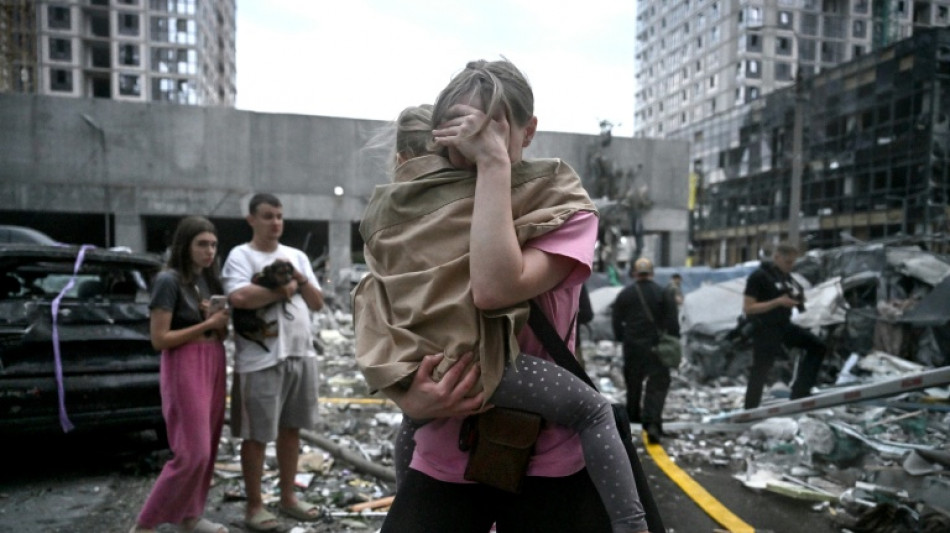
Through more than four years of the Russian invasion, 27-year-old Oleksiy Virskovsky largely hasn't bothered going to to the underground shelter in the building next door -- despite almost nightly missile and drone attacks.
Now, he told AFP in Kyiv, that has changed.
Russia's strikes on the Ukrainian capital have become "more aggressive", "more massive" and "more intense", Virskovsky said.
"It's somehow become more frightening, and I've started going down to the shelter... I've begun to take safety more seriously than before," the student added.
Moscow has been firing missiles and drones at Kyiv since the first day of the invasion.
But a spate of deadly attacks using dozens of ultra-fast ballistic missiles that Ukraine's air defences struggle to intercept have frayed nerves.
More than 50 people have been killed in Kyiv so far in July -- with two of the deadliest strikes on the capital of the entire war coming less than a week apart.
In a strike on the night of July 5-6, Kyiv's defences failed to down a single ballistic missile -- a worrying development for what was previously seen as the best protected area of the country.
In another attack, the blast of a missile over the Kyiv skyline rocked sleeping residents even before the city's air alert sirens managed to sound.
It was a rare, unexplained, glitch in a system that blares out warnings of incoming attacks multiple times a day through loudspeaker announcements on the street and metro, and the collective ping of phone notifications.
- 'Nerve-racking' -
President Volodymyr Zelensky has conceded Ukraine does not have enough US-supplied Patriot missile interceptors to adequately protect the city.
At a NATO summit on Wednesday, US President Donald Trump appeared to give the green light for Kyiv to start manufacturing its own -- but the details remain unclear and it will take months before they can be used.
In the meantime, most people in Kyiv are reassessing the routines they have developed over the last four years.
Through personal experience and helped with a plethora of social media channels that track incoming Russian missiles and drones, many felt they had calibrated a good sense of how real and immediate the danger was at any given point.
But the ballistic strikes -- which can reach Kyiv within just a few minutes -- have upended that.
On days when a big attack is expected, some residents now head straight to metro stations -- the typical underground overnight refuge -- when they finish work, not waiting for the air alert.
The station floors -- packed with people taking their pets, tents, air mattresses, prams and cots -- have become overcrowded.
The Kyiv metro said more than 50,000 camped out inside the network on the night of a recent attack -- the most since the first months of the war.
Veronika Khudenko, in Kyiv for the past month for an internship from London, has spent every single night there.
"The latest attacks are very hard to bear, very nerve-wracking," the 22-year-old told AFP.
"It's very hard to function during the day, because there is strong emotional pressure throughout the night," she added.
- 'Children are afraid' -
Anna Nesterova, a 46-year-old podologist, told AFP she is still hanging tight at home.
"We sit in the hallway," she said, citing a fear of being stuck in a crowded underground during an attack.
"It's more convenient for me and I feel calmer at home."
Her son has been at the front since he turned 18. Nesterova feels a duty to be "calm" for him.
Another who stays at home is Yulia Parkhomenko, a 34-year-old mother of two. The metro is too far from her home and there are no decent shelters or basements nearby.
So as soon as the air alert starts, she takes blankets and pillows into the bathroom with her children and hunkers down.
"With each attack it's getting more and more frightening," she said.
"And the scariest thing is for the children. My children are just very afraid."
afptv-fv/jc/rlp
H.Seidel--BTB