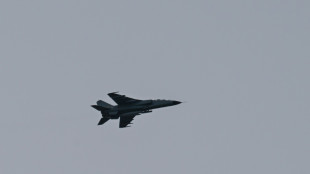
From bombmaking to motorcycle tweaks: how Nigerian jihadists use AI / Photo: © AFP

 Ethiopia's conflict: the regional dimension

 Life expectancy almost back to pre-Covid levels, says WHO

 Turkey's football referee chief faces judge in graft probe

 Verstappen goes own way to avoid the rain

 Oil slides, bonds steady as EU addresses diesel price surge

 Spain housing package at risk in parliament, as protests mount

 Swedish Social Democrats leader to make new bid to form government

 North Korea calls Seoul 'despicable' after DMZ apology demand

 Taiwan boxer Lin wins gold as virtual taekwondo makes Games debut

 Man City face appeal deadline after explosive financial verdict

 Pole vault superstar Duplantis to skip indoor season

 Sri Lanka drop Asalanka from T20 against Pakistan

 Disney president says layoffs 'extremely painful' but necessary

 Indian flydubai pilot opened cockpit door to save passengers
 Alex Marquez clocks record lap at MotoGP Japan practice

 Tom Kim leads Asian Games golf in chase to avoid military service

 Asian stocks hit as oil spike fans rate hike bets, eyes on US jobs

 'We're losing our scientists': west Africa's STEM struggle
 World powers gather in Pacific to chart climate battle

 Return of swarming moth spectacle has Australia in a flutter

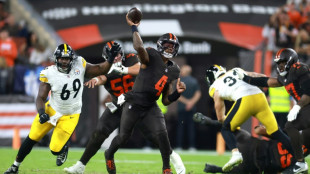 Browns snuff out Rodgers fightback to beat Steelers 27-24
 Braves power past Phillies to set up Dodgers showdown

 Asian stocks drop as oil spike fans rate hike bets, eyes on US jobs

 Viral anti-vax posts weaponise Philippine inoculation fears
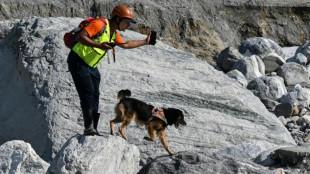
 Saudi coalition accuses Houthis of drone attack on Medina

Nigerian jihadists have "institutionalised" the use of AI, using it for everything from battlefield strategy to bombmaking, according to a new study, in a push for tech-driven efficiency mirroring the world's largest corporations.
Africa's most populous country has been entrenched in an insurgency since 2009, and technological advancements by militants are not new.
Jihadists in west Africa and worldwide have long spread propaganda with the aid of the internet and online messaging platforms -- and more recently adapted recreational drones for combat.
But "AI adoption by terrorist groups has been much faster, more extensive and more systematic than we thought," Antonia Juelich, the author of the study, said in an interview with AFP on Monday.
"It's not just some individual commanders who became aware of AI, but they have really institutionalised it, in terms of having dedicated units" working with AI and organising training on how to use chatbots, she added.
Juelich, a researcher affiliated with Cambridge University, published her study on AI adaptation by Nigerian jihadists last week, based on interviews with ex-militants from both Islamic State West Africa Province (ISWAP) and rival Jama'at Ahl as-Sunnah lid-Da'wah wa'l-Jihad (JAS) -- better known as Boko Haram.
Foreign trainers "assembled the top people in a room. They used a projector to show how it works on a big screen," one former ISWAP militant told Juelich.
While the internet -- along with foreign and homegrown expertise from battle-hardened commanders -- has long been an aide to jihadists, "the step by-step-instructions" provided by chatbots as well as "being able to ask specific questions" represent something novel, Juelich told AFP.
ChatGPT, Claude, Gemini, Grok, Meta AI and DeepSeek were all recorded as being used by the militants, the study noted.
- 'AI told us' -
If the expert-led trainings and top-down organisational focus on AI is similar to some business practices, however, the way jihadists use AI is probably different -- from seeking help with Evel Knievel-style motorcycle modifications to learning about new and unfamiliar weapons seized in combat.
When confronted with trench defences dug by the military, "We saw in a movie how motorcycles can jump over bridges. We used AI to learn how to do this," an ex-ISWAP member was quoted in the study as saying.
After repeated practice, "the next time we attacked, we could jump".
In bombmaking, chatbots have introduced new types of explosive devices and also helped improve existing ones.
"AI told us what chemicals to put in that made the explosion heavier," a former JAS commander said.
Other uses included using AI to study battlefield tactics that could lead to reduced casualties, an ex-ISWAP militant said.
The research comes as AI bosses have warned their technology could pose existential risks for humanity while also promising safeguards embedded in their chatbots.
Some requests, like how to jump a motorcycle over a trench, are not necessarily nefarious in nature.
"But explosives don't fall into that category and that's where safeguards should kick in, and they haven't," Juelich told AFP.
The study covered jihadists' use of AI from 2023 through 2024, with one militant able to speak on AI use as recently as 2025 -- meaning safeguards could have changed or improved since the fighters defected.
"But I'm worried about the trajectory, where terrorist groups embrace AI and the safeguards are not strong enough," Juelich said.
A.Gasser--BTB