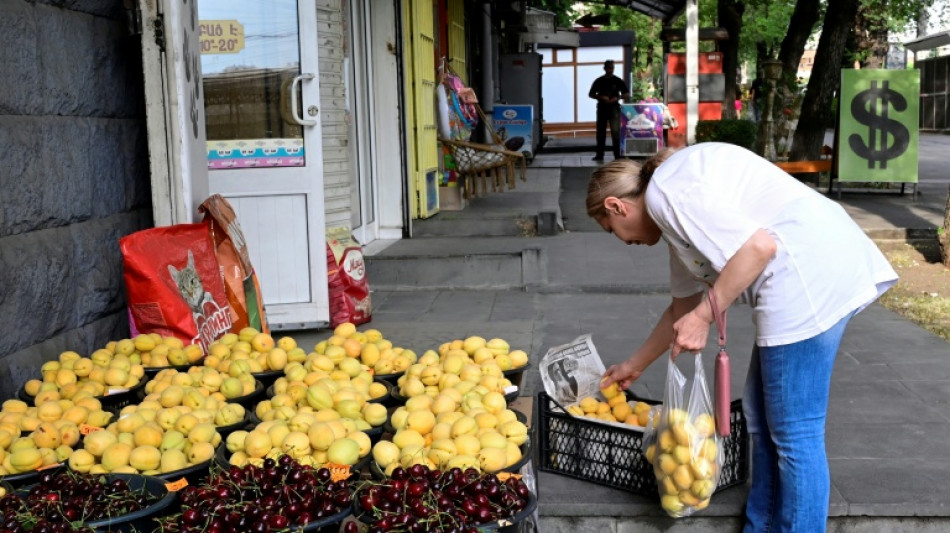
Armenian apricots become geopolitical battleground with Russia / Photo: © AFP

 Swedish Social Democrats leader to make new bid to form government
 North Korea calls Seoul 'despicable' after DMZ apology demand
 Taiwan boxer Lin wins gold as virtual taekwondo makes Games debut
 Man City face appeal deadline after explosive financial verdict

 Pole vault superstar Duplantis to skip indoor season

 Sri Lanka drop Asalanka from T20 against Pakistan
 Disney president says layoffs 'extremely painful' but necessary
 Indian flydubai pilot opened cockpit door to save passengers

 Alex Marquez clocks record lap at MotoGP Japan practice
 Tom Kim leads Asian Games golf in chase to avoid military service
 Asian stocks hit as oil spike fans rate hike bets, eyes on US jobs

 'We're losing our scientists': west Africa's STEM struggle
 World powers gather in Pacific to chart climate battle

 Return of swarming moth spectacle has Australia in a flutter
 Browns snuff out Rodgers fightback to beat Steelers 27-24
 Braves power past Phillies to set up Dodgers showdown
 Asian stocks drop as oil spike fans rate hike bets, eyes on US jobs

 Viral anti-vax posts weaponise Philippine inoculation fears
 Saudi coalition accuses Houthis of drone attack on Medina
 Effective Altruism: the philosophy behind Silicon Valley's AI fears
 Chinese judoka accused of biting as home hope wins Asian Games gold

 Four-member crew docks at International Space Station

 Portugal win without Ronaldo as Klopp's Germany get first victory
 Wemby: 'Very sad' to see players endorse betting firms

 Manchester City Women scrape draw with Real Madrid

In Armenia's Ararat valley, where apricots ripen beneath the biblical mountain of the same name, farmer Aramais Kazaryan's harvest has been swept into the centre of a geopolitical battle between Russia and the West.
Angered at Yerevan's pivot away from Moscow, the Kremlin imposed bans and restrictions on the imports of a wide range of Armenian goods, including fruits, vegetables and flowers, ahead of parliamentary elections earlier this month.
Russia said it was for unspecified sanitary concerns, but it is widely seen as an attempt to heap economic pressure on Prime Minister Nikol Pashinyan to reverse course and turn back toward Moscow.
The 75-year-old farmer's eyes filled with tears as he walked through his orchard in the village of Vosketap, where a breeze from snowcapped Mount Ararat, across the border in Turkey, dispelled the summer heat.
"The apricot is a symbol of Armenia," he told AFP.
"Its taste and aroma are royal. The apricot is a wonder of wonders."
Cultivated for millennia, Armenia's famed apricots were known to ancient Romans as the "Armenian apple."
Before the ban, the vast majority of exports went to Russia.
- 'Cannot be forgiven' -
Kazaryan planted his orchard in 1991, after the collapse of the Soviet Union when farmland was distributed to private owners.
Within five years, the trees were bearing fruit, and Russia became the natural destination for much of the harvest, trucked north across the border.
Russia has also restricted Armenian fish, famed Jermuk mineral water, wine and brandy.
The move has angered Kazaryan and many of his fellow farmers.
"For decades this trade went on. And suddenly everything changed?" he said.
"This cannot be forgiven in any way."
Moscow was punishing ordinary workers over the government's European course, despite Russia's claims of historic friendship, he said.
"This is aimed not against Pashinyan or the leadership, it is going against our people."
Pashinyan's party won the June 7 vote -- despite intense pressure and allegations of interference from Moscow.
Russian President Vladimir Putin has so far withheld formal congratulations and Moscow has talked up alleged violations in the vote.
- Trade war -
Ex-Soviet Armenia has strong formal ties to Moscow -- a member of the Russia-led Eurasian Economic Union that hosts a Russian military base.
But Pashinyan has sought to reduce Yerevan's dependence on Moscow after Russia failed to intervene during military conflicts with Azerbaijan over the then-disputed Karabakh region.
Armenia has frozen participation in a Moscow-led security bloc, deepened ties with the European Union and the United States, and set the country on a path toward possible EU membership.
The Armenian government has scrambled to soften the blow of the trade war unleashed by Moscow.
In early June, it approved support for farmers, including subsidies for greenhouse exports.
It is also compensating customs duties on fresh fruit, vegetables and flowers exported to the EU.
The European Commission has pledged more than 50 million euros in immediate assistance, along with measures granting nearly 80 percent of Armenian exports tariff-free access to the EU's 450-million-consumer single market.
- 'Focus on quality' -
Armenia's economy could contract by up to two percent if exporters fail to find new markets, Central Bank Governor Martin Galstyan has warned.
Economic analyst Ashot Aramyan said government measures and EU help would only ease the shock temporarily.
Armenia exported nearly $200 million worth of fresh fruit, vegetables and flowers in 2025, with 93.3 percent going to Russia, he said.
"It will not be possible to redirect the entire harvest to European and other markets," Aramyan told AFP, warning of overproduction, bankruptcies and possible social strain.
Officials are putting on a brave face.
"The times have passed when we used to say that Armenian products were uncompetitive in Europe," Economy Minister Gevorg Papoyan told lawmakers.
Apricot farmer Kazaryan sees reason for optimism.
Italian investors have planted large orchards in a nearby village and have started to export back home.
But many farmers worry "what to do with fruit that may have nowhere to go."
Under good weather conditions, he said, a single apricot tree can yield up to 500 kilograms.
"For a long time we were chasing only volumes, quantity -- after all, Russia was an inexhaustible market for us."
Armenian farmers, he said, should focus more on quality than yield to carve out a place in alternative markets.
"Now the main thing is quality."
M.Ouellet--BTB