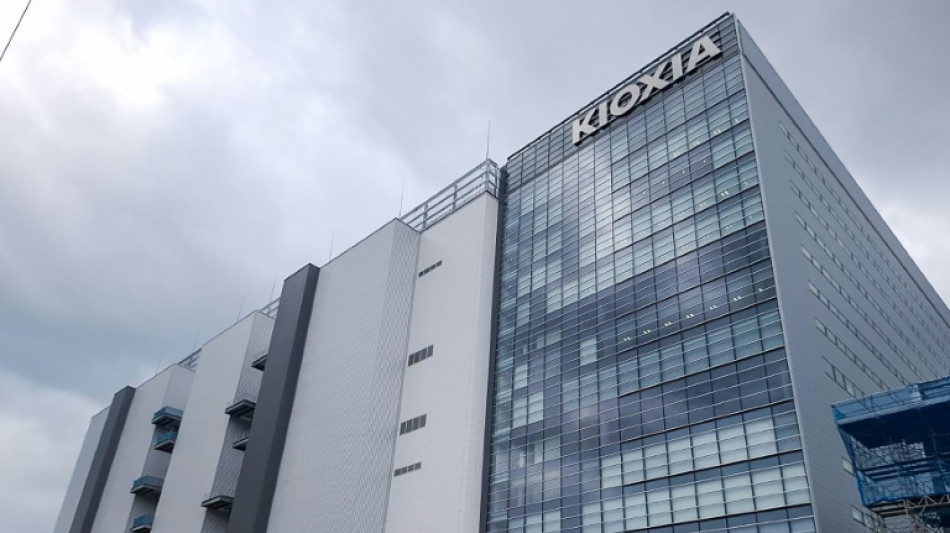
AI ignites 'ignored sector' for Japan chipmaker Kioxia / Photo: © AFP

 Taiwan gender-row boxer Lin Yu-ting wins 'monumental' Asian Games gold

 Taiwan receives its first US-made F-16V fighter jets

 Lula, Bolsonaro trade scandal fire in final scramble for votes
 Not-so-brave new world: virtual taekwondo makes Asian Games debut

 Arab Israeli candidate drops out of election race

 Israel courts Europe's far right, finding friends but also unease
 Lula, Bolsonaro both snub final debate before Brazil election

 Nepal's grim DNA puzzle to identify flood dead

 EU nations to hold emergency meeting on soaring diesel prices amid US pressure

 Anthropic's Dario Amodei: AI's most visible CEO and enigma

 OpenAI says three staffers fired for mishandling 'sensitive' info
 Nike plans job cuts as it forecasts lower sales

 Ireland game interrupted twice by Gaza protests

 Judge denies acquittal bid by US woman who killed her kids

 Klopp averts crisis with first win as Germany boss

 A saintly spat and debate snub: Brazil enters final campaign stretch

 US tells European allies to act 'immediately' to lower diesel prices

 G20 trade ministers fail to see consensus against overproduction

 Portugal edge Denmark in Ronaldo's absence

 US stocks edge higher as bond yields retreat for now

 US tells European allies to 'immediately' act to lower diesel prices

 Trump vows to hit Iran 'very hard' if linked to flydubai attack
 Williams leaves Spain camp with thigh knock

 WTA reduces 2027 schedule for world's top 50

 US says 'in Europe's best interest' to cooperate on fuel supply

Robotic transporters carrying silicon wafers whizz by on overhead rails at a new factory that Kioxia, one of Japan's most valuable companies, hopes can help it meet overwhelming AI-driven demand.
The global race to build artificial intelligence data centres has turbocharged business for chipmakers, creating shortages and sending prices soaring for memory components in particular.
And Kioxia is reaping the rewards.
While it is barely known outside the tech industry, its share price has soared around seven-fold this year, and in June it briefly became the largest Japanese firm by market capitalisation after speeding past Toyota.
Other once-obscure tech supply chain players in Asia are also hitting the big time, such as South Korea's SK hynix, which last week listed on Wall Street after one of the world's biggest ever stock sales.
Different types of memory chips that store digital information are used in AI systems alongside powerful processors able to crunch data to generate chatbot responses or realistic images.
AI use "has been expanding rapidly" so "we have high expectations that the market for the flash memory we produce will continue to expand", Kioxia CEO Hiroo Ota said this month at the new chip fab that opened in September in northern Japan.
The company specialises in so-called NAND flash chips, an increasingly hot commodity as AI agents -- tools that can carry out tasks for users -- require ever-more storage space.
- Chinese competition -
"Kioxia's stock price surge represents a normalisation of valuation for what was once an 'ignored sector'," Counterpoint Research analyst MS Hwang told AFP.
One challenge will be "maintaining its competitive edge against rivalry" from China's Yangtze Memory Technologies Co (YMTC), a rapidly expanding maker of the same type of chips, Hwang said.
Broader concerns of overstretched valuations have also fuelled fears of a market bubble, along with questions over when the eye-watering sums being spent on AI will reap returns.
The new fab is Kioxia's second facility in the green outskirts of the city of Kitakami, an area with several other big factories.
AFP was shown rows of bulky white chip-etching machines in a cleanroom, where conditions are closely controlled to stop dust contamination.
Near Kitakami station, Noriyuki Takahashi, a 47-year-old recruiter, said work has been busy lately thanks to Kioxia.
"It's a good thing to have so many jobs here experiencing improving business sentiment," he told AFP.
Hana, 57, who runs the bar Tachinomi Hanachan, had a less rosy perspective.
"Semiconductors are an industry with a lot of ups and downs," she said. "The locals are anxious about how long it will last."
- Big bonuses -
In its 1980s heyday, Japan commanded around half the share of the global semiconductor market.
That has since dropped to less than 10 percent, says the government, which is aiming for an eightfold revenue increase from domestically produced microchips by 2040 from 2020 levels.
The country is building a chip hub with top-end technology in northern Hokkaido, while Taiwanese chipmaker TSMC has a plant in southern Kyushu.
Some analysts say AI has brought a new dimension to the dramatic boom-and-bust cycles the memory chip industry is known for.
Kioxia started life as Toshiba Memory, a pioneering memory chip business that Japanese conglomerate Toshiba, then in dire financial straits, sold off in 2018.
Now the company says it is planning a US listing like SK hynix, forecasting 1.3 trillion yen ($8 billion) in operating profit for April-June -- a massive jump from 45 billion yen a year ago.
Some workers in Kitakami boast of bonuses that are "impossibly high" for the region, Hana told AFP.
But competition is fierce, and "Taiwan is working hard, other places are working hard", she added.
"It's good for the moment, but when we ask how many years the demand will continue, the local community is looking at it with unease."
Y.Bouchard--BTB