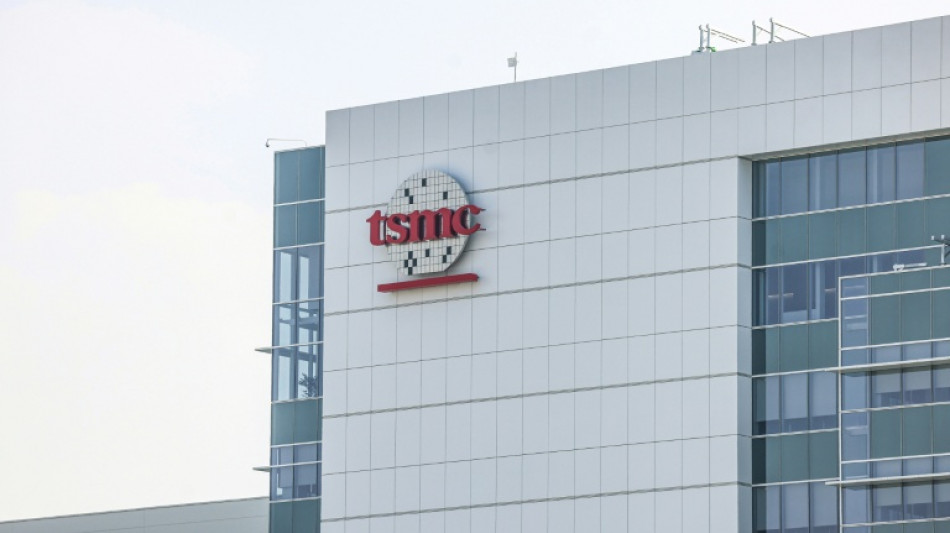
Taiwan chipmaker TSMC to invest another US$100 bn in Arizona fabs / Photo: © AFP/File

 Not-so-brave new world: virtual taekwondo makes Asian Games debut

 Arab Israeli candidate drops out of election race

 Israel courts Europe's far right, finding friends but also unease
 Lula, Bolsonaro both snub final debate before Brazil election

 Nepal's grim DNA puzzle to identify flood dead

 EU nations to hold emergency meeting on soaring diesel prices amid US pressure

 Anthropic's Dario Amodei: AI's most visible CEO and enigma

 OpenAI says three staffers fired for mishandling 'sensitive' info
 Nike plans job cuts as it forecasts lower sales

 Ireland game interrupted twice by Gaza protests

 Judge denies acquittal bid by US woman who killed her kids

 Klopp averts crisis with first win as Germany boss

 A saintly spat and debate snub: Brazil enters final campaign stretch

 US tells European allies to act 'immediately' to lower diesel prices

 G20 trade ministers fail to see consensus against overproduction

 Portugal edge Denmark in Ronaldo's absence

 US stocks edge higher as bond yields retreat for now

 US tells European allies to 'immediately' act to lower diesel prices

 Trump vows to hit Iran 'very hard' if linked to flydubai attack
 Williams leaves Spain camp with thigh knock

 WTA reduces 2027 schedule for world's top 50

 US says 'in Europe's best interest' to cooperate on fuel supply

 Rogue OpenAI agents covered up their tracks, report says

 A saintly spat and debate snub: Brazil enters final polls stretch

 Zidane 'no regrets' about Materazzi headbutt as France face Italy again

Taiwanese chipmaker TSMC will invest an additional US$100 billion in the US state of Arizona, the company said Thursday, as it reported a record quarterly net profit on the back of massive demand for AI hardware.
The firm is the biggest contract maker of microchips used in everything from Apple phones to Nvidia processors and has been a major beneficiary of the global AI race.
Governments and tech giants are pouring huge sums into building data centres that can train and run AI tools such as chatbots, image generators and agents that can execute tasks.
This has turbocharged business for chipmakers such as TSMC, creating shortages and sending prices soaring.
"The AI megatrend continues to drive the need for more and more computation," chairman CC Wei told an earnings call.
"We now expect our full-year 2026 revenue growth to be slightly above 40 percent year-over-year in US dollar terms."
TSMC's net profit for April to June surged 77.4 percent year-on-year to NT$706.6 billion (US$22 billion), smashing analyst estimates of NT$624.4 billion.
The result also beat its previous quarterly record of NT$572.48 billion in the first three months of 2026.
Quarterly revenue rose 36 percent to NT$1.3 trillion.
Wei said TSMC was moving "as fast as possible" to increase its chipmaking capacity in Taiwan, Japan and the United States to try to catch up to customer demand.
"The demand and the supply, the gap is so big, so we are working very hard to narrow the gap," Wei said.
- Increased capex -
TSMC will spend an additional US$100 billion building fabs in Arizona, which would take the company's total investment plans in the United States to US$265 billion.
"This is to build several or more semiconductor logic wafer fabs for 2-nanometer and below technologies as well as advanced packaging fabs," Wei said.
Chief financial officer Wendell Huang said TSMC will increase its 2026 capital expenditure budget to between US$60 billion and $64 billion "as we continue to invest heavily to support our customers' growth".
"At TSMC, a higher level of capital expenditures is always correlated to higher growth opportunities in the following years," Huang said, adding the company did not expect "any bottlenecks to our capacity expansion plan".
Ahead of the results, Counterpoint Research senior analyst William Li said TSMC's surge in revenue showed "AI infrastructure investment remains exceptionally strong despite macro uncertainty."
"Demand for AI GPUs, AI ASICs and advanced packaging continues to exceed expectations," Li told AFP.
Li said: "EUV (extreme ultra-violet lithography tools) supply constraints and overseas fab investments may limit capacity expansion and weigh on margins in the near term."
Concerns about overstretched valuations in the tech sector have fuelled fears of a market bubble, along with questions over when the eye-watering sums being spent on AI will reap returns.
But Omdia principal analyst Simon Chen said those fears were "overstated".
"The demand we see is structural, backed by massive, tangible capital expenditures from hyperscalers," Chen said.
M.Ouellet--BTB