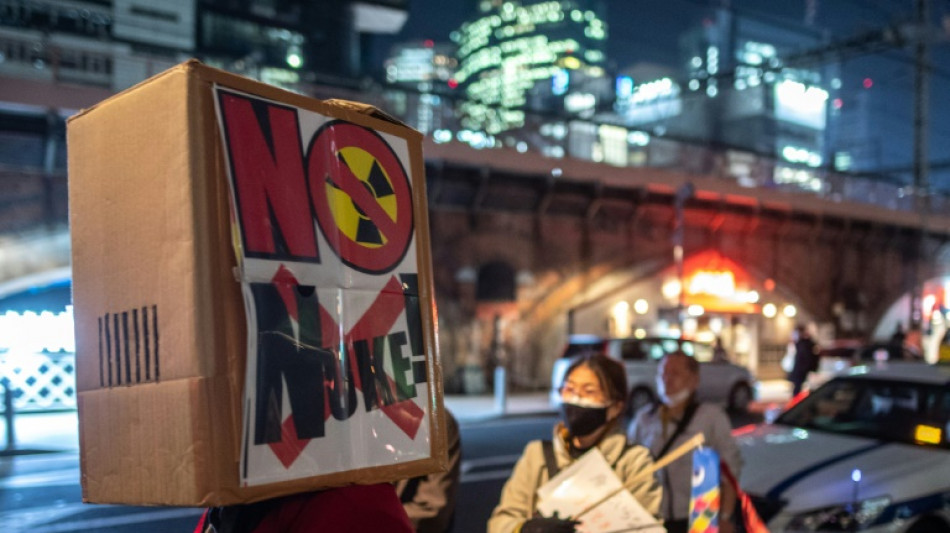
Japan PM eyes nuclear power push to combat energy crunch / Photo: © AFP

 Man Utd's Fernandes crowned PFA player of the year

 Dolly Parton: quotes on life, love and music

 Brazil fines TikTok $30 mn in 'powerful signal' over child safety

 Cameroon's Baleba joins as Man Utd boost midfield options
 US country music legend Dolly Parton dies at 80

 Kolisi fit to captain South Africa against New Zealand

 Volkswagen workers boo boss during speech on job cuts

 Djokovic, Sabalenka tumble out of US Open mixed doubles

 CIA director Ratcliffe visits Moscow: US media
 Trump threatens to rename Lake Ontario as 'Lake America'
 'Here to win': Xavi vows to restore pride to Dutch football
 Canada unveils counter tariffs of 15% to 50% on US goods

 Spain moves to speed up return of migrants stranded in Ceuta

 At least a quarter of NFL players may get brain disease: study

 Iranians queue for petrol after US announces new sanctions

 Blockchain Infrastructure Firm tZERO Integrates with Sui for Institutional-Grade Digital Asset Securities

 Oil down as traders weigh US sanctions threat against Iran

 Canada to unveil response to Trump's steep tariffs

 Curling attracts curious Romans under Colosseum's shadow

 World must rein in autonomous weapons: UN, Red Cross

 'Wartime situation': tornado ravages French village

 Germany's Merz addresses critics with climate action pledge
 Stocks rise, oil down as traders weigh Iran sanctions threat

 Europe's gaming bash kicks off as industry eyes 'Grand Theft' boost

 Welsh rugby league great Boston dies, aged 92

Japan's prime minister on Wednesday called for a push to revive the country's nuclear power industry in a bid to tackle soaring imported energy costs linked to the Ukraine war.
Such a move could prove controversial after the 2011 Fukushima disaster led to the suspension of many nuclear reactors over safety fears.
But like many countries, Japan -- which is aiming to become carbon neutral by 2050 -- has faced a squeeze on its energy supplies since Russian forces entered Ukraine six months ago.
"Russia's invasion of Ukraine has vastly transformed the world's energy landscape" and so "Japan needs to bear in mind potential crisis scenarios", Prime Minister Fumio Kishida said at an energy policy meeting.
Japan should consider building next-generation nuclear reactors, he said, while the government will also discuss bringing more nuclear plants online and extending the service life of reactors if safety can be guaranteed.
Kishida called for "concrete conclusions by the end of the year" on the topic, which remains a sensitive one after a deadly tsunami in March 2011 caused a meltdown at the Fukushima plant, the world's worst nuclear disaster since Chernobyl.
Eleven years on, 10 of Japan's 33 nuclear reactors are back in action, although not all are operational year-round, and the country is heavily dependent on imported fossil fuels.
The national nuclear safety watchdog has approved in principle the restart of seven more reactors, but those moves often face opposition from local communities.
- 'Politically challenging' -
"In addition to securing the operations of the 10 reactors that are already back online, the government will spearhead an effort to do all it takes to realise the restart" of the others whose safety has been approved, Kishida said.
The prime minister, who joined the meeting remotely after testing positive for Covid-19, also urged policymakers to consider "constructing next-generation nuclear reactors equipped with new safety mechanisms".
Before the Fukushima disaster, a third of Japan's power generation came from nuclear sources, but in 2020 the figure stood at less than five percent.
Tom O'Sullivan, a Tokyo-based energy consultant at Mathyos Advisory, said building next-generation reactors in Japan would be a "major step", because "all the current reactors are conventional ones".
Bringing more existing nuclear plants online will need to be approved by local governors, which could prove "politically challenging", O'Sullivan told AFP.
"But again, there's a different environment now after the Ukraine war," he said.
For the Japanese public, "I don't think it's just the electricity costs. It's the reliance on Russia, for natural gas, oil and coal... the Japanese public have really woken up to that."
The price of Japanese shares related to nuclear power surged in afternoon trade as local media reported the possible plans, with Tokyo Electric Power ending up 9.96 percent and Mitsubishi Heavy Industries jumping 6.85 percent.
Japan has imposed sanctions on Russia over the war in Ukraine along with other G7 countries.
The government has also pledged to make efforts to reduce its energy dependency on Russia, which supplies around eight percent of Japan's LNG needs.
P.Anderson--BTB