HIV progress in 'real danger' as global funding plummets / Photo: © GETTY IMAGES NORTH AMERICA/AFP/File

 8.3 mn refugees at risk due to 'severe' funding cuts: UN
 Stocks drop and oil rises as Hormuz hopes fade
 OpenAI cancels release of newest model due to safety concerns

 AI bosses head to White House as safety pressure builds

 Batista sacked as Costa Rica coach after six months
 Flooding, power cuts and evacuations as Hurricane Polo slams Mexico

 Dodgers eye three-peat, Red Sox face Yankees as MLB playoffs begin
 Certification of Boeing 737 MAX delayed by software bug

 Celine Dion wows Paris Fashion Week with surprise gig

 AMD buys firm founded by AI 'godmother' Fei-Fei Li
 Italy rebound in Turkey as France win late in Belgium

 Pope says concerns about AI 'should be taken seriously'
 Hurricanes to hoist title banner as NHL season begins
 Justice Alito steps aside from major US climate case

 Willis happy with England exile after retains Top 14 player award

 Spain housing protests keep heat on government as PM seeks new law

 Wissa spoils Zimbabwe homecoming as DR Congo win AFCON qualifier

 UK police release on bail five men held over airbase incident

 Ex-All Black Plummer 'sure' New Zealand will find Super Rugby solution

 Shein sees 1% revenue growth in first half of 2026
 Netherlands regrets Israel retaliation in settlements row
 Moscow seizes Russian assets of German food retailer Metro
 Bulgarian spirits inflamed by new rakia rules

 Documentary turns camera on architect Peter Zumthor

 UK police say releasing on bail five men held over airbase incident
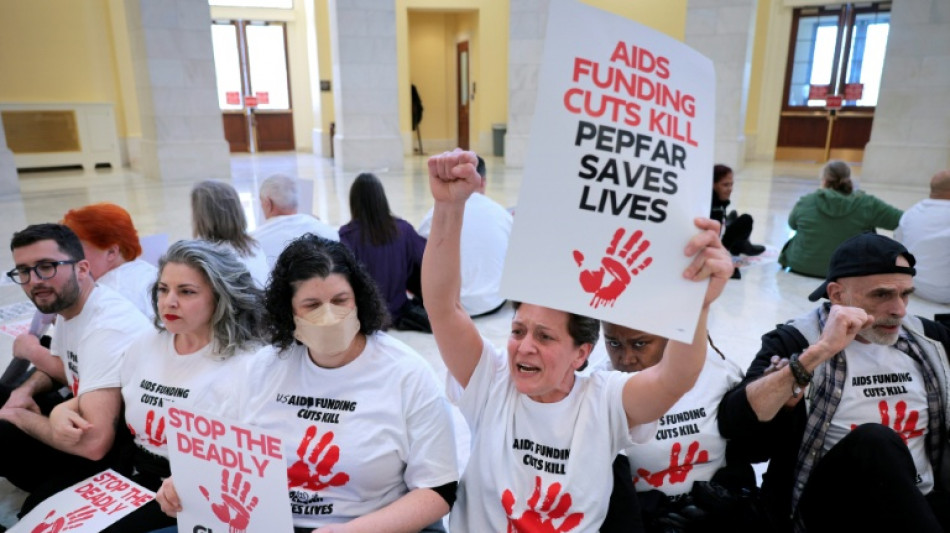
The science has never been better, but political will has reached a new low: AIDS experts warned Monday that the fight against HIV was in real danger as funding fell by a fifth last year.
A major international AIDS conference got underway in Rio de Janeiro for the first time since the United States began to dramatically slash foreign aid following Donald Trump's return to the White House last year.
European nations including France, Germany and the UK followed suit.
"Never has donor funding fallen so far, so fast, and those most vulnerable are already paying the price," said Beatriz Grinsztejn, president of the International AIDS Society (IAS), warning that the gathering was taking place at a time of "real danger" for the battle against HIV.
Once a fatal and terrifying diagnosis, scientific breakthroughs and massive funding efforts have transformed HIV into a manageable disease for millions of people.
"The end of AIDS is no longer limited by science. The scientists have done their part. It's limited by inequality. Science has done its job, now politics must do its job," said UNAIDS chief Winnie Byanyima.
She said the world was living through "one of the most exciting moments in the history of HIV science," with prevention medicines that have almost vaccine-like effectiveness.
But millions still do not have access.
"When prevention disappears, infections rise. When treatment is interrupted, people die. We know how this story ends if we fail to act," warned Byanyima.
- Developing nations 'step up' -
International financing for HIV in developing countries fell by 18 percent in 2025 alone, according to a UNAIDS report released at the 26th International AIDS Conference.
Since 2011, HIV funding from European countries has fallen by 58 percent, according to the report. As the European contribution decreased, the US share of the funding rose.
This meant that despite the sweeping cuts by the Trump administration last year, the United States still provides 74 percent of funding given by donor governments, the report said.
Developing countries with the highest HIV rates -- many of which are in sub-Saharan Africa -- are meanwhile "stepping up", UNAIDS deputy executive director Angeli Achrekar told AFP.
Domestic funding rose four percent last year and now represents nearly 60 percent of the total HIV response, according to the report.
However, these figures are still "a drop in the ocean" compared to what is needed, Byanyima told AFP last month.
Many low-income countries in Africa are dependent on overseas development assistance for 90 percent of their HIV response, the report said.
Experts have cautioned that it is still too early to see the full impact of the funding cuts.
The number of new HIV cases and AIDS-related deaths dropped to their lowest levels in more than 30 years in 2025, according to the report.
New infections, however, rose in 21 countries.
- New drugs -
The UN aims to end AIDS as a public health threat by 2030.
One of the goals is for 20 million people to have access to anti-retroviral drugs which prevent the spread of HIV.
Almost half of all children living with HIV were not receiving these drugs last year, the report warned.
Achrekar called on pharmaceutical firms which make a range of new drugs seen as breakthroughs "accessible and affordable to all".
Ahead of the conference in Rio, the US pharma giant Merck announced plans to allow some manufacturers in Africa and India to make cheaper generic versions of its once-monthly anti-retroviral pill alimatravir, which has not yet been approved.
Also last week, Doctors Without Borders (MSF) called on US pharma company Gilead to make its preventative drug lenacapavir -- which has been hailed as a game-changer because it only needs to be injected twice a year -- available to more nations in need.
Countries where clinical trials were held to test the drug -- such as Brazil, Argentina, Mexico and Peru -- are excluded from current deals allowing for the sale of generic versions, the NGO pointed out.
Research has shown lenacapavir can be made for $40 per person a year, but it costs up to $28,000 per patient annually in the United States, MSF added.
L.Janezki--BTB