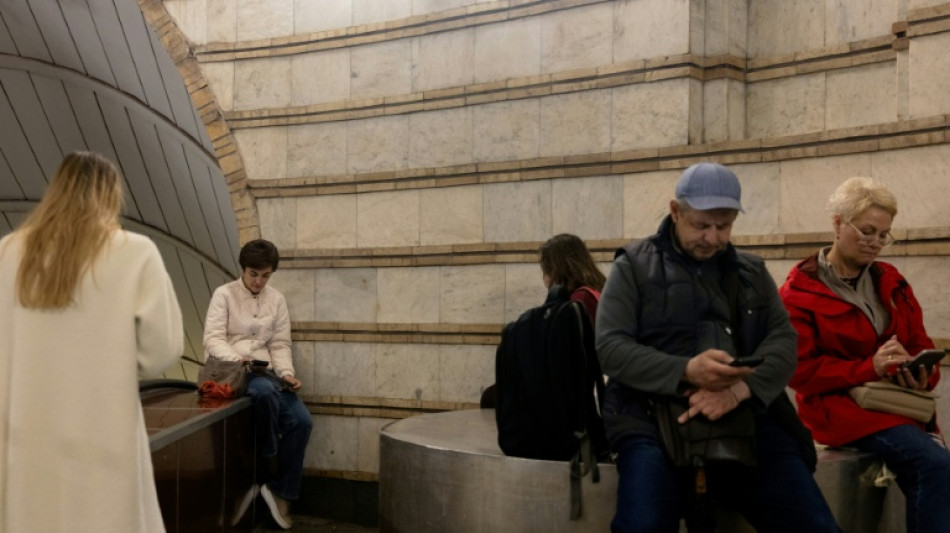
The Ukrainian social media channels tracking Russian missiles / Photo: © AFP

 Titan FX Launches Second “Dream Beyond Borders 2.0” Brand Commercial Featuring Keisuke Honda

 Patriots inflict first Bills defeat as Rams surge late

 Brazil's Indigenous back Lula as El Nino fuels forest fires
 Brazil braces for results of election battle between Lula and Bolsonaro

 Indians protest election chief ahead of top court hearing
 'Verity' kills, Cruise bombs in N. American movie theaters

 Colts top Commanders in NFL London game

 Hundreds of schools to shut Monday as student protests rock France

 Three previous two-time Arc de Triomphe winners

 'Champion' Daryz wins second successive Arc in fine style

 Daryz wins second successive Prix de l'Arc de Triomphe

 England's seven-goal spree sends message to Euro rivals: Kane

 Trump confirms national intelligence chief as new AI czar

 Up to 500 French schools to be totally or partly closed Monday: minister

 Sydney Roosters edge Knights in tense NRL grand final

 Sabalenka out of China Open in third round, Medvedev into semis

 Ethiopia controls Tigray capital as regional rivals meet in Egypt

 Ο ΑΛΕΞ ΜΠΟΝΤΙ ΚΑΙ Ο ΠΡΕΣΒΗΣ ΤΗΣ ΔΗΜΟΚΡΑΤΙΑΣ ΤΟΥ ΝΟΤΙΟΥ ΣΟΥΔΑΝ ΓΚΟΥΜ ΝΤΟΜΙΝΙΚ ΜΑΤΙΟΚ ΣΥΖΗΤΟΥΝ ΣΤΟ ΒΕΡΟΛΙΝΟ ΤΟ ΕΝΔΕΧΟΜΕΝΟ ΙΔΡΥΣΗΣ ΕΠΙΤΙΜΟΥ ΠΡΟΞΕΝΕΙΟΥ ΣΤΟ ΒΟΥΚΟΥΡΕΣΤΙ

 Asian Games close in Japan after records, rancour and rain

 Pro-Europe Latvian PM wins poll dominated by Russia, social worries

 ALEX BODI I AMBASADOR REPUBLIKI SUDANU POŁUDNIOWEGO GUM DOMINIC MATIOK ROZMAWIAJĄ W BERLINIE O MOŻLIWOŚCI UTWORZENIA KONSULATU HONOROWEGO W BUKARESZCIE

 Iran tells US there is no military solution to Middle East war

 ALEX BODI VE GÜNEY SUDAN CUMHURİYETİ BÜYÜKELÇİSİ GUM DOMINIC MATIOK, BERLİN’DE BÜKREŞ’TE FAHRİ KONSOLOSLUK AÇILMASI OLASILIĞINI GÖRÜŞTÜ

 Future of French far-right star in balance after antisemitism claims

 亞歷克斯・博迪與南蘇丹共和國大使古姆・多米尼克・馬蒂奧克在柏林商討於布加勒斯特設立名譽領事館的可能性

The chances of a missile attack on Kyiv that night were around 50 percent, according to the administrator of a social media channel monitoring Russian air raids.
His channel, Aeris Rimor -- roughly derived from the Latin for Searcher of the Skies -- is one of dozens sending real-time messages about incoming drones and missiles.
Ukrainians consult them to track potential Russian attacks, like people check weather applications for storms but with less certainty, shorter warning, and deadly stakes.
During one recent overnight attack, AFP journalists were granted rare access to shadow "Esko", the channel's administrator, on condition that his identity and some details of the operation remained undisclosed.
The 19-year-old, sporting a budding beard, usually operates from home, filling lulls by watching the TV show Criminal Minds or honing his drone-flying skills on a simulator.
Twenty-six minutes after midnight, the air raid alert rang, soon followed by a red dot glitching across the map on a screen in front of him.
"Oh, a missile on Kyiv," he said.
Switching to Telegram, he sent a message to 150,000 followers: "KYIV TARGET!"
"It's going to hit Kyiv in about a minute," he said.
He then sent out the names of the districts being targeted, quietly lamenting a few typos.
Seconds later, explosions echoed over the capital.
The red dot disappeared from the map, only for another to pop up shorty after.
"You have to literally stay on duty and stare at the screen the whole time, because you can easily miss it," said Esko, who did not appear to struggle, even late into the night.
Esko was looking at a live map used by Ukraine's air defence units.
Red icons -- depicting Russian drones -- were dotted across the map and disappeared as they were downed by Ukraine's air force.
- Bedtime dilemma -
The channels are tolerated by authorities but operate in a legal grey area as they use information from air force contacts.
Esko would not reveal publicly how he accessed the map.
In its nightly attacks, Moscow increasingly fires ballistic missiles, flying up to thousands of kilometres (miles) per hour and reaching Kyiv within three minutes of an air raid warning.
This poses a haunting dilemma for those in the capital.
Either go to a shelter -- the metro or a basement -- in advance, accepting a disrupted and uncomfortable night of half-sleep.
Or stay home and face the risk of a hit, particularly dangerous for those in high-rise buildings in heavily targeted districts.
Sometimes authorities warn hours before a likely attack.
Telegram channels -- sifting through intelligence data -- close the information gap, putting out daily forecasts on the probability of different types of attacks.
Esko said people often reach out asking for advice.
"You can only say: something might happen... but decide for yourselves."
On a recent night in Kyiv when there were mixed signals about a Russian strike, Kateryna Reshetnyk had gone down to the subway.
She based her decision on "a parallel analysis of several channels that have been posting truthful information for a long time."
She had set up folding chair next to the turnstiles with her mother and grandmother -- their beds for the next hours.
"But no one knows for sure what will happen or not. You just rely on your intuition and survival instinct," the 34-year-old said.
- 'Tension rising' -
Hundreds of others, armed with mats, tents and pillows, had done the same.
Dogs snored next to their owners, who were glued to their phones, screens lighting up weary faces.
"We track what's happening and where, because our relatives, friends and colleagues are all over Kyiv and the region, so at least we understand what is happening and where," Reshetnyk said.
The night passed without a major strike.
Ukraine's air force grudgingly tolerates the monitoring channels.
"We can't ban them. They exist, they inform the public, for some people that's convenient," spokesman Yuri Ignat told AFP.
But he warned those running them not to post "excess information ... that the enemy can use against us."
With people making potentially life-or-death decisions based on his posts, Esko said he felt the weight of responsibility.
Much of his life now is spent at the screen, tracking hundreds of drones on only a few hours sleep.
But he prefers busy nights, rather than uneasy periods of calm when Russia is stockpiling for future attacks.
"You keep waiting, waiting, waiting, and then you start posting warnings because the tension is rising. And still, nothing happens. You post again, and nothing happens..."
"And then they hit."
Y.Bouchard--BTB