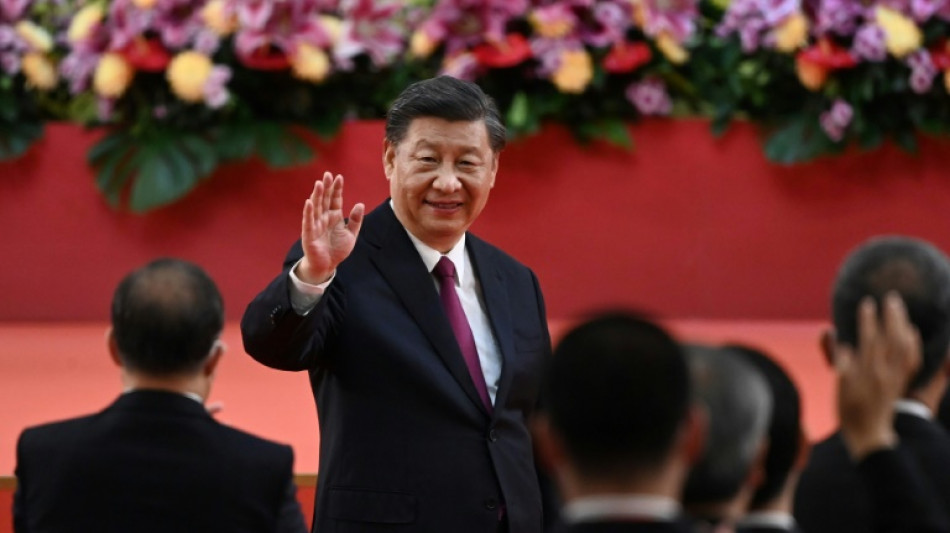
Xi: China's most powerful leader since Mao / Photo: © POOL/AFP

 Fave or flop? A guide to gauging video game success

 Williams-Alcaraz fall in US Open mixed quarter-finals

 Mark Carney, the former central banker who said 'no' to Trump
 Segner out of South Africa tour as New Zealand injuries pile up

 Meta knew teen safety tools were ineffective, witnesses testify
 Williams and Alcaraz win opener at US Open mixed doubles
 Man Utd's Fernandes crowned PFA player of the year

 Dolly Parton: quotes on life, love and music

 Brazil fines TikTok $30 mn in 'powerful signal' over child safety
 Cameroon's Baleba joins as Man Utd boost midfield options

 US country music legend Dolly Parton dies at 80
 Kolisi fit to captain South Africa against New Zealand
 Volkswagen workers boo boss during speech on job cuts
 Djokovic, Sabalenka tumble out of US Open mixed doubles
 CIA director Ratcliffe visits Moscow: US media
 Trump threatens to rename Lake Ontario as 'Lake America'
 'Here to win': Xavi vows to restore pride to Dutch football
 Canada unveils counter tariffs of 15% to 50% on US goods

 Spain moves to speed up return of migrants stranded in Ceuta

 At least a quarter of NFL players may get brain disease: study

 Iranians queue for petrol after US announces new sanctions
 Blockchain Infrastructure Firm tZERO Integrates with Sui for Institutional-Grade Digital Asset Securities

 Oil down as traders weigh US sanctions threat against Iran
 Canada to unveil response to Trump's steep tariffs
 Curling attracts curious Romans under Colosseum's shadow

Xi Jinping, who is soon expected to be anointed for an unprecedented third term in office as China's ruling Communist Party (CCP) holds its 20th Congress, has become his country's most powerful leader since Mao Zedong.
He joined the pantheon of Chinese leadership in 2012, two decades after bursting onto the scene as a graft-fighting governor.
The country's rubber-stamp parliament boosted Xi's considerable power in 2018 when it approved a constitutional amendment abolishing presidential term limits.
The move allowed Xi, now aged 69, to remain in power for as long as he wishes, and is the latest feather in the cap of a Communist "princeling" who is remaking China in his own image.
Xi has amassed seemingly unchecked power and a level of officially-stoked adulation unseen since Communist China's founder Mao.
Even though his father Xi Zhongxun -- a renowned revolutionary hero turned vice-premier -- was purged by Mao, Xi has remained true to the party that rules with an iron fist and over which he now reigns supreme.
Xi is the first Chinese leader to have been born after 1949, when Mao's Communist forces took over following a protracted civil war.
The purging of his father led to years of difficulties for the family, but he nevertheless rose through the party's ranks.
Beginning as a county-level party secretary in 1969, Xi climbed to the governorship of coastal Fujian province in 1999, then party chief of Zhejiang province in 2002 and eventually Shanghai in 2007.
That same year, he was appointed to the Politburo's Standing Committee, the apex of power in China.
Following Mao's disastrous economic campaigns and the bloody 1966 to 1976 Cultural Revolution, the Communist leadership had sought to prevent further chaos by tempering presidential power through a system in which major personnel and policy decisions were hashed out by the Standing Committee.
That move helped prevent political power from becoming too concentrated in the hands of a single leader but was also blamed for policy indecision that led to growing ills such as worsening pollution, corruption and social unrest.
But "Xi Dada" ("Big Uncle Xi"), as he has been dubbed by Communist propaganda, has broken sharply with that tradition since taking over as president in 2013 and now looms over the country with a deepening cult of personality.
His tenure has seen crackdowns on corruption, tightening control in the northwestern Xinjiang region, crushing of a democracy movement in Hong Kong and strict lockdowns on cities in the name of curbing Covid-19.
He has also revitalised Chinese nationalism -- sparking standoffs with the United States over the self-ruled island of Taiwan, which Beijing has pledged to retake one day, by force if necessary.
Fighting graft and upholding party leadership were already central to him when he spoke to AFP in 2000.
At the time, Xi vowed to root out corruption following a $10 billion smuggling scandal, but ruled out political reform to confront the problem, saying he would work within the one-party structure and system of political consultation and "supervision by the masses".
- Chairman of everything -
Xi's face graces the front page of newspapers in the country, while his exploits and directives regularly headline the evening news.
The Communist Party Congress in 2017 confirmed Xi's induction into the leadership pantheon alongside Mao and market reformer Deng Xiaoping by writing his name and political ideology into the party's constitution.
In November last year, China's top leaders passed an important resolution on the party's past, braiding Xi more tightly into the CCP's story.
It was only the third such resolution issued in the party's 100-year history, after two under leaders Mao Zedong and Deng Xiaoping, and aimed to consolidate the party's achievements while providing an ideological roadmap for its continued rule.
Following a divorce from his first wife, Xi married the celebrity soprano Peng Liyuan in 1987, at a time when she was much more famous than him. The couple's daughter, Xi Mingze, studied at Harvard but stays out of the public eye.
Xi has also presided over a tough crackdown on civil society and freedom of speech, and he tolerates no ridicule or slander of his person.
He has presented a defiant face to overseas rivals, batting back criticism of his government's actions in Hong Kong, attitude towards Taiwan and treatment of Uyghur Muslims.
And he is pushing on with an emphasis on a strong party for the "great rejuvenation of the Chinese nation".
O.Lorenz--BTB