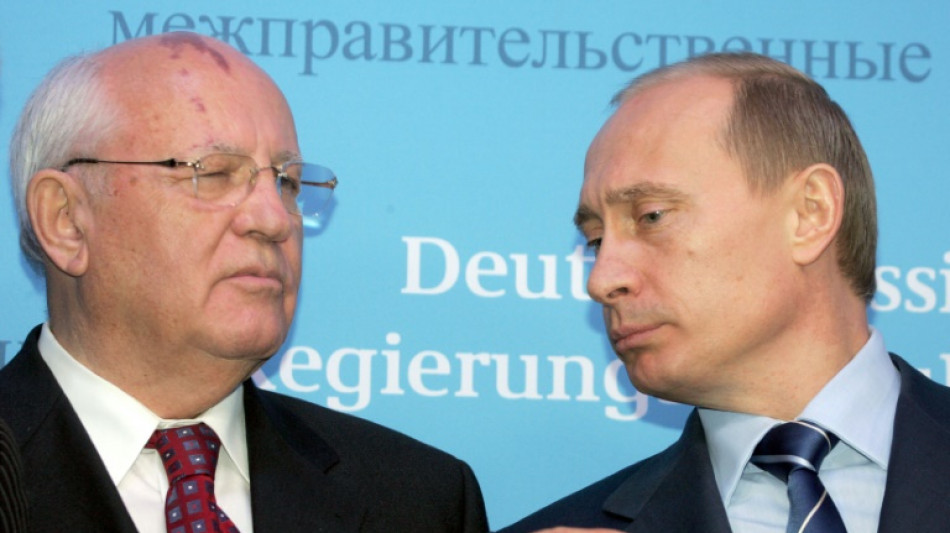
Gorbachev's love-hate relationship with Putin / Photo: © AFP/File

 Too small for fries: drought shrinks Belgian potatoes

 Drought-hit Danube gives way to fossil hunt in Bulgaria

 Julia Curlee, CIA officer fired by White House for being transgender

 Fave or flop? A guide to gauging video game success
 Williams-Alcaraz fall in US Open mixed quarter-finals

 Mark Carney, the former central banker who said 'no' to Trump
 Segner out of South Africa tour as New Zealand injuries pile up
 Meta knew teen safety tools were ineffective, witnesses testify
 Williams and Alcaraz win opener at US Open mixed doubles
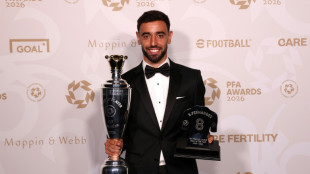 Man Utd's Fernandes crowned PFA player of the year
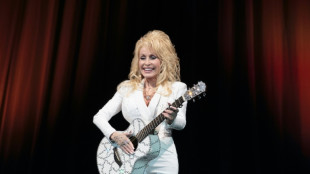 Dolly Parton: quotes on life, love and music
 Brazil fines TikTok $30 mn in 'powerful signal' over child safety
 Cameroon's Baleba joins as Man Utd boost midfield options
 US country music legend Dolly Parton dies at 80
 Kolisi fit to captain South Africa against New Zealand
 Volkswagen workers boo boss during speech on job cuts
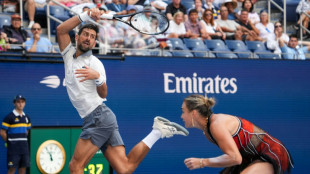 Djokovic, Sabalenka tumble out of US Open mixed doubles
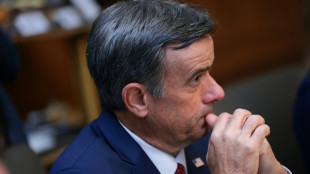 CIA director Ratcliffe visits Moscow: US media
 Trump threatens to rename Lake Ontario as 'Lake America'
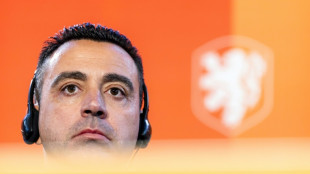
 'Here to win': Xavi vows to restore pride to Dutch football
 Canada unveils counter tariffs of 15% to 50% on US goods
 Spain moves to speed up return of migrants stranded in Ceuta
 At least a quarter of NFL players may get brain disease: study
 Iranians queue for petrol after US announces new sanctions
 Blockchain Infrastructure Firm tZERO Integrates with Sui for Institutional-Grade Digital Asset Securities
Mikhail Gorbachev struggled to make up his mind about Vladimir Putin.
Over the more than 20 years after Putin came to power, the ex-Soviet leader embraced, then rejected, then embraced again the man who -- much like Gorbachev in the 1980s -- came to embody Russia in the eyes of the West.
A grudging respect seemed to have developed in the end, with Gorbachev saying ahead of Putin's 2018 re-election for a fourth term: "Today he is a leader who deservedly enjoys people's support."
After the chaos of the 1990s and the rule of his nemesis Boris Yeltsin, Gorbachev expressed hope for the former KGB agent who was first elected Russia's president in 2000.
Putin, he said at the time, was "intelligent, serious, reserved and well-organised. I like people of this kind."
For Gorbachev, Putin represented a chance for stability and economic growth, while continuing the transition to democracy he had set in place.
Even in 2006, as activists expressed increasing concern about the tough treatment of civil society under Putin, Gorbachev was able to declare that "those who fear Putin's authoritarian tendencies are wrong."
But as the years went by and hopes of democratic development in Russia evaporated, Gorbachev turned to veiled criticism and then to strongly worded attacks.
Fraud-tainted 2011 parliamentary elections hardened his attitude against the president, as well as Putin's decision to stand for an unprecedented third term in office.
Gorbachev backed a protest movement that followed the elections and in 2013 made a stinging attack on Russia under Putin.
"Politics is more and more turning into an imitation of democracy. All power is in the hands of the authorities and the president," Gorbachev said at the time.
"The economy is monopolised. Corruption has taken on colossal proportions."
Foreign media often latched on to his comments and he part-owned the proudly anti-Kremlin Novaya Gazeta newspaper, which suspended publication earlier this year after Russia launched its military action in Ukraine.
- An irritating thorn -
But at most Gorbachev was an irritating thorn in Putin's side.
The Kremlin shrugged off criticism from the man who allowed the collapse of the USSR, which Putin famously described as the biggest geopolitical tragedy of the 20th century.
When Gorbachev slammed Putin over the decision to return to the Kremlin for a third term, the Russian strongman spat back by accusing the former Soviet president of "abdicating" power.
By 2014, there were signs of another change of heart, with Gorbachev supporting Moscow's seizure of Crimea from Ukraine despite a Western outcry.
"Crimea is Russia and let someone prove the opposite," Gorbachev said.
The next year he backed Russia's launching of a military campaign in Syria to support President Bashar al-Assad's regime.
By the time Putin was running for a historic fourth term in 2018, Gorbachev was saying he was the kind of leader Russia needed in a "very complicated international situation".
The bitter irony was that in his twilight years Gorbachev supported a man who did not think much of him and who dismantled much of what the Soviet leader worked to achieve.
While Gorbachev had opened the door to political opposition and a free press, Russia under Putin was accused of persecuting dissenters and squelching freedom of speech.
Putin said little of Gorbachev's achievements in a letter of condolences after his death.
He was, Putin wrote, "a politician and statesman who had a huge impact on the course of world history", one who "strove to offer his own solutions to urgent problems".
E.Schubert--BTB